


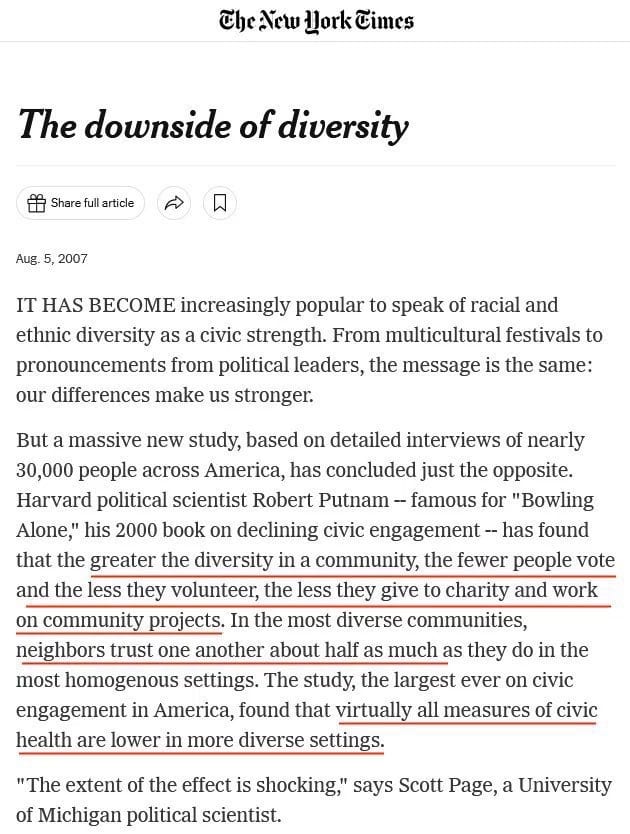
Some sentences in modernity have become sacred phrases, talking points we’re not supposed to question repeated so often they turn into mindless slogans. “Diversity is our strength” is one of the largest. Challenge it and you’re “the problem.” But slogans aren’t arguments, and when you actually pressure-test this one you see how ridiculous it is on its own. Read the underlined parts of the above article from the NYT in 2007, back before the media didn’t suffer from an odd brand of political correctness and people could share things that were plainly true. There’s plenty of data here against the slogan that’s repeated by people operating at the level of trained circus seals.
So let’s talk about this more, because, and you might be surprised to hear this after the last paragraph, but diversity can be good. Different inputs, different perspectives, different experiences, these things together can produce better outcomes. But can isn’t always does, and that’s where the conversation usually gets abandoned in favor of applause.
Consider a portfolio. Any serious investor will tell you diversification matters, but not all diversification is equal. A portfolio stuffed with low-quality, money-losing assets across different sectors isn’t diversified in any meaningful sense, it’s just broadly bad. The goal was never variety for variety’s sake, it was finding the best opportunities across a wide range of sources, then being selective. Indiscriminate spreading of bets is a bad strategy, as any investor who has lost money will tell you a bad asset doesn't become good just because it sits next to a different kind of asset.
Think about a jazz ensemble. The music works because every player is excellent at their instrument and genuinely listening to the others. The “diversity” of sounds: trumpet, bass, piano, drums, creates something greater than the parts. But only because each part clears a high bar. Fill those seats with people who can’t keep time or aren’t proficient with their instrument, and the diversity of instruments collapses into a cacophony.
Or, look at the Navy SEALs. The teams are among the most effective fighting forces ever assembled, and they draw candidates from every conceivable background, race, socioeconomic status and geography. That diversity is real and welcomed. But it's downstream of something else entirely: a selection process so brutal that roughly 75-80% of candidates don't finish. The people who make it through share a near-identical psychological profile of tolerance for suffering, team orientation and the ability to perform under extreme stress. The diversity of backgrounds is real, but the homogeneity of standards is what makes the machine work. Nobody gets a seat because of where they're from, they earn it the same way everyone else does.
Systems that actually perform comprised of teams, companies and institutions may be diverse, but they also must be very intentional and held to high standards. They have to select for merit and compatibility above all. They must maintain a coherent culture while integrating the best ideas and people from a wide range of sources. That’s a fundamentally different thing than a Marxist checkbox exercise, and there is a difference.
The media industry offers a case study in what happens when the slogan becomes policy. Jacob Savage's reported piece in Compact documented the shift in newsroom hiring over the DEI era, including a quote from a senior hiring editor at a major outlet that's a telling admission: "It was a given that we weren't gonna hire the best person." And remember, that’s not a critic of the policy speaking, that's someone who administered it. The outlets that operated this way didn't get stronger, they got ideologically narrower, financially weaker, and less trusted by the public they were supposed to serve. The diversity box got checked but the product got worse. That's exactly what happens when you optimize for the ingredient and forget about the judgment.
The problem with turning “diversity is our strength” into a bumper sticker is that it obscures all the other variables that actually matter. It suggests the presence of difference is sufficient, that the work ends once you’ve assembled a varied enough room. It doesn’t.
Real strength comes from clear expectations, honest standards, and deliberate choices. Diversity could potentially be one of the ingredients. But ingredients alone don’t make something great, judgment does.
Repeat a phrase enough and it becomes a substitute for thinking. This one deserves more scrutiny than it gets and if you understand this nuance and this post doesn’t bother you, congrats, you aren’t part of some kind of cargo cult. If you’re someone who is bothered here, ask why that is.
file that under "things-that-we say-because-they-sound-nice", together with "our employees are our most valuable asset" and "AI will not replace your job but someone using AI will" :)
It depends on how you interpret the phrase, and you're using a very restrictive interpretation.
For example, it's clear that for the history of the US "Diversity is our strength" is very true as immigration from all parts of the world fueled the economic engine that the US became.
If you think about a small group of people playing a sport, it may or may not be true. For example, you want your basketball team to be tall and diversity of height is not a strength there.
But in most cases the phrase is used to contrast against homogeneity. We've seen that more diverse companies are more innovative (https://www.forbes.com/sites/forbesinsights/2020/01/15/diversity-confirmed-to-boost-innovation-and-financial-results/) and more diverse groups are more adaptable as compared to homogenous teams.