



The WSJ recently ran a story about people opposing new housing in Yountville, California, a town of 3,400 people where the median home value is $1.3 million, median income is $51,000/year, and people drive 50-mile daily commutes because they can’t afford to live near their job. There’s another story on it in MSN if you need a link without a paywall which says about the same thing. It’s classic California, a place where they pretend to care about “the people” yet do everything they can to hose them, at least when it comes to real estate.
The town wants to build a paltry 120 housing units on a shuttered elementary school site. Thomas Keller, owner of The French Laundry, where dinner starts at $425 a head showed up to oppose it. So did Gary Jabara, who paid around $300 million for The Estate Yountville resort. Their primary concern? Studios are “too small” (despite quotes from local employees in the WSJ story saying these would be fine).
But here’s the thing: the objection itself isn’t the point. Whatever the proposal, there will always be another reason to push back. Not because it can’t be fixed, but because fixing it isn’t the goal. The goal is delay, and objection is just the tool used to achieve it.
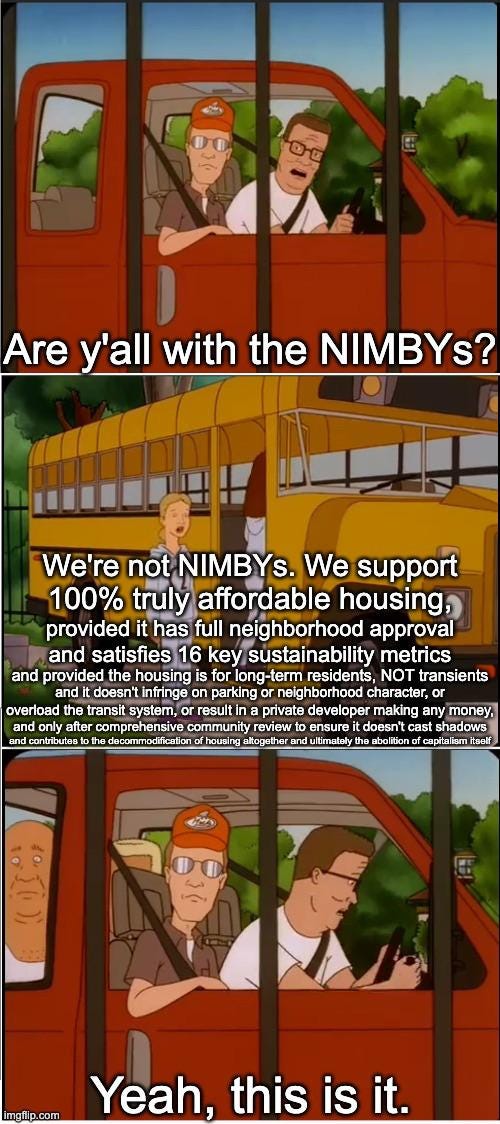
I watched this exact playbook run for many years when I lived in San Francisco. Environmental impact reports weaponized to freeze projects for a decade. Parking studies commissioned to buy another year. “Community character” invoked to mean, essentially, not more new people. After 23 public meetings in Yountville the opposition still wants more studies and data. The process is the weapon against progress.
This is the banality of evil made real. The mustache-twirling cartoon villains or supposedly heartless corporations (willing to bet you most large companies are YIMBY) are rare. The actual villains that walk among us are at zoning meetings with a packet of objections that will be replaced by new objections the moment the first ones are addressed.
California NIMBYs have turned hypocrisy into a civic identity. People in $3M craftsman bungalows benefiting from total boomer luxury communism attend vigils for income inequality, then file appeals to block apartment buildings down the street. They rage against corporations and capitalism while doing everything possible to freeze housing supply and protect their own asset values. They aren’t ‘fighting the system,’ they are the system, and it’s simply a racket to screw over anyone who isn’t landed gentry.
I live in Austin now, it’s a much better model where the city actually builds, and the results are not subtle. Rents have been falling for several years running because we embody the American ethos of growth instead of crying in meetings about “the character of the neighborhood.” The barista and the line cook and the grocery clerk can afford to live a reasonable distance from where they work. A city where service workers can live near their jobs is a city with shorter commutes, stronger neighborhoods, more rooted communities, lower turnover, and frankly better restaurants, because the person cooking your food isn’t exhausted from hours in a car before their shift starts. Austin isn’t perfect, but it has demonstrated the core truth that the NIMBY coalition refuses to accept: supply and demand rules everything around us. They simply pretend not to understand this.
In the housing debate, the free market is on the right side. Developers want to build, builders want to do their job. The town manager in Yountville put it plainly: “Is someone really suggesting that no one will rent a studio among the 2,000 people that come to this town from across the Bay Area?” in response to Jabara saying there wouldn’t be demand for the new units. Imagine how much you’d have to hate your own staff to oppose this.
A referendum has now paused the project until voters decide in November, because of course. Meanwhile, staff members drive 100 miles a day to work round-trip. The housing crisis is not some great mystery, it’s the entirely predictable outcome of people with power using it to make sure nobody else gets what they already have.
Watching it play out in my area. Everyone wants lower housing costs, but do not want to build more housing.
Just want a wand waived making everything cheaper. Its very obvious who paid attention at school and who skipped class.
I lived in Austin for 5 years and was pleasantly surprised to experience a market-driven rent freeze about a year or two after the new moderate mayor paved the way for more construction.
Austin market-driven rent freeze > NYC government-imposed rent freeze