


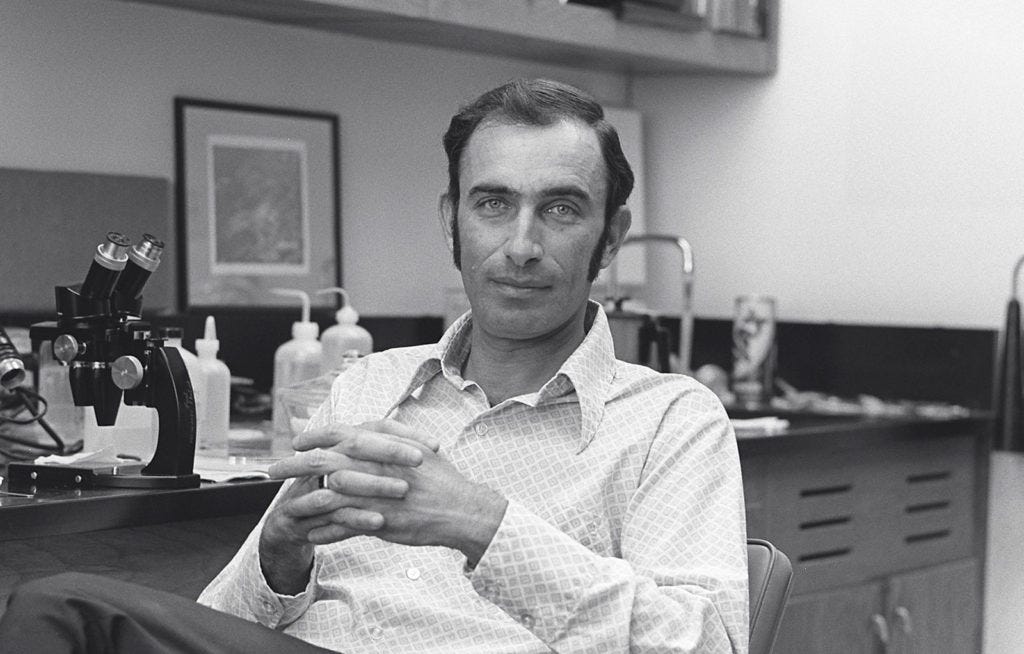
In 1968, Paul R. Ehrlich published The Population Bomb and helped ignite one of the most influential intellectual panics of the modern era. The thesis was stark: there were simply too many people on Earth, meaning resources would run out, hundreds of millions would starve, and civilization would begin to crack under the weight of human reproduction.
The book sold millions of copies, universities embraced the thesis, television programs booked Ehrlich constantly, most famously on Johnny Carson's Tonight Show, where he appeared to such fanfare that the book shot up the bestseller lists after each appearance. Policymakers listened, and our media and academic institutions elevated a hyperbolic (and false) warning by a malthusian crank into something many believed was scientific fact.
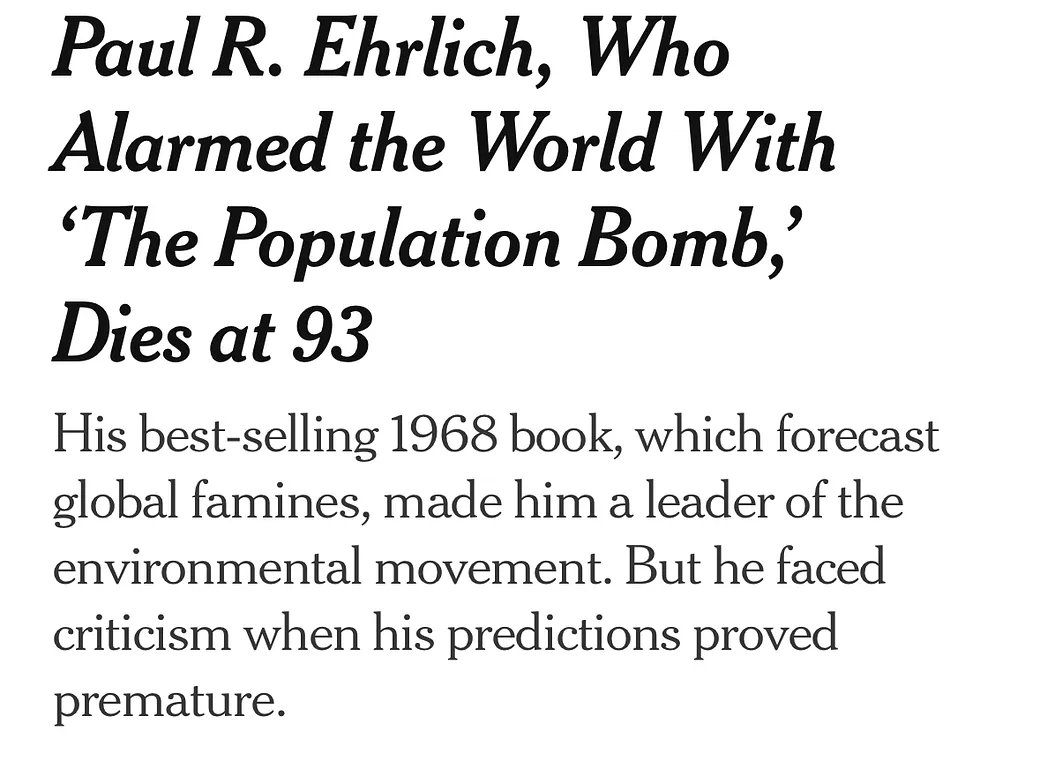
Now Ehrlich has died at 93, and obituary writers faced a problem: history happened. The Times elected to describe his predictions as “premature.” But that word rewrites what actually occurred, because Ehrlich’s predictions weren’t “premature.” They were wrong, and not slightly wrong, but flat out hogwash. This entire obituary, likely along with many in the academic and media community will glaze a man in the near-term who history will look back on as a textbook example of the banality of evil (expert edition).
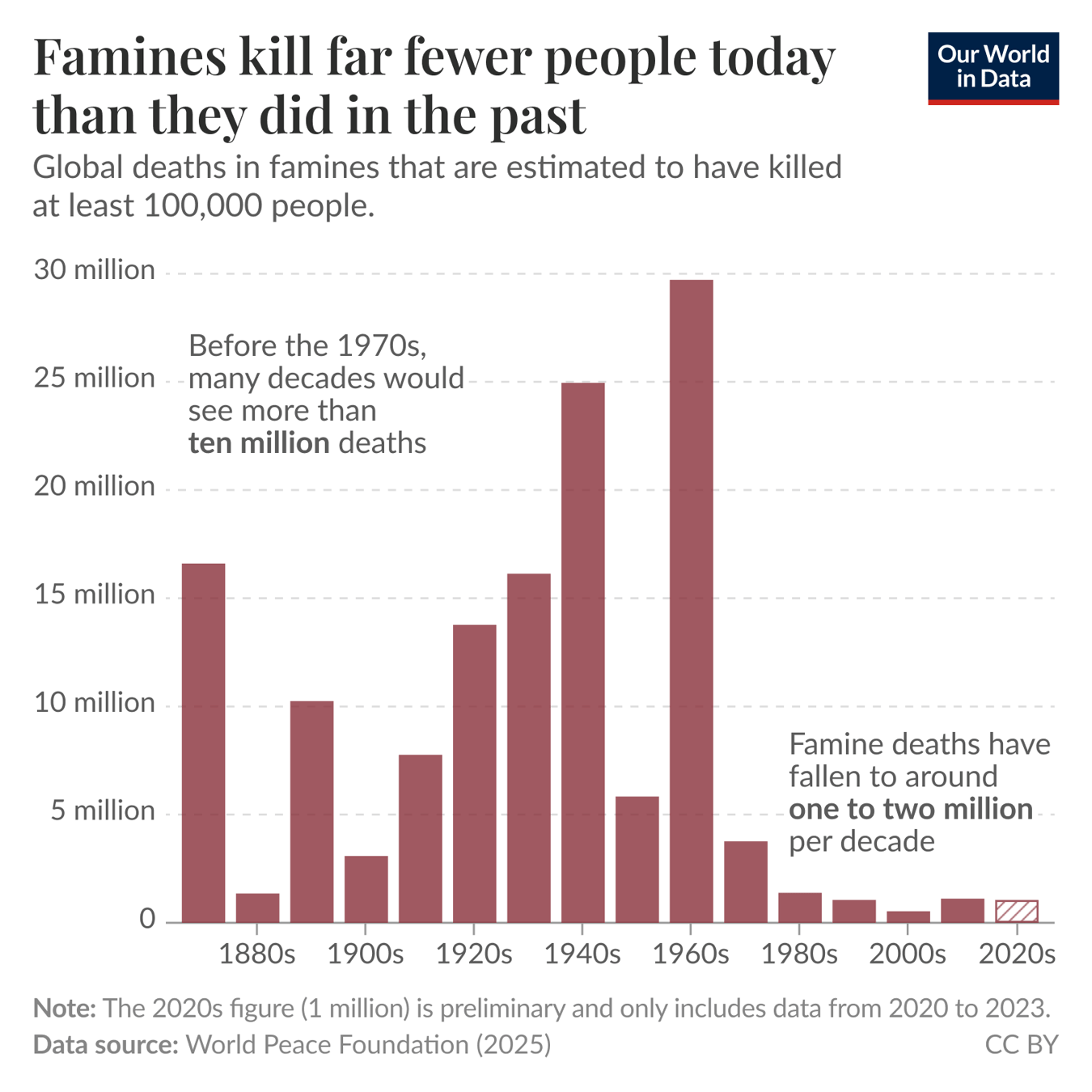
It’s worth going a few of his ideas, so you can get a sense of just how wrong this gentleman was (and the impact of a false prophet). He predicted mass starvation in the 1970s and 1980s as population growth overwhelmed agriculture. He wrote that India “couldn’t possibly feed two hundred million more people by 1980” and called food aid to the country “hopeless.” Instead, the opposite happened. The Green Revolution, driven by scientists like Norman Borlaug, transformed global food production so dramatically that India, the very nation Ehrlich had written off, became a net food exporter. Global population grew dramatically, and yet calories per person increased. The catastrophe Ehrlich treated as inevitable never arrived.
In 1980, economist Julian Simon challenged Ehrlich to a bet: Simon wagered that a basket of five commodities (copper, chromium, nickel, tin, and tungsten) would be cheaper in 1990, adjusted for inflation, than in 1980. Ehrlich took the bet, confident that surging population would exhaust resources and drive prices up. Simon won decisively. Every single commodity was cheaper a decade later. Human ingenuity, it turned out, was itself a resource, and an inexhaustible one.
And yet perhaps no failed prediction is more illustrative than this: in 1971, Ehrlich confidently declared that England would “not exist in the year 2000.” When pressed on it afterward, he shrugged: “When you predict the future, you get things wrong.” That was his entire defense.
The most striking thing about Ehrlich isn’t simply that he was wrong. Smart people are wrong all the time. What makes Ehrlich remarkable is that he seemed completely unbothered by his wrongness. He did not revise his worldview in any meaningful way when proven incorrect, nor did he display any humility, he simply kept forecasting collapse and dug in to being a permabear. In a 2004 interview, he acknowledged some predictions hadn’t yet materialized but said he felt “little embarrassment.” As recently as 2022, 60 Minutes gave him a primetime platform to proselytize civilizational doom, and was roundly ridiculed for it.
Over the years, Ehrlich lashed out at his opponents, calling them names like “right wing” even though skeptics of his ideas came from all over the political spectrum (we’ve talked about this phenomenon before, a clear indicator someone isn’t being objective and has lost their sense-making abilities).

And the stakes were never merely academic. Ehrlich openly advocated coercive population control policies, including forced sterilization. In his 1977 book, he proposed adding sterilants to drinking water or staple foods so that governments could dial population fertility “up or down” as technocrats saw fit. As recently as 2012, he called involuntary mass sterilization “a great idea.” This was all far worse than simply the musings of an eccentric crank because it was by someone promoted heavily who wielded enormous institutional influence.

The era of promoting population growth fears had consequences. In India, during Indira Gandhi’s Emergency period of 1975–77, population control campaigns escalated into government programs that forcibly sterilized millions. In 1976 alone, more than 8 million men and women were sterilized, many forcibly, with reports of entire villages being cordoned off by police while men were dragged in for surgery. World Bank President Robert McNamara praised it, saying, “At long last, India is moving to effectively address its population problem.” In China, the later one-child policy, shaped by the same global anxiety about overpopulation, resulted in decades of forced abortions and sterilizations affecting millions of families.
Ehrlich does not see himself as responsible for any of it. This, too, is part of the record. But again if you listen to his actual words, he was in full support of such programs (and was influential on the global stage about them). In 1970 Ehrlich said plainly, that large families should be treated negatively on television, that the government should “legislate the size of the family” and “throw you in jail if you have too many kids” reflecting the unflinching authoritarian logic at the center of his worldview.
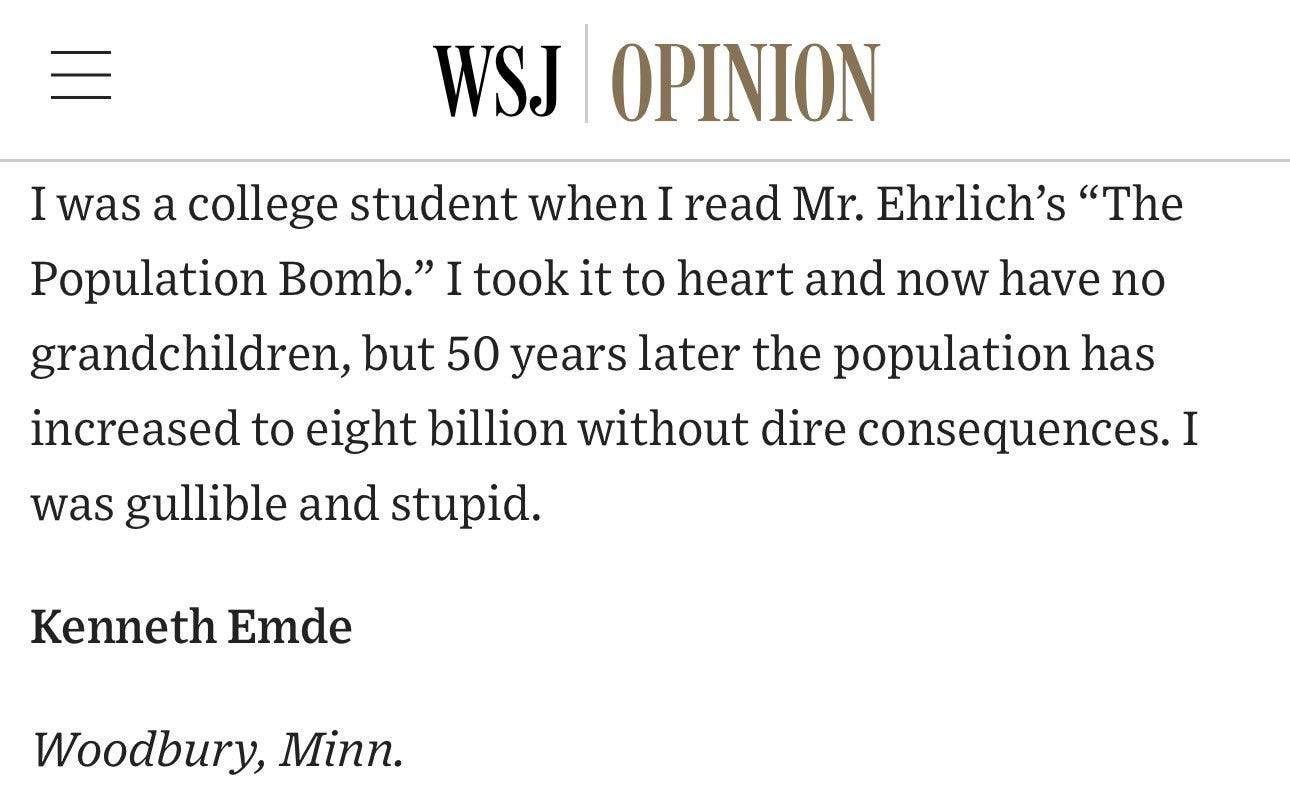
When critics continued to raise objections, they were often portrayed by media as backward, ideological, or anti-science. Today the obituary framing is even stranger: pieces go out of their way to mention that “conservatives” opposed Ehrlich’s ideas, as though skepticism about mass sterilization needed to be politically categorized.
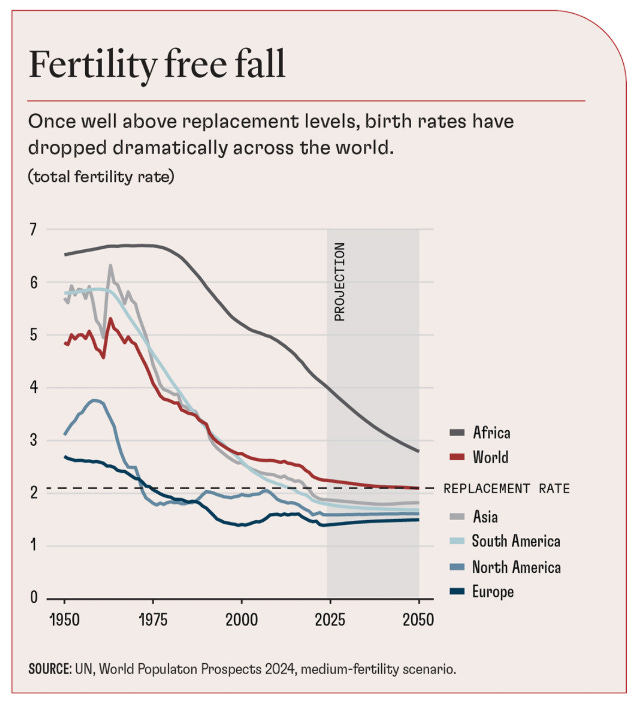
Not only did Ehrlich’s predictions fail to materialize, his rhetoric contributed to the opposite problem. Across the developed world, birth rates have collapsed below replacement level. The crisis isn’t too many people, it’s too few. Countries with aging, shrinking populations face unsustainable pension systems, labor shortages, and cultural decline. Interestingly, Israel stands as one of the rare first-world exceptions: a developed nation with a fertility rate above replacement, and arguably a more instructive model for the future than any doom merchants would consider.
The deeper problem here isn’t Ehrlich himself. Every era produces prophets of doom. The real failure is institutional platforming of someone spreading a form of malthusian mental illness in the population. A functional media environment should immunize the public against these psychopaths and their fear-porn prognostications. Instead, because much of our media operates in a subprime attention economy, it fans the flames. Apocalyptic predictions drive clicks, prestige, speaking invitations, and bestseller lists. When the predictions fail, the same publications that promoted them quietly soften the edges and proclaims false predictions “premature,” not “wrong.” It’s just incredible to me how consistently they allowed him to promote his ideas even after empirical evidence regularly proved him wrong. At some point there should be consequences, simply in the form of no one taking the person seriously. At least he had to live for several decades seeing his ideas not come to fruition and watch much of the intellectual community turn against him.
The correct lesson from Ehrlich is actually simple: if someone claims civilization is headed for collapse, the burden of proof is on them. It can’t just be “vibes.” It also can’t be “moral urgency” or useful idiots like Greta Thunberg yelling in anger. People should have real, falsifiable predictions that survive contact with reality. If they can’t do that, their credibility should be exactly what Ehrlich’s now deserves to be historically: zero. Let’s hope his eco-pessimist, dystopian ideas die with him.
This Malthusian was as anti-humanist as they come. Ironic that he lived to 93, well past the median age. Thank God we had/have people like humanist economists Julian Simon and Thomas Sowell in the US to provide counterarguments to the horrible theories/policies people like Ehrlich push(ed) on society. The poor Chinese and Indians that were literally killed by the ilk of Ehrlich Malthusians didn't have that support.
Is there an equivalent in our modern era? Maybe MSNBC writ large from 2014-2024?
Clearly millions upon millions of people are on SSRIs and benzodiazepines because of their breathless reporting that totalitarianism was upon us.
Earlier this week, I saw Heather Richardson say local zoning laws were preventing the Trump administration from building concentration camps. That was the single most boomer thing I’ve ever heard.