


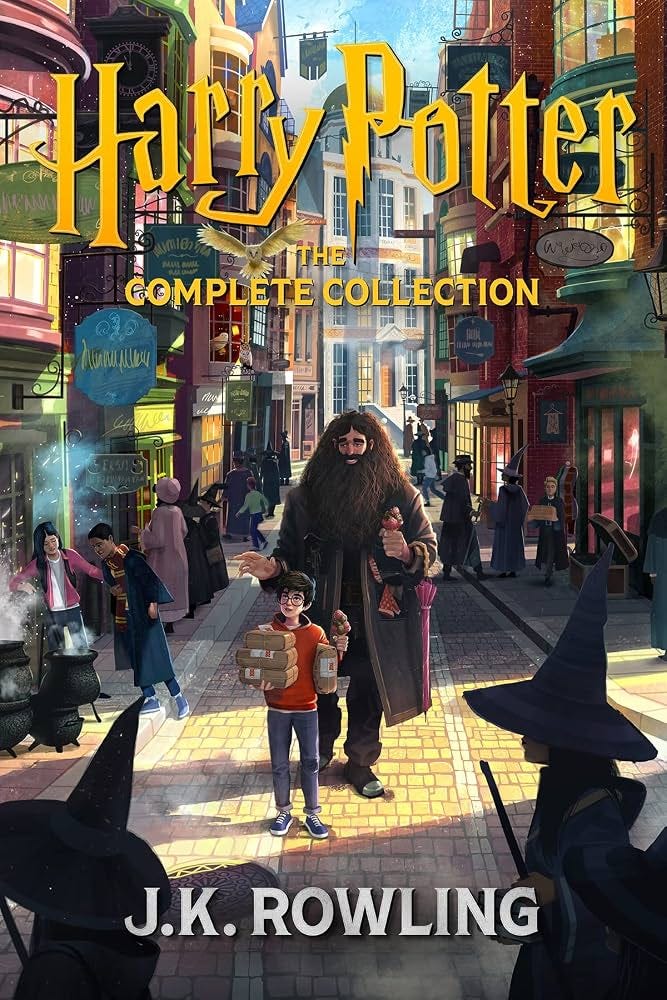
J.K. Rowling's life is a remarkable story, and one for sure worth celebrating if you don’t know the specifics. She was not born into any sort of literary dynasty or financial wealth. Her mother died of MS when she was 25, after which she married and moved to Portugal, had a daughter, and eventually returned to Britain as a single mother after things didn’t work out. It was then she wrote Harry Potter while surviving on benefits and sitting in coffee shops with her daughter. When completed and pitched, 12 publishers rejected it.
A reader at the Christopher Little agency decided it had promise. Seven books and nearly two decades later, Harry Potter became one of the largest franchises globally: the books have sold over 600 million copies and have been translated into 85 languages. This is truly the pinnacle of what any writer could ever hope to achieve.
After her success, she didn’t go and relax on a tropical island and sip margaritas, instead Rowling has proven her character as a human being well beyond most celebrities, having given >£200 million to charitable causes. Her mother died from MS, so she funded a major neurology clinic in her name. In 2004, she saw a photo of a child in an institution and it affected her so deeply she created Lumos, an international charity dedicated to ending the institutionalization of children. Lumos says it has since helped more than 280,000 children move into family-based care. Rowling has also founded a sexual-violence support service for women in Edinburgh.
This is a woman who went from being a struggling mother on benefits to one of the most successful authors in history, then spent a substantial portion of the resulting fortune, time and visibility trying to solve problems she personally and deeply cared about.
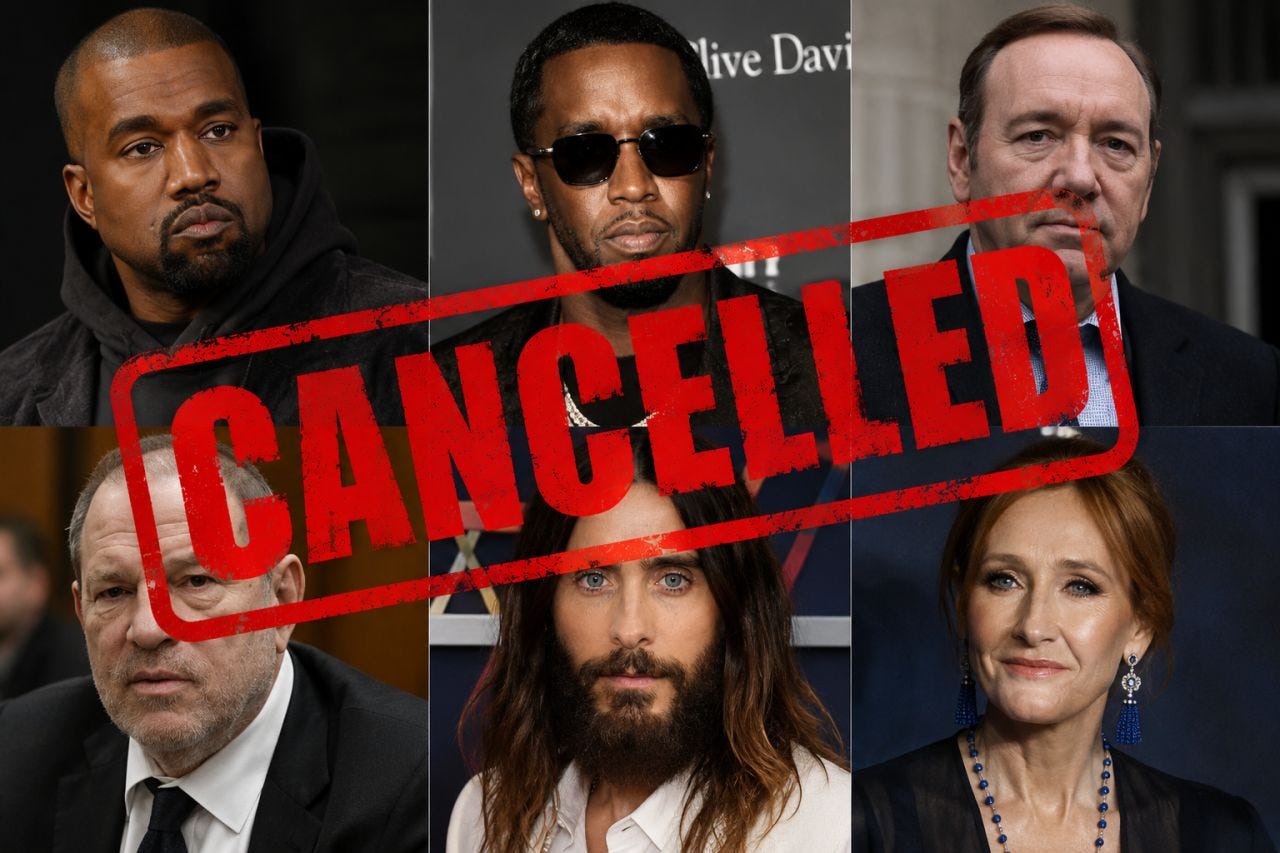
Which is why, when I saw her included in a graphic of “cancelled celebrities,” on LinkedIn (of course, it’s the bad place) my first reaction was pretty simple: what did she actually do? Below you can see what was posted by an academic. You would think LinkedIn would be a place that might champion women in leadership who actively support other women. But you would be wrong.
Let’s set aside the internet discourse or what the media has fabricated about her for a moment (more on all this shortly) and look at what Rowling actually says. In her own words, Rowling has argued for some basic rights for women: that they should have access to female-only changing rooms, bathrooms, rape crisis centers; they should not have to compete against men in women’s sports; female prisoners should not automatically be housed with violent male prisoners; women should remain protected as a sex class in law; people should be free to disagree re: whether sex can be changed; and that troubled minors should receive appropriate mental-health support as opposed to irreversible medical interventions where the evidence of benefit is disputed.
You can disagree with any of those positions. But which of those statements, exactly, is supposed to justify putting her next to people like Harvey Weinstein and Kanye West? It’s totally bonkers. On a separate note, for this story, I asked several of my friends who aren’t extremely online and they had no idea about any issues with Rowling, if you want to know where the normies are at.
When I first commented that I wasn’t sure why Rowling was on the list, I genuinely was shocked to see her the above graphic, it just makes no sense. But quickly, I was told to Google the issue (as if I should already know why she is on the cancelled list), that Rowling is a “leader of the anti-trans movement,” that her views are “objectively” bigoted, and that, when I pointed to her decades of charitable work as relevant to the question of her character, the KKK was offered as an example of a community organization that also did good works. I found that a rather astonishing response. There is no coherent “anti trans” movement I could find anywhere online that Rowing is the supposed leader of. And everyone from heads of medical associations to the NYT, Science Journals on both sides of the political spectrum and other mainstream outlets have discussed this topic since it actually does affect everyone. We live in a liberal society not an authoritarian state where people may not present facts or having opinions on certain topics, lest I remind you (even as reporters are personally attacked or lied about merely for covering the topic).
Anyway, we have apparently reached a point where a woman publicly arguing for women’s rights can be discussed in the same conceptual category as an organization historically defined by racial terror and violence (the LinkedIn conversation above is not the only place this happened, I saw similar comments by others around the web when researching this topic, so it’s not unique but certainly emblematic). This is the type of extremism the left resorts to when you go against their religion, the conversation quickly veers into strange territory and people make extreme comparisons (another example, these same people have no idea what the word genocide actually means and casually throw it around against groups they don’t like). To be fair the right can do this too, and I would like everyone to disarm and find a way out of this ideological era altogether.
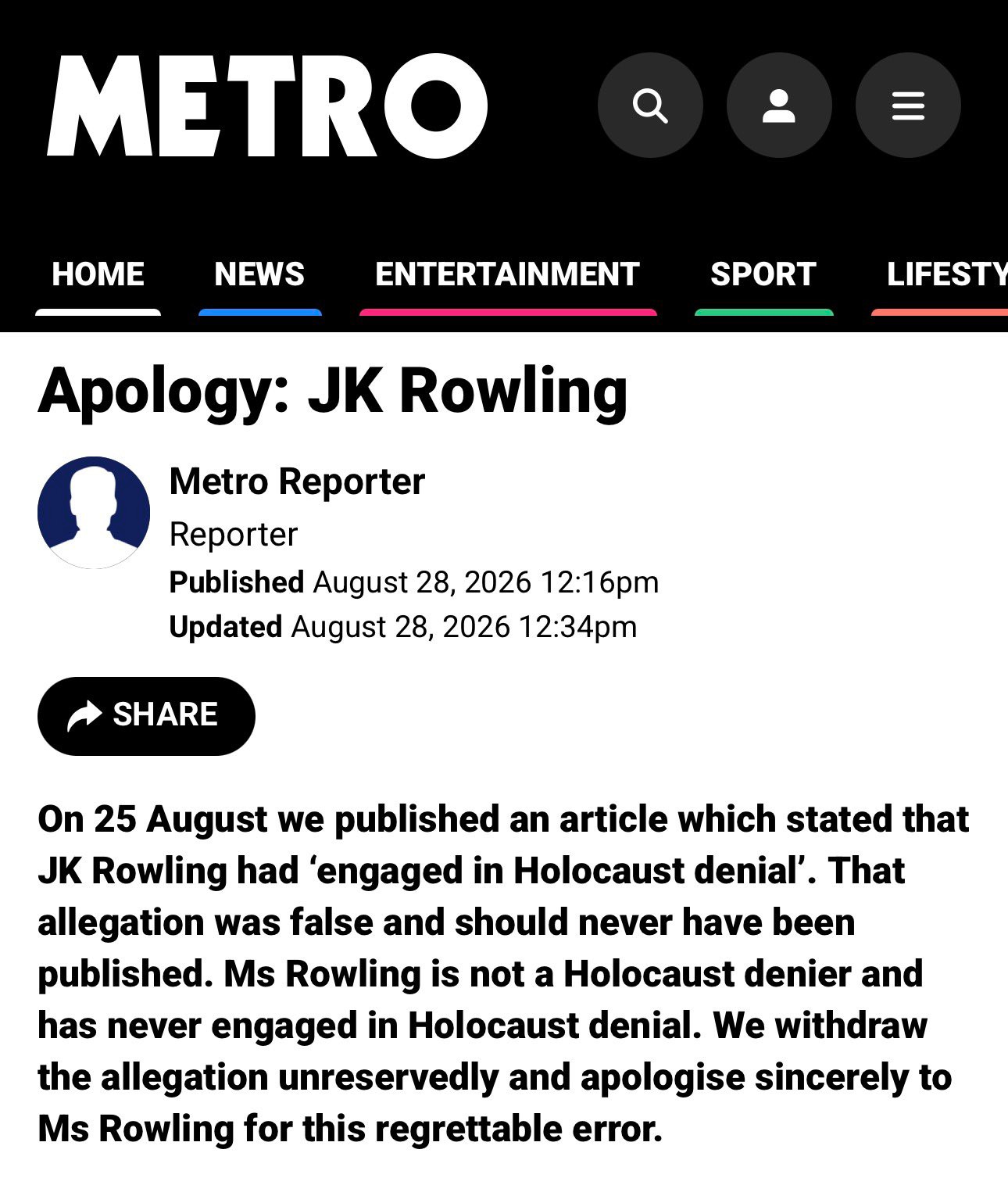
Also as I mentioned above it’s also notable the media have engaged in outright lies about Rowling and what she believes, so it’s likely many upset are arguing from a position of being agitated/propagandized for clicks (as they’ve never read her actual beliefs, which don’t at all seem hateful or worthy of cancelation). As just one recent example I found, UK publication Metro was forced to give an apology to Rowling for slander about patently untrue statements. These are the people running the narrative, and many online believe them uncritically or simply want to tear down others for attention. Of note many readers see the original fabrication and almost no one sees the corrections.
The wild part about all this is much of the public doesn’t agree with members of the online mob upset at Rowling. A 2025 British poll found that 47% approved of Rowling’s efforts to fund organizations advocating for women-only spaces, compared with 18% who disapproved. 59% agreed with the UK Supreme Court’s ruling concerning the legal meaning of sex and woman under the Equality Act (they unanimously concluded that those terms have a biological meaning).
The American numbers are even more striking. A 2025 Pew Research Center survey found that 66% of Americans favored requiring transgender athletes to compete on teams matching their sex at birth, while just 15% opposed it. Gallup found essentially the same thing: 69% of Americans said transgender athletes should only play on sports teams corresponding to their birth sex. And in another Pew survey, 67% of Americans said whether someone is a man or woman is determined by their sex at birth, compared with 31% who said it can be different.
You are of course free to disagree with Rowling’s views. But if 2/3 of Americans hold the same position on one of the central questions she's been publicly arguing about, it becomes pretty difficult to characterize the position itself as some sort of fringe ideology normal people couldn't possibly agree with. The Death penalty, marijuana legalization, same-sex marriage, and a legal path for undocumented immigrants all have about the same amount of support, by the way. Should someone be canceled merely for holding those views?
I’ve written before about the strange paradox of modern “diversity” where the people most loudly demanding it are the least tolerant of ideas they don’t agree with, even while their own ideas are unpopular. The Rowling story presents another good example of this. It’s basically mob behavior demanding compliance, even when our own institutions and researchers don’t agree on the topic.
I also want to note I don’t think being successful, then donating wealth makes someone immune from criticism. And perhaps more importantly I don’t think being famous makes someone’s opinions automatically correct (in probably more cases, I think famous people’s opinions are pretty bad). But, I do think it is crazy to pretend a woman who spent decades being a humanitarian and inspiring millions of young people should be placed on a “cancelled” list alongside people who committed actual violent crimes, merely for expressing her opinions on something that most of the population agrees with.
Not that she is actually cancelled by the adults in the room who make the important decisions in the media sector, because they are obviously level-headed enough to see through this particular drama. She’s still an executive producer on HBO’s new Harry Potter series, which is adapting the seven books for streaming, and premiering this December. And also, to LinkedIn’s credit, if you query her name you see plenty of professionals sharing quotes and stories from Rowling’s life and non-profit work as inspiration.
Anyway I’ve said enough, and I’ll throw it over to the community: do you think J.K. Rowling warrants being “cancelled”? Or, phrased another, more specific way: do you think someone who is clearly a moral person, who has contributed creatively to the world and via vast philanthropy should really be thrown out of society for holding an opinion you disagree with, on an issue that will likely be debated forever?
Interesting post-script to this story: a reader today sent me several clips of major democratic political candidate James Talarico saying the same things Rowling was canceled for, and points out the irony or perhaps hypocrisy that many people vocally against her now support him, someone who has come around to agree with her position.
Agree that this conversation deserves more nuance and ignoring the good she has done, or putting her against people like Weinstein worsens the quality of the discussion.
The objection isn't that she defends women. It's that she draws the boundary in a way where the costs fall on a much smaller and more vulnerable group. You can think that tradeoff is right, and many do. But that's the tradeoff her critics who are "canceling" her are critiquing her for.
You write that being famous doesn't make an opinion correct, but neither does being popular. This is a liberal ideal and why tyranny of the majority is one of its founding concerns. Mill's whole argument in On Liberty is that the danger isn't only the state; it's social pressure, the mob, prevailing opinion enforcing itself.
That's the principle you're using to protect Rowling from a pile-on, but it's also the same principle that says a poll doesn't settle what a minority is owed. Support for gay marriage as well as interracial marriage were once fringe opinions. The people who defended those rights did so on the appeal to liberal principles. And it's really the point - these protections matter the most exactly when they are counter to "popular opinion"
And to circle back to the nuance - the fact that she is someone who really cares about women shows that good people can inadvertently create a lot of harm, even when they think they are defending rights. Trade-offs are unavoidable, so it is worth thinking about who bears the costs, so we can be careful about how to minimize overall harm, and not just sacrifice one group's rights to defend another's. The liberal answer is to consider context and carefully weigh the harms on the smaller and more vulnerable group.
Thank you for writing this! I've been so frustrated with the whole J.K. Rowling thing. Back when I first heard about it, I did some digging until I found her exact words, not just what the media or random people on Youtube said. She's never said anything outright against trans people and I find that the people who are upset with her are either twisting her words (or reading the twisted versions posted by others), don't understand her words and/or refuse to acknowledge that trans rights are not a simple, black and white thing and actually contain nuance and grey areas, which Rowling is highlighting.
From what I have gathered about her statements, Rowling is mostly wary about children diving into transitions without more medical understanding and she's concerned that in the discussion about trans-women, cis women are not being considered enough because rights for both trans-women and cis-women affect each other in legal and social spaces. She's scared that cis-women could lose safety if this isn't handled correctly. None of those things equal an anti-trans stance. I think she just feels like there's an imbalance in the conversation. It's insane to me that there are people out there who basically feel like if you aren't 100% on their side it means that you are 100% against them and that's what happened with Rowling.
In online book groups, there is this growing opinion that if an author isn't the perfect picture of goodness and morality, their work is no longer worth reading; As if only perfect people can or are allowed to create great things. Now, I am not advocating for bad behavior or harming other people. And if an well-known author (or anyone really) is proven to be engaging in things like that, they should be held accountable. But it still doesn't erase the fact that they wrote something amazing that has meaning to lots of people. I recognize that can be an uncomfortable thought, but it would do many people some good to learn how to sit with an uncomfortable thought. It's been hard to see so many people in these groups talk about how meaningful the Harry Potter series was to them and that they trashed or gave away all their books over this supposed controversy; as if the books changed somehow, or that the meaning they personally gleaned from them became invalid. It is the very definition of "throwing the baby out with the bathwater."