


The following was written by my friend David Armano, he asked if he could contribute something for you all and I of course encouraged him to. David’s smart and I’ve long been a fan of his thinking, design work and writing (he was a big part of the early blogosphere, some of you were there). He now writes about the intersection of AI, work, and human potential through the lens of intelligence, wealth and the future of work.
Subscribe to his Substack, David by Design and Follow him on LinkedIn here.
When my older adult son was going through a particularly rough patch, what concerned me most was his lack of curiosity. He was inquisitive as a child, but as he entered his teens, those qualities declined. After graduating from high school, he decided to drop out of college after his first year and struggled for a few years. As he was figuring out what he’d do for a living, we’d often have debates on all kinds of topics. But he rarely showed genuine interest or intellectual curiosity beyond getting his opinions verbalized and expressed. Over time, his situation improved, and I found our conversations more balanced, less intense and less confrontational. He still doesn’t ask a lot of questions, but he shows more curiosity than he did during the years when he struggled. It’s progress.
This always stuck with me for some reason.
Outside my family life as a father to two GenZ sons, a husband to my wife, and a dual dog owner, I probably spend too much time immersed in the tech world, both at work and off the corporate clock. I spend time reading and writing about humanity’s relationship with technology and, of course, how AI is changing the game before our very eyes. I find myself having philosophical conversations with all kinds of colleagues, friends, and even the president of the practice I work in, and oftentimes, when talking about the impact of AI on our work, society, and world—I sometimes feel pressured to “pick a side”; i.e., view AI primarily through the lens of flowery optimism or dreary pessimism.
This instantly makes me feel uncomfortable. While so much of what’s presented in the media about AI often does feel like one extreme or the other, the polarization of thought just feels too simplistic and inadequate. I remember telling our president, who is also a friend, at a time when there were several big AI stories all of our peers were talking about, that I remained curiously skeptical...
I am generally an advocate for AI. I recently launched my first Claude Code project, and the technology feels like magic to me in so many ways. I’m also skeptical about the long-term tradeoffs that come with it. I become skeptical when I see utopian OR dystopian visions of the future. In my nearly fifty-five years of life, if I have learned one thing, it is that life rarely fits into the clean and tidy partitions and frameworks we want to assign to it. It’s far messier, human, imperfect, and unpredictable.
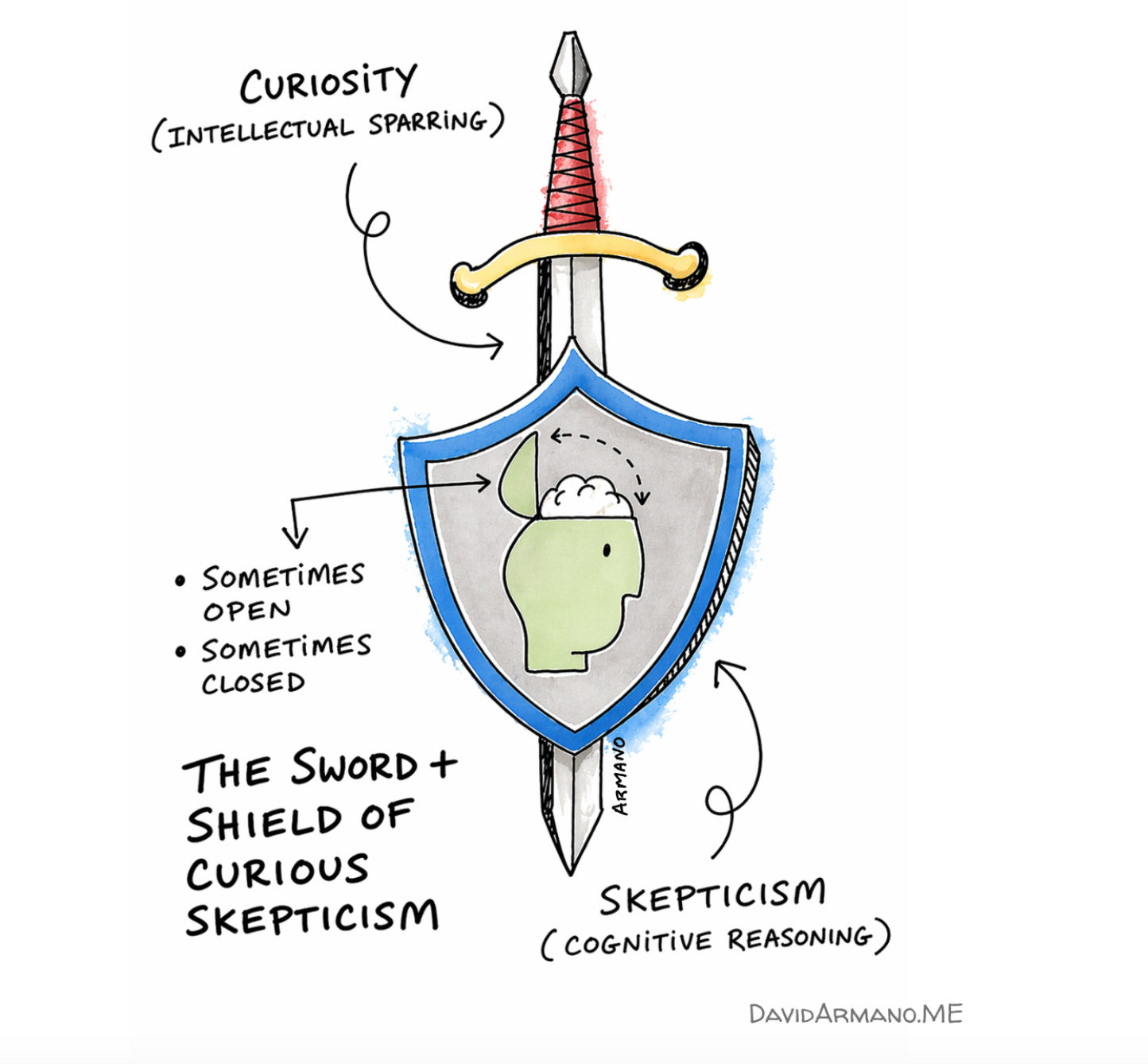
Intellectual sparring with the sword and shield of curious skepticism
Being curiously skeptical sounds like an Oxymoron—as if the two are incompatible with one another, like Jumbo Shrimp, bittersweet, or deafening silence, but they actually go really well together, and we’d be well-served to combine them when we dare discuss and debate issues of consequence. Permission to use a flawed metaphor, but for some reason, I was compelled to talk about this using the example of a sword and shield, which, taken at face value, makes this feel like we’re going into battle.
Well, no and yes.
Think of the Sword of Curiosity from a sparring perspective, where the goal is to improve yourself and test your opponent in friendly “competition”. A sword can be used to push, probe, and understand how your opponent functions. How will they “attack and defend” themselves? Where are they most formidable? Where are they most vulnerable? Again, I want to reinforce the context: sparring vs. a life-or-death battle.
In the context of intellectual sparring, the Sword of Curiosity is a diagnostic tool instead of a weapon meant to cause damage. Rather than dealing a finishing blow, you use it to map an opponent’s logic through:
- Probing: Tapping their guard to test structural integrity—seeing if their stance is built on solid evidence or assumptions.
- Binding: Maintaining contact with their strongest points (steel-manning) to “feel” the weight and intent of their convictions.
- Feinting: Using hypotheticals to observe cognitive agility—discovering if they double down under pressure or pivot with grace.
This is the “gym,” not yet the “coliseum,” the goal is a mutual refinement of skills where the “salute” ensures the relationship survives the exchange.
Now let’s take a look at the Shield of Skepticism, where, again, in my highly imperfect metaphor, I am framing it within a certain context. Here, our shields represent “cognitive reasoning”. Think of our shields of skepticism as filters, with a default setting that keeps our minds’ “lids” at the halfway point between open and shut. Sometimes our shield of skepticism is used just enough to ensure we don’t take things at face value, and other times, we are fully protecting ourselves from nonsense we feel like we have enough facts, evidence, and, yes, intuition to counter, which requires us to protect our own intellectual resilience. A shield of skepticism is useful for:
- Tactical Parrying: Deflecting bad-faith arguments or logical fallacies once intuition or evidence confirms they are non-viable.
- Neutral Quarantine: Using the shield to “catch” and hold foreign concepts for inspection without immediately integrating them into your core beliefs.
- Resilience Preservation: Fully closing the lid when necessary to guard against cognitive overload or bad-faith exhaustion.
A call to arms
Here’s where I am going to shift from the training gym to the coliseum. There is an opponent, but it’s not who you think. Depending on the content of Hot Takes, you might think it’s Adam on some days, or someone like him. You may think it’s the person who shares political beliefs or even societal values that are in opposition to yours. Or maybe it’s just an AI expert hustling to get you to buy their training course while they evangelize the utopian world of automation to come. The call to arms I’m talking about is a resistance movement against a world that reduces every complex thought to its lowest common denominator.
Forget soundbites, we’re way past those. We’re now operating in a world where nuance is practically extinct, people only talk past each other (if they talk), and the media only demonstrates skepticism when covering a story that challenges their core beliefs, and that goes for the bifurcation of media because there really isn’t objectivity in media anymore — it’s more of a reinforcement of strongly held beliefs by the viewer/reader/listener which media gladly reinforces.
There’s a saying I keep seeing more of online these days: "Idiocracy was a documentary.” The sword and shield of curious skepticism is my call to arms to combat that, as imperfect an analogy as that might be. Staying curious is how the resistance ignites and grows, while learning when, where, and how to remain skeptical is how we preserve our intellectual resilience over time.
If I had to design a medieval-style crest for myself these days, this would be it.

We would be lucky if everyone was as thoughtful about modern discourse as David, he consistently is calm and reasonable even with people who are deep into the political abyss. It's really impressive to watch.