


Back in late 2023, I wrote that we need Twitter now more than ever, that it remained the digital tavern no institution or megacorp clone could replicate, and it’s essentially a cockroach company. In fact I’ve said this many times over the last 15 years or so, and every time the comments are eerily similar. But as a user of social media longer than most of the people commenting (I’ve been a forum nerd since the 90s) this is one area I personally know pretty well. Anyway, as usual no one who predicted “it’s over” in any of their (multiple) times will acknowledge their mistake because they’re incapable of admitting they were wrong, they’ll just move the goalposts or pretend they never said that.
I also understand this type of thinking, in a way I used to be like them and incapable of believing I could be incorrect on certain investments (to my own detriment). I don’t hold losing stocks anymore either, it’s much better to live this way. Cut your losing positions and ideas! I cannot stress to you enough how much easier things become after. “We cannot change the wind we can only adjust the sails” is a good way to live your life. You can be wrong, just don’t stay wrong.
Let me help you with what some of you want to say before you comment, because you don’t have to use every social network, and no one is forcing you to like every one either. I think TikTok and Instagram are dumb, but I don’t declare them dead (they are indeed quite popular). I just think they are rotting your brain. Easy enough to say something like that, at least it’s honest. Just please stop gaslighting us.
So now we’ll share some stats, which I’ll let speak for themselves. Recent eMarketer analysis (below) shows US unique visitors from June 2025 to March 2026: X holding steady around 130 million while Threads collapsed from 12.4 million to 7.1 million, less than a rounding error in Twitter/X’s shadow. Bluesky, the other would-be replacement, sits at 1.5 million (but it’s still at least a real community, niche communities are great, maybe they don’t have to be billions of users).
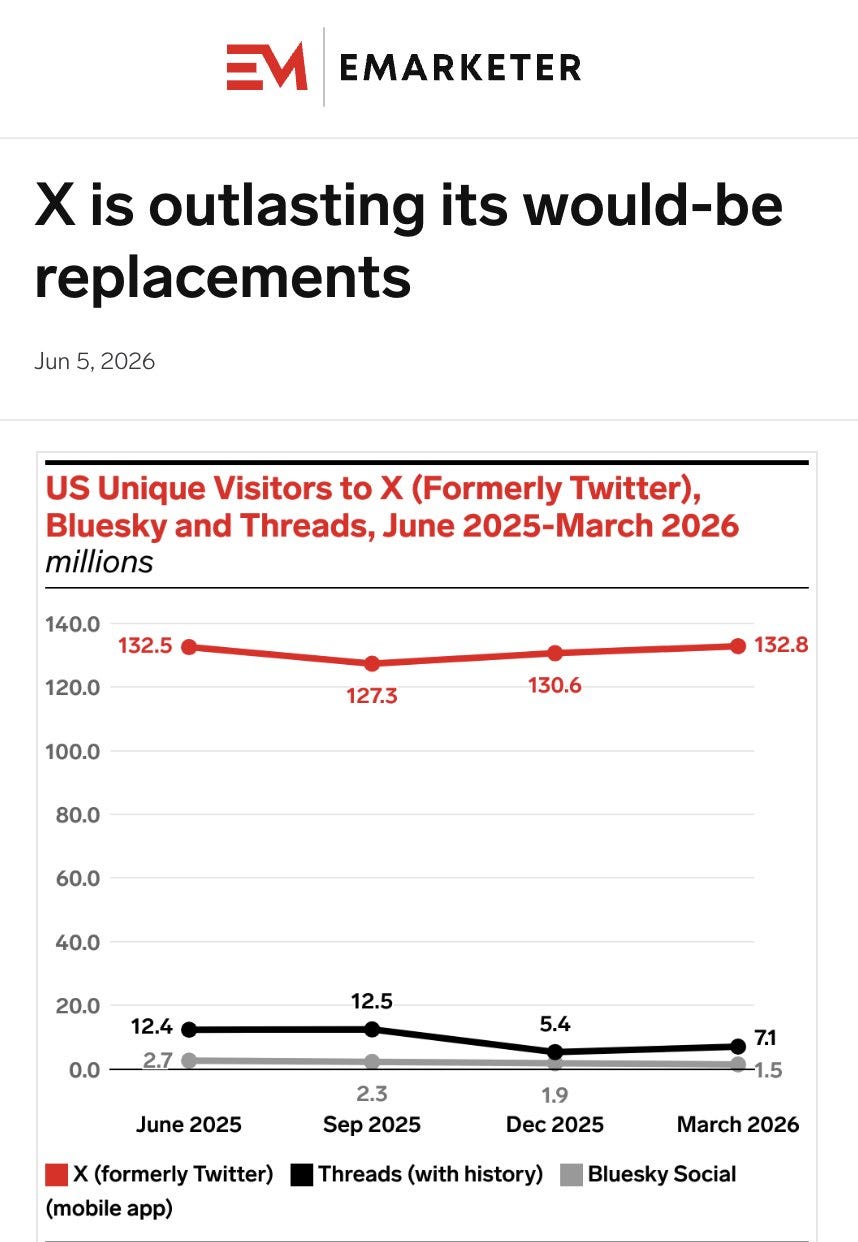
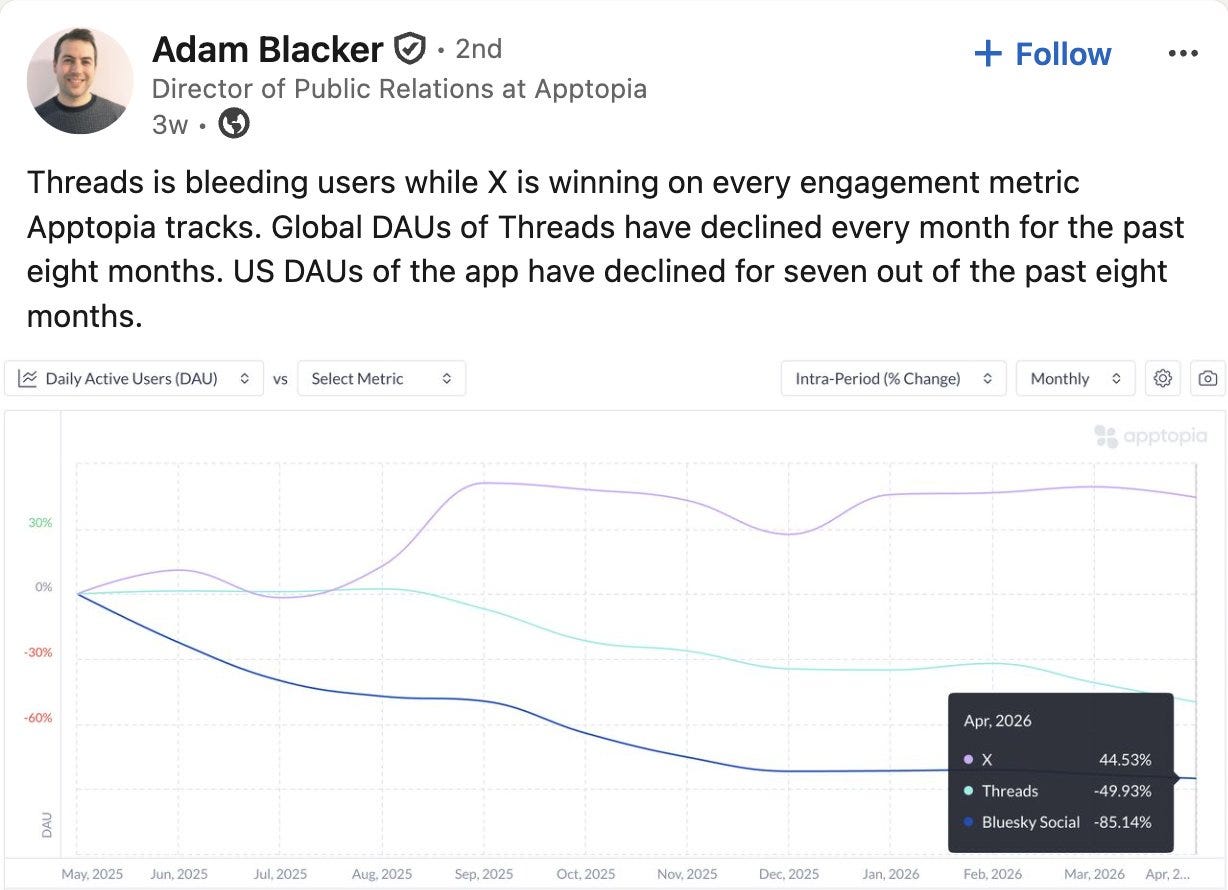
The second chart from Apptopia is even more telling: X daily active users up 44% since May 2025, Threads down nearly 50%, Bluesky down 85%. As the headline on the eMarketer chart puts it, and you really couldn’t write it better, “X is outlasting its would-be replacements.”
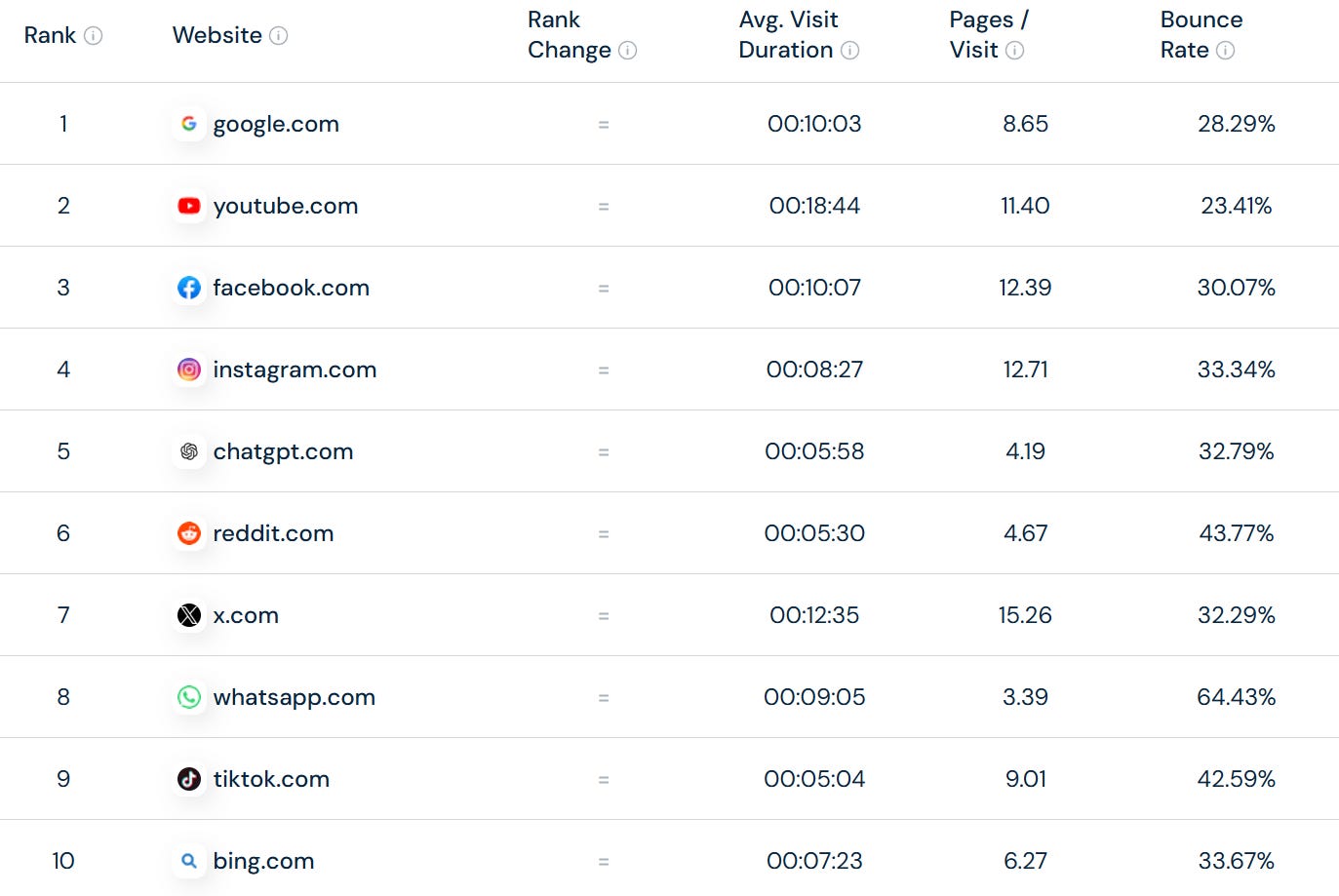
As for web, Twitter remains a top 10 website in the world according to multiple sources which are all as valid as you’ll get from sampled data (here’s similarweb below). But even the people who work internally there have posted they’ve hit several ATHs in usage, which would be the most valid numbers of all.
Meanwhile, what about Threads, the Meta clone that was supposed to finally kill Twitter? I wrote about its existential problems when it launched, and nothing has really changed. Whatever user numbers Threads posts need a large asterisk: this is part of a company with billions of existing users across Facebook and Instagram, with every incentive and algorithm at its disposal to funnel them into a new product. Of course it has downloads, that’s what you can do when you have a captive audience. But the user behavior tells the real story: Threads users spend an average of 3-5 minutes daily on the app versus ~31 minutes for Twitter. The discourse there is exactly what you'd expect when you populate a network by dragging Instagram users into a text box: shallow, empty, throwaway (I’ve still never seen a serious screengrab from a Threads post shared elsewhere, other than to poke fun at it). These are not proper posters. There's no edge, no real debate, no one saying anything of consequence. Threads has bodies in seats, Twitter has a community. You cannot manufacture what Twitter built by importing Instagram accounts and calling it microblogging, and no amount of Meta's traffic funnels will change that.
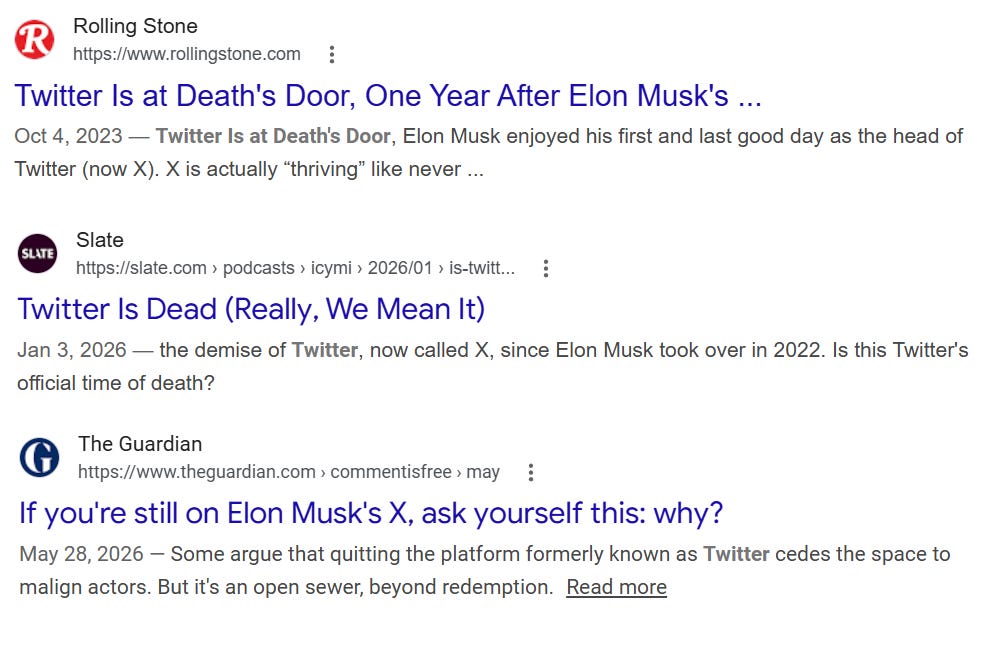
The media’s relationship with this story has been pretty crazy. The same outlets that spent years writing Twitter’s obituary are still posting their scoops there first, embedding tweets in their articles, and using it to build sources. The cognitive dissonance required to repeatedly call something dead while also treating it as part of your reporting and marketing infrastructure is remarkable, though by now, not surprising.
I also wrote at the time that the “Twitter killer” narrative fundamentally misunderstood what the product is. It’s not a feature set. It’s a specific concentration of people who actually care: politicians, journalists, founders, researchers, anon weirdos all in one place, in public, in real time. You cannot recreate that by pressing a button in Menlo Park.
On management: I’m actually a fan of what Nikita has been doing as product lead (if you don’t follow him, he’s personally nuking spam/grifter accounts, very satisfying). He’s one of the best people in social, visibly uses the product, and clearly cares about it in the way only actual users can. That’s rarer than you’d think in this industry and it shows if you’re paying attention. I do think they could fix the algorithm but that’s a different team, and I mostly don’t use that part of the product, I browse who I follow and lists I curate, which is a much better way to use social. Other social products don’t let you do that, LinkedIn for example might have a decent network, but they don’t let you customize your feed at all, making it a toy in comparison.
As for the broader Elon derangement syndrome that colored so much of the "Twitter is dead" discourse, it’s also something I noticed when I bought a Tesla and some people lost their minds about it. The same strain of irrationality: people who couldn't name the CEO of their bank, their health insurance company, or the firm that made their laptop's chips, suddenly developing a specific, burning need to lose their minds about this one product from this one person (meanwhile these teams all have many people working on them, some of them might even be your friends). They’ll all still use Starlink on an airplane and simply not tell anyone.
Maybe my friend Morgan Housel, author of Psychology of Money can help some of you understand leaders with extreme personalities better (I’ve queued up the time). I’d really recommend watching this if you are someone who sees red whenever you see Elon’s name, perhaps this will help.
The weirdest part of the whole saga to me was watching people insist Twitter was dead for reasons that had nothing to do with whether anyone was actually using Twitter/X. Usage became secondary to symbolism. The platform wasn’t being judged as a product anymore but as some kind of political Rorschach test (meanwhile, I actually see people across the political spectrum there). Once that happens, evidence stops mattering as every data point gets filtered through identity first and reality second. That’s why so many people were able to confidently predict Twitter’s collapse and then simply ignore the fact that it never happened.
The “it’s over” crowd was wrong in 2015, 2018, 2020, 2023, pick a year they’ve declared it dead (it’s happened so many times!). They’re still wrong now. And again, it’s okay to be wrong, no one bats 1,000, just don’t stay wrong.
I just want to discuss stocks, news, and sports with the guys/girls. BSKY by far has the best discussions for the last year or so and its not even close.
Anyone playing the platform alive / dead game needs to find better activities.
One point on the SimilarWeb data: the fact that Threads doesn't even register as a website there proves that all the traffic is from Instagram, which is a mobile-first experience. Hence, no web traffic. The other important metric is time spent. X is at a 30-minute average per session, while Threads is at a 5-minute average per session. Because no one uses Threads on purpose.
And if you don't like this data, there is plenty more.