


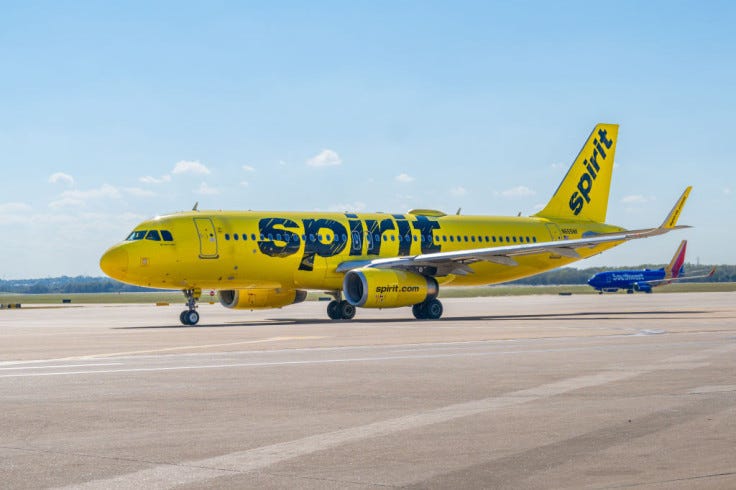
The DOJ blocked the JetBlue–Spirit merger in January 2024 on antitrust grounds. Now 17,000 jobs are gone, ~80 airports and hundreds of routes won’t be served, and consumers in smaller markets are left with fewer and more expensive options. The airline that pioneered budget travel in America and let millions fly who previously couldn’t afford to is liquidating (I ran simulations suggesting that, had the merger gone through, the added revenue scale would have provided a meaningful buffer). Multiply that by a few more examples and a picture emerges.
The government recently also blocked Adobe from acquiring Figma for $20B, a deal 2 years in the making, because regulators decided the future of design software competition was better managed from Washington than from the market. They blocked Kroger–Albertsons, a $24.6B merger that would’ve built a genuine rival to Walmart at scale. And then there’s iRobot. The FTC under Lina Khan, cheered on by Elizabeth Warren, killed Amazon’s $1.7 billion acquisition of the Roomba maker and celebrated it. They said so publicly. The outcome? iRobot is now Chinese-owned, Shenzhen Picea Robotics assumed 100% of its equity. Chinese brands already held over 60% of the global smart vacuum market before this, now they own the most iconic American brand in the category too. A stunning outcome driven by deeply flawed policymaking.
The aggressive interventionism of the last several years has a home: it lives in the progressive wing of the democratic party and in organized labor. Lina Khan’s FTC and the DOJ under Jonathan Kanter treated merger enforcement as ideology, funny how pervasive that’s become and how it never leads anywhere good. Warren wrote the FTC urging them to block the iRobot deal not because of any careful economic analysis, she did it to score populist points against Amazon. The result was predictable: in their rush to hurt Amazon (an American success story they absolutely loathe), Warren and Khan chased iRobot out of Massachusetts and straight into China’s hands. Worth noting: iRobot is headquartered in Massachusetts, Warren’s home state. Those laid-off workers are her constituents.
Unions play their own version of this game, they oppose consolidation because it threatens existing labor arrangements and dues-paying membership counts. The UFCW spent nearly two years organizing opposition to Kroger–Albertsons, running press conferences, Senate hearings, and media campaigns to kill it. The argument was dressed up as “protecting competition,” but the underlying force was protecting institutional power. Meanwhile Kroger argued the opposite, the merger was the best path to securing union jobs, having added over 100,000 union positions since 2012.
When Democratic Socialists who hate free market capitalism push to block deals, they do something worse than inconveniencing shareholders, they hurt the workers they claim to represent. iRobot’s own co-founder called the bankruptcy “a very powerful cautionary tale of what happens when the government forgets that its goal is to strengthen the U.S. economy.” The jobs that vanished, the equity that evaporated, the routes that disappeared, they’re the cost of policy driven by ideology rather than outcomes. Of course, we know the reason why.
You can be for antitrust in extreme cases, I fully agree something like Apple and Microsoft shouldn’t be allowed to merge, and in fact they already wouldn’t try. But these small/mid-sized pieces of M&A make no sense to block. This should all be businesses as usual. Our economically illiterate policymakers changed the rules to make deals that would’ve passed 10-15 years ago instead to be flagged, expanded the presumption of illegality and broadened theories of harm, including things that may or may not actually happen. None of this is good policy, it prioritizes government control of market structure and “power” over the older Chicago School view focused on prices, which actually affect consumers. It’s interventionist, Ayn Rand villain type stuff.
In this new world, regulators take a snapshot of reality: who the players are today, what the market looks like this quarter, and then freeze it. As if the world is going to sit around and wait. It never does.
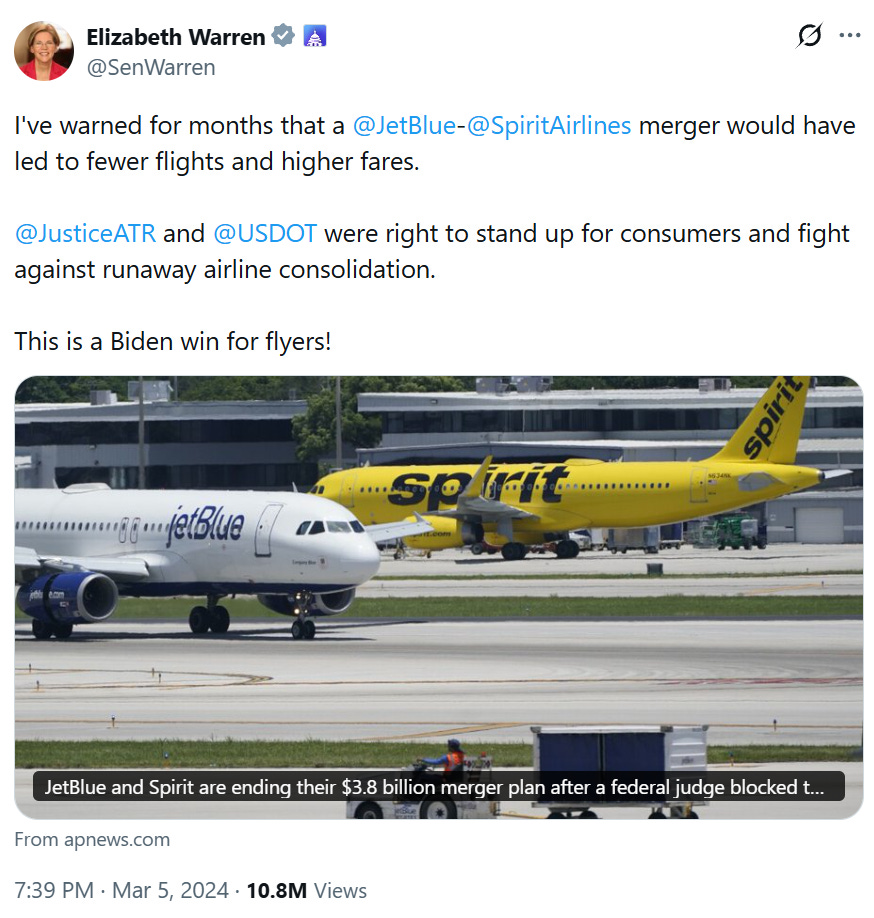
The Spirit case is actually the clearest example. The big four carriers: American, Delta, Southwest, United, already controlled about 80% of the U.S. market before the block. The government’s theory was that blocking the merger would protect competition. What it actually did was remove the one lifeline available to a marginal carrier in a brutally capital-heavy, thin-margin industry. Spirit kept fares below competitors on routes it flew. Studies have found that when ultra-low-cost carriers like Spirit enter a route, fares can fall meaningfully, often by double digits across competing airlines.
Regulators looked at the deal and said that this merger reduces competition. What they produced instead: zero competition, zero service, zero jobs, and higher fares. The analysis was wrong, the model was wrong, and nobody is being held accountable for it. This outcome was predictable: the DOJ’s intervention didn’t eliminate consolidation, it just ensured it happened via bankruptcy instead of a structured merger where workers and routes could have survived and the other large airlines would have had a new proper competitor. The DOJ feared harm; the counterfactual delivered more of it. As usual, when regulators feel the need to look busy and justify their job by doing something, they end up hurting everyone.
The Adobe–Figma block was regulatory intervention in one of the most dynamic categories in software. Product cycles are measured in months. There are many competitors, open-source alternatives and different choices always just a click away. AI is already compressing entire creative workflows and the competitive landscape was shifting under everyone’s feet while regulators ran a multi-year review process.
About 90% of startup exits are M&A deals which is a big part of the engine of the venture ecosystem. When regulators treat large acquisitions as presumptively anticompetitive, it’s way worse than just killing one deal. This actively chills VC investment: if investors expect regulators to block high-growth acquisitions, they invest less in startups, the ROI equation that funds the whole system gets thrown out of balance, and we all get less innovation. iRobot’s co-founder said his outlook on exit strategy is now permanently shaped by what happened, and that precedent ripples outward to every founder and VC pricing in the possibility that their expected exit won’t come through.
The Kroger–Albertsons block rests on a specific assumption: that preserving today’s grocery market structure is the correct call. Walmart has kept expanding, Amazon has kept building, Costco trades at ATH, regional players keep evolving, there are any number of food and meal delivery startups, the competitive dynamics don’t freeze just because regulation wants to. What the block actually preserved was Walmart’s existing advantage, which is a strange outcome for a policy supposedly designed to protect consumers. Notable leftist politicians have been yelling about grocery stores for some time, and never once mention their razor-thin profit margins. None of the businesses in this sector are the evil, greedy corporations they are caricatured to be.
Our regulators have simply become overzealous in their desire to control the world. Free markets—left to innovate, build, and adapt—self-correct in ways government intervention almost never does, while regulation locks in a snapshot and delays adaptation. And when it’s wrong, when the model didn’t account for fuel prices, or AI, or Chinese manufacturers moving up the value chain, or any of the thousand things that make dynamic markets dynamic, there’s no mechanism to reverse the damage fast enough to matter. Mucking with the engine that makes America run, frequently by people who have never even built anything and constantly demonize businesses, is incredibly shortsighted. Look, when policymaker social media feeds are just a constant squawking about their disdain for successful people and companies, you know they’re deeply unserious. I don’t understand why anyone would trust these people (or anyone under them) to make real decisions.
The reflexive interventionism that’s been normalized in progressive regulatory circles, wrapped in “consumer-protection” language while union lobbyists and political point-scorers cheer from the sidelines, keeps producing results that hurt everyone. And the people who pay are never the politicians. They’re the workers who lose jobs, the founders and employees whose equity disappears, and the consumers who pay higher prices, frequently for scarce or worse products.
At some point the question isn’t “should this deal happen?” It’s whether we trust markets or bureaucratic committees more to allocate the future, and if we want to take a step towards freedom or tyrannical state control. Committees don’t have a great track record or even the right incentive structure to make the right calls. They’re working from static models in a dynamic world, insulated from consequences, with every institutional incentive to intervene, score political points and look busy mucking with a productive system — and none to ever admit they were wrong. On the other hand, the freer American markets are and people actually in the game building the world aren’t nanny-stated to death, the more we all prosper.
I agree that blocking the iRobot acquisition and others in the Khan FTC were mistakes.
However, to your bigger examples:
1. Spirit Airlines rejected a merger with Frontier in pursuit of more money from JetBlue, knowing there was a lower likelihood such a deal would be approved. Even the simulations you ran show the result JetBlue/Spirit entity would likely have failed with the fuel price shock which did kill Spirit (From the simulator: "Distress risk is real. At this leverage ratio, the merged entity would be vulnerable to any external shock. Bond markets would price the debt at high-yield spreads, adding to the burden.").
2. Adobe was, unquestionably, a monopoly. Forget about measuring iterations in weeks, there had been no competition in design for over 3 DECADES. Instead of your claim that "regulators decided the future of design software competition was better managed from Washington than from the market." they thought we needed some competition, which is their job. They were right, as Adobe had to slash their prices and design software has more choices at lower price points.
3. Your criticism of Kroger-Albertsons is self-contradictory. You can't complain we have consolidation in airlines with the big 4, then complain when they prevent hyper-consolidation in supermarkets. The top 4 supermarket chains already control 50% of the grocery business in the US, which is exactly when regulators get ahead of consolidation. https://www.ers.usda.gov/topics/food-markets-prices/retailing-wholesaling/retail-trends
Your larger point that we should "just trust the market" is something we long ago disproved in American history during the age of Standard Oil, etc. Our anti-trust system designed to avoid that, and while you might disagree with their motivations I don't see much evidence they acted against that mandate.