


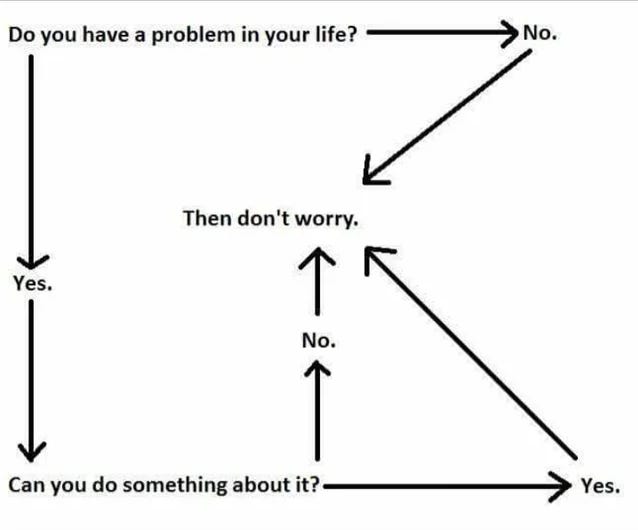
Many people have anxiety issues in modern times, it’s understandable, although solvable once you understand what’s actually happening. If you’re someone who suffers from this, let’s share some brief research with you today to help (if you go to the gym regularly you likely already suffer from this less).
A paper I found published in Behavior Therapy tracked the actual outcomes of worries in people diagnosed with generalized anxiety disorder, a population whose entire psychological profile is organized around anticipating bad outcomes. Using ecological momentary assessment, researchers had participants log their worries in real time, then tracked what actually happened over 30 days. Independent raters coded the results.
The finding: 91.4% of worry predictions did not come true. The most common outcome per person was a staggering 0% accuracy, meaning the majority of participants had not a single worry materialize into reality. Even more damning, participants’ expected likelihood of their worries coming true was dramatically higher than the observed rate. The anxious mind is confidently and systematically wrong. And most importantly: the more people recognized this inaccuracy during treatment, the faster their anxiety symptoms dropped.
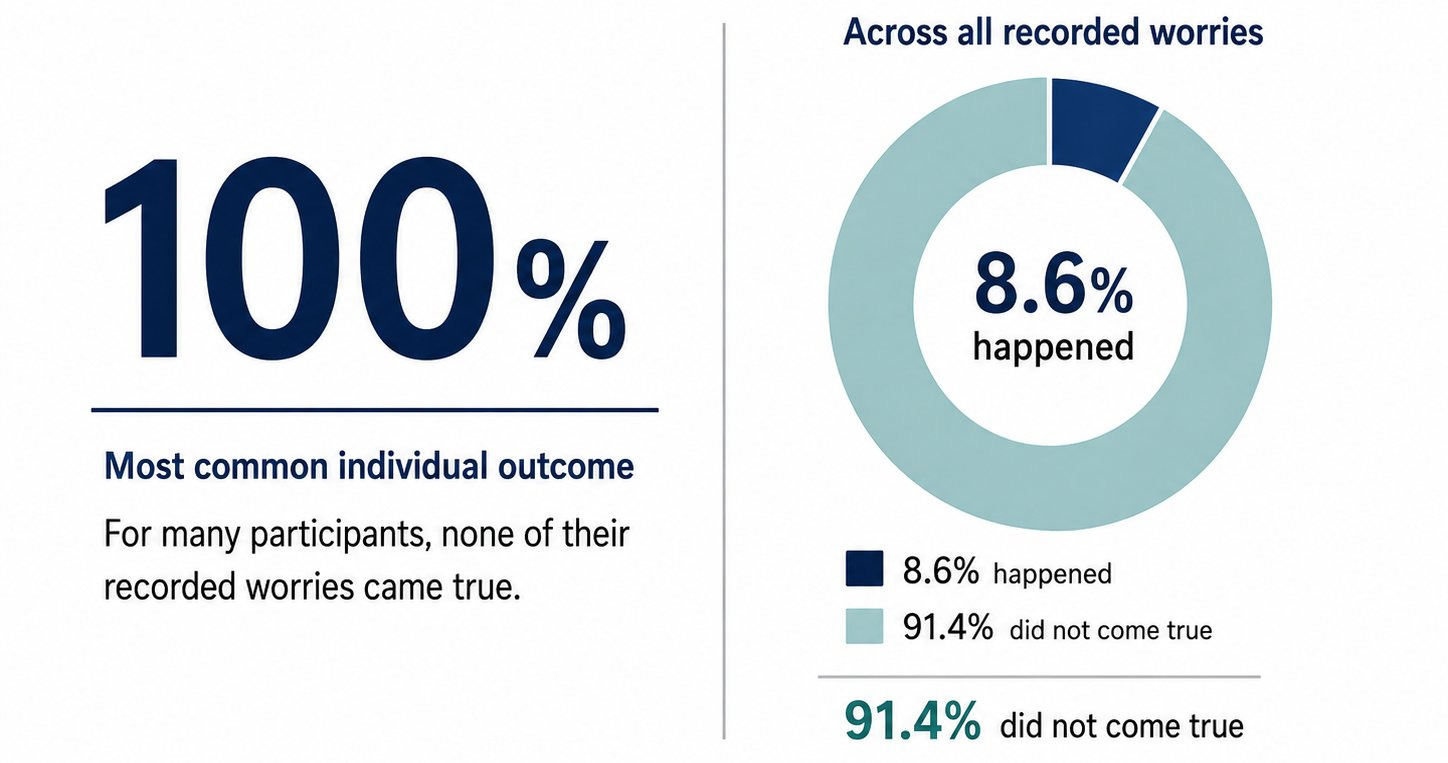
Now consider those participants are professional worriers, the clinical worst case. If the people most practiced at worrying are wrong 91% of the time, the rest of us should assume our own predictions are at least as unreliable (we simply have fewer).
And yet the modern world is engineered to keep the worry machine running hot. The internet delivers a fire hose of amplified catastrophe from across the entire planet 24 hours a day. Certainly, there’s always something you could worry about, and algos will find it. You did not evolve for this environment, in fact your evolutionary instincts are working against you here. Further, the smartphone collapsed the boundary between work and home, creating an ambient anxiety of 24/7 notifications many people don’t turn off. Making things worse, AI anxiety is now layered on top of legitimate financial precarity, meaning people are genuinely unsure whether their job will exist in a few years. These are real pressures, and I won’t be annoying today and fully dismiss them.
But here’s the thing: even with all of that, most things are fine. The constant emails or Slack notifications don’t ruin you, the financial news doesn’t wipe you out, the outrage on social media doesn’t exist if you log off and go for a walk. Most of the worst-case scenarios your brain rehearses at 2am simply do not arrive. The data on this is clear, your brain is a catastrophizing machine making you consider worst case scenarios or stay in fight or flight because it’s wired for survival, and the modern attention economy figured out how to monetize that anxiety and pipe it into your eyes all day.
Worry feels productive or perhaps like preparation, but it’s neither. It’s expensive cognitive overhead burning your focus and peace on outcomes that, in the vast majority of cases never happen.
The practical move is simple once you understand the above: treat your anxious predictions like your favorite bad forecaster you’ve caught being wrong over and over. You wouldn’t keep listening to a pundit who was wrong 91% of the time, would you?
Now, follow people around who never worry and count how often they’re wrong. 😑
There’s a weird disconnect between whether worries are accurate or not and whether worry was warranted because bad shit actually happened. No evidence presented on that score, just generalized speculation.
As nonworrier, I get the agenda the researchers are pushing, but I’m not seeing evidence that not worrying will improve those people’s lives—just that they suck at worrying (which they already know).
What's concerning is that this post lacks a solid clickbait title and still gets 16 likes.