



Everyone in Silicon Valley and the tech industry at large has AI psychosis. It’s a real, documented phenomenon, you can read about here. AI is all they think about 24/7, they’re so investment and automation-pilled they’re incapable of processing anything else at this point in the market cycle. All must fit into AI whether it be art, business, their social life, name it. It’s truly a mass psychosis event.
But for fun, let’s take a second and imagine someone fully reliant on AI. On their own, they can’t book somewhere to go to dinner without their agent. They certainly can’t write an essay themselves. They can’t play an instrument or compose a song. They can’t pick a place to meet a friend for coffee. They don’t know what to do on a Saturday without asking for help. Do you even like this person? Do they sound completely helpless? I’ve described where this goes before.
This brings us to the latest trend we’re being pushed is to use AI agents to do simple tasks that are already convenient and frequently enjoyable like book a flight, hotel or dinner reservation, things like this. These tasks are easily accomplished on the web right now, today. They take seconds, sometimes a minute or two, and have interfaces designed for the specific task. Unless you’re under duress, or simply do not care where you sleep or how you travel, a trip for instance should take a small amount of time and consideration, that’s good. You want to look at photos, read reviews, daydream a bit …act, you know, human. A voice or chat interface is in my opinion inferior to visually seeing all options (not just options the AI decides to show) presented in one window, with another window for your own research or context. As an adult I have a workstation with two monitors, plenty of screen real estate. I do not require an infantilized view, and since I am not cognitively impaired also do not require a machine to make decisions for me. Notable, I also don’t use mobile to accomplish these tasks, which are tasks suited for an office. Other people have no boundaries nor opinions on computing best practices and simply use mobile for everything. They’re measurably less happy by the way. I can see why they’d want to use AI instead, as they already don’t really like computing, do so without thought for ergonomics, sophisticated decision-making etc. Perhaps some percentage of the population doesn’t really want to do anything.
I’ve watched for years as the tech industry manically promotes the next thing merely because it’s new. But as agents are pushed on us, AI is especially pernicious because it presents a pretty large ceding of agency to machines. And while I want machines to do some things for me, I don’t want them to do everything. I personally disliked the time I even had a human personal assistant to book travel at a previous job. I prefer to do things myself (I also don’t pay someone else to work on my yard, aka get exercise outside for me, that’s enjoyable, too). I want to live my own life, and that involves being capable and practiced at things, and more importantly, the one who decides the details. You start to lose something when you outsource too much of this. There’s a reason we encourage older people to stay socially, physically, and mentally active, and why cognitive stimulation is incorporated into care for people as they age. Using your brain, making decisions, remembering things, and learning skills are all forms of mental engagement. What happens when we systematically remove those little opportunities for agency and effort from everyday life, across an entire society? I don’t think we’ve really thought through what that means.
The irony here is so much of Silicon Valley talks about the importance of agency, and yet they themselves are building products that remove it from the user. A bit of ‘agency for me, not for thee,’ and here, they are happy to become the intermediary in your life. They think you’ll thoughtlessly accept this. But I’m willing to bet you find the people with the fewest things to do are also the least happy. They have the most time to sit around and contemplate their mortality instead of actually accomplishing anything or be active participants in their own life. It’s literally the formula for unhappiness! You can listen to these same people on podcasts talk endlessly about seeking happiness in their own life and the lengths they go for “optimizing their routine.” But everyone else who still has some tasks and meaning is already happy. No pharmaceuticals, psychedelics, life hacks or self-help books required, it’s just not a thing that needs work. Even people at the highest echelons of wealth like Markus Persson who sold his company to Microsoft for $2.5 billion ended up depressed and empty when he was left with nothing to do. I really don’t see how we don’t see a similar rise of nihilism driven by AI if we allow it to sufficiently live people’s lives for them.
And this isn't limited to the big decisions in life, for sure the same thing happens with taste. I personally don’t find interesting music, friends to follow, or much else in the way of creative work through machine-selected choices (algos or AI). I like to select what to subscribe to. I go to the physical vinyl shop and browse records in all sorts of different sections and genres. I browse Beatport by release date in the category without any other signals, and certainly don’t let any large tech firm dictate playlists for me (my collection is local, but I also hand-make sets on SoundCloud). All this helps me resist slop world, and not have machines dictate my life and taste. This is important.
We’ll for sure see more latent cultural functions of technologies emerge as AI does more things for people here. The important thing that no one talks about in these discussions, and the AI permabulls don’t understand is tradeoffs are real, and rule everything around us. They also don’t really think about the concept of diminishing returns, and honestly everything around us is already pretty efficient. I personally would rather spend an extra few seconds on tasks where I get to decide specificity vs let a machine or company decide. In a way this is no different than letting another form of government control your life: it might be okay today, but what happens when people you don’t agree with run the show? And anyway, are you really so busy you want every small decision outsourced? It would ultimately leave you empty.
One other interesting comment here is the gaslighting, or maybe just odd commentary. I posted about how I prefer a visual UI to text or voice interface here, and you can read some of the responses. I think the most interesting ones are from people who automatically assume every new way of computing with less personal control is superior (conveniently, this also pumps their stocks or is beneficial for their startup). Everyone is just talking their book here. The other are the people who, like clapping seals, simply applaud a ceding of agency to machines. The funny part is I actually do things like travel more than they do (many times per year), whereas most engineering nerds with the strongest opinions on technology actually live a different, stranger existence. It’s certainly going to be an interesting battle of normal people vs nerds in the future. Having sat in the room at large technology companies before, I just hope they occasionally do still focus on the user. Perhaps our only hope here is open source AI remains legal and we do not end up at the whim of one or two large companies.
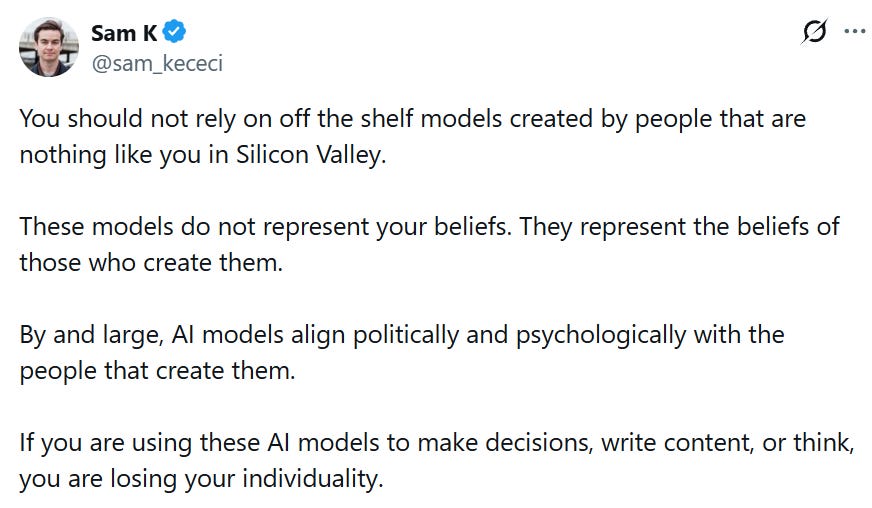
You can imagine a future where all control is taken from us, and it’s just you and the chatbot. You can ask it for anything, and it will return what it deems, based on whatever digital signals it has the “correct” choice for you. Perhaps it will be the right choice, but perhaps you’ll simply accept it because that’s what’s presented. You won’t question the price, which could be determined based on an estimation of your net worth instead of a market rate. How would you know, everything is abstracted away. Your hotel might be fine, but probably won’t be unexpectedly in a more active part of town and cause you to visit some nightlife you wouldn’t have experienced. Of course, serendipity is mostly managed out of your life here. Maybe it’ll program it in by suggesting a new video game. Something to sell you. But the magic and chance of the world ever dwindles. Your agency shrinks. Your life continues to be more outsourced. Are you sure you want this future, anon?
One could even say that more joy came from booking a trip or a night out when it was done via phone with a person BEFORE we booked online. We might meet that person or at least have likely had one of the most highly sought out experiences that are diminishing in our "online" lives - a quality personal interaction with another person.
Everyone acts today as if strangers are too challenging to deal with (look at dating). The reality is that more joy comes from interactions with other people than anywhere else in life.
I think that the AI companies have yet to find the killer app for the general public, so they're casting about for ideas that only save minimal amounts of time and effort.
Compare to the Internet. It allowed us to do things we simply couldn't before that. It expanded our lives. AI does some of that professionally, but few of the personal use cases amount to much, yet.