


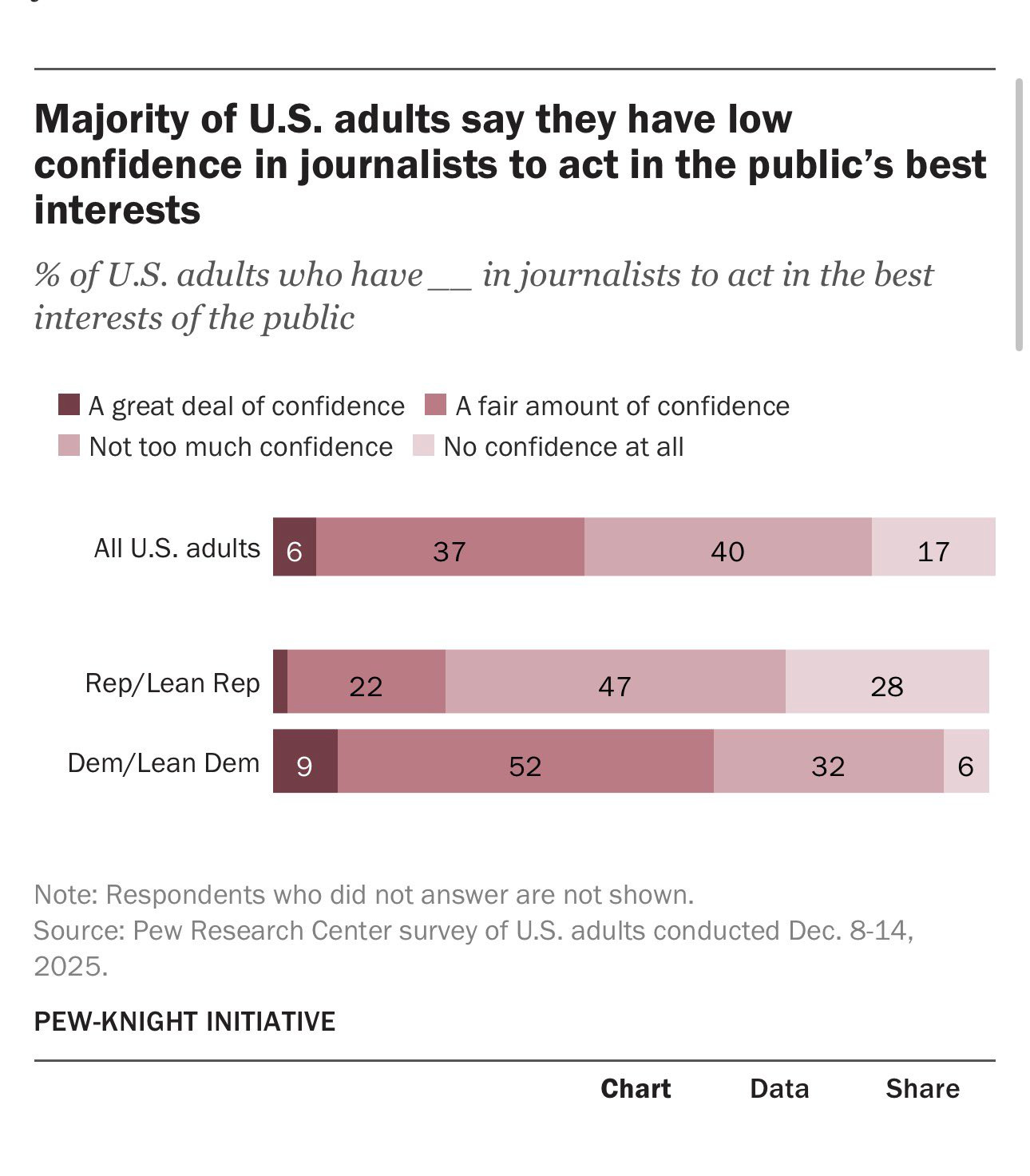
PEW just published new research on how the majority of Americans (57%) express low confidence in journalists to act in public’s best interests. This includes 40% who say they have not too much confidence and 17% who say they have none at all. This continues a trend where confidence in journalists lags behind other institutions like the military, scientists, even police.
This will come as no surprise to readers here, as I’ve noted about the media’s subprime attention bubble and open disdain for users and the internet previously, not to mention ongoing promotion of Marxism. When your core product is a mix of ideological signaling, contempt for your own audience and “fiat news” optimized to be first/cheap instead of accurate, no one should be terribly shocked when the public eventually stops trusting them. It’s not a good situation for anyone, and I genuinely hope great reporters and publications help turn this around instead of fighting against anyone trying to at least do something different.
Since it’s a self‑inflicted wound, it is fixable when the sector wants to have an honest assessment of its practices. That would mean: stop chasing low quality clicks and attention, stop treating the open internet as a threat rather than a core distribution channel, and actually reward reporters who get things right over time instead of those who “go viral” or generate outrage.
On the other side of the trade that should also care about this loss of trust, marketers working on ads supporting the media need to address major issues too. If you keep funding low‑trust properties with junk metrics, user-hostile environments and allocate to spam operations, you’re doing something worse than simply wasting money: you’re helping extend the time institutions act in a way your customers already told you they don’t believe in. We should all encourage them to improve instead.
While the continued trend of loss of trust in this institution is real, and concerning, it does also present an ongoing opportunity for people reading this. If you are an honest broker, if you are willing to treat your audience like adults and do genuinely great work, it’s never been a better time to start a media brand. While you can’t replace entire newsrooms (which we still need, and we hope they do better and rebuild trust) it’s still a blue ocean to seek truth without trying to please certain ideologies or use cheap shortcuts.
The way to proceed is: be honest, correct yourself publicly when you miss, resist low quality/spam tactics, and don’t secretly hate the people you’re talking to. In a landscape where over half of Americans say they don’t have much confidence in journalists, anyone willing to build a high‑trust audience over years instead of chasing cheap short-term attention can play a better game.
The central problem I have with this premise — that "the media" are failing — is that the term is so vague and amorphous that it means almost nothing. When I was an intern at The Daily Caller, for example, we'd regularly disparage "The Media," even though we were a part of it.
To build on one of your points: yes, many outlets said Biden was fine to serve another term. There were also many other outlets saying the opposite.
Many of these problems won't be fixed until J-schools tame the Marxist influences that dominate their faculty and/or journalism is taught outside of academia.