


![TOMT] [webcomic] Webcomic where a man creates a bunch of ...](https://substackcdn.com/image/fetch/$s_!oLuY!,f_auto,q_auto:good,fl_progressive:steep/https%3A%2F%2Fsubstack-post-media.s3.amazonaws.com%2Fpublic%2Fimages%2Fa77a5a95-defe-4bdc-8ea4-bc4a9379b349_640x642.jpeg "TOMT] [webcomic] Webcomic where a man creates a bunch of ...")
A strange phenomenon has emerged in American journalism over the past few years, where a kind of psychological tic has replaced principled criticism. For lack of a better term, let’s call it Bari Weiss Derangement Syndrome.
It began when Weiss left legacy media and built The Free Press into a commercially successful publication that rejected several sacred cows of the modern press: that journalists must all share the same politics, that dissent is “dangerous,” and editorial judgment is a form of violence. Since then, a predictable pattern has repeated itself whenever her name appears in a headline: elite establishment journalists stop behaving like professional journalists and lose their objectivity. Fake claims about her are posted everywhere, many by people who have clearly never even read her publication.
Her critics, like Margaret Sullivan have published stories and social posts that are conspiracy-theory riddled and unbecoming of media pros. Let’s just take one story in the Guardian as an example.
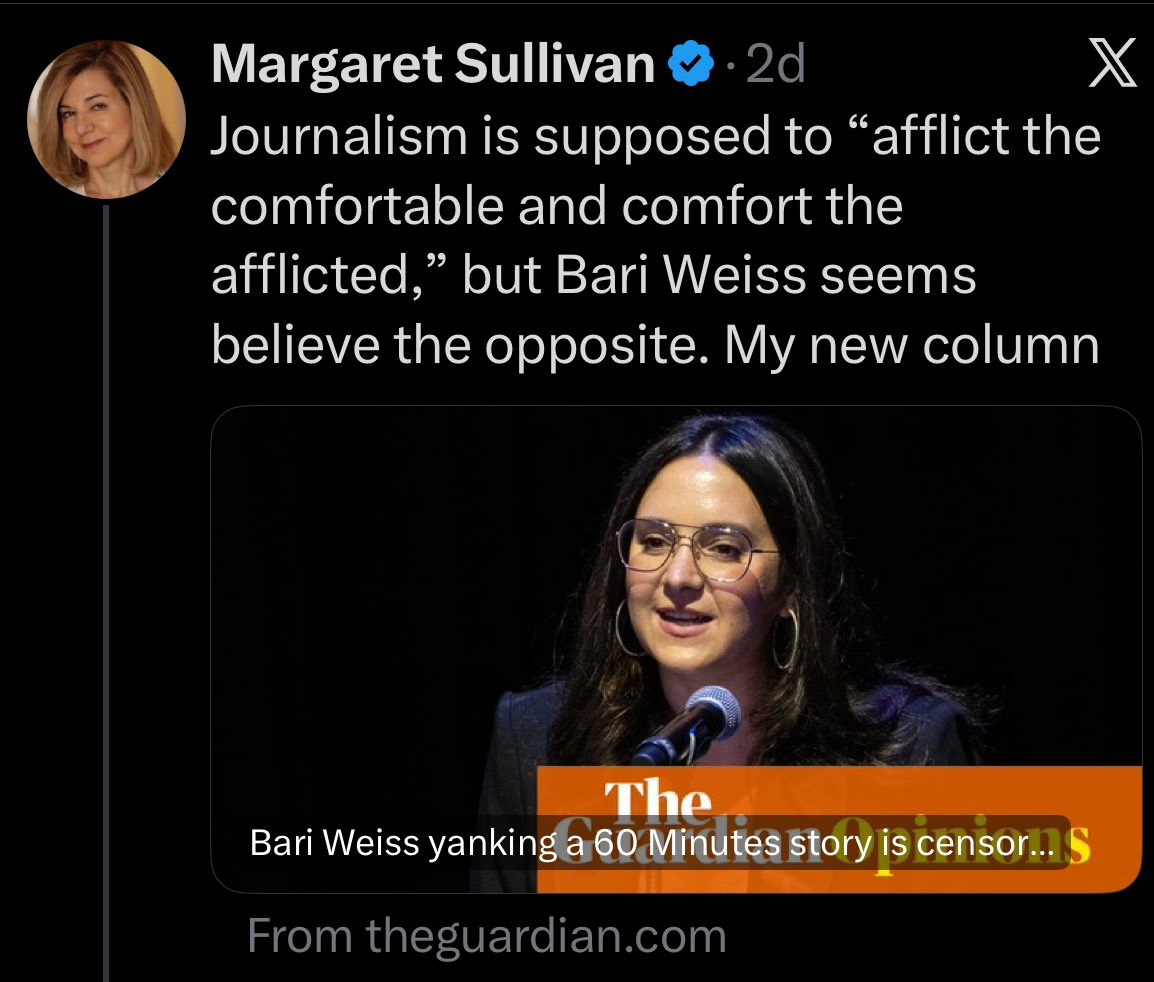
That Sullivan once served as the New York Times’ public editor and now helps run Columbia’s journalism school tells you a lot about what’s broken in the industry. Journalism’s job is to inform the public, not to run a crusade immune from factual scrutiny. In her story, she waves away editorial concerns about “flaws” in a CBS segment without addressing any of them, never citing the specific issues Weiss raised.
More damning, she omits key facts already on the record, including that the administration did provide comments that were excluded from the aired segment. That alone should end the argument. Instead, Sullivan dismisses further fact-gathering as unnecessary.
She then claims Weiss damaged the CBS News brand, ignoring the obvious reality that public trust in media, including CBS, is already at historic lows, in large part because of precisely this kind of reporting. The reporter involved has a track record of high-profile misfires that have already eroded trust in 60 Minutes, yet Sullivan celebrates that behavior and substitutes motive she admits she doesn’t know as accountability. Side note: I appreciate CBS is aware enough of this they even recently publicly addressed the trust issue, the first step to improvement in anything is acknowledging the problem. Even alcoholics learn this.
When people pushed back, Sullivan then locked her social account to retreat into her echo chamber rather than reply to anyone who offered rebuttal.
I have seen this same behavior repeated time and time again by people like Sullivan. And it’s precisely why Americans don’t trust the elite media. While Weiss may not make every right call, it’s hard to imagine doing worse than the model Sullivan continues to defend.
Oh yeah, and journalism isn’t supposed to do whatever that Hallmark-card like nonsense is in Sullivan’s social post promoting the story. It’s supposed to be truthful. You’ll recall previously the NPR CEO said “our reverence for the truth might be a distraction getting in the way of finding common ground & getting things done.” This is rampant in the professional media managerial class.
This reaction isn’t unique to Weiss, it’s how the establishment responds to anyone who exits the approved institutional pipeline and continues speaking (especially once they attract a large audience, as with many Substack writers, podcasters, or heterodox academics). Ordinary disagreement devolves into moral panic when success makes dismissal impossible, and criticism shifts from evaluating decisions on their merits to imputing sinister motives. Editorial judgment becomes “censorship,” rigor becomes “protecting power,” and disagreement implies shadowy interests, where the substance no longer matters, only the fact that the decision was made.
This is all against the backdrop of a sector that has engaged in a subprime attention bubble, platformed degenerates and internet trolls like Hasan Piker, and frequently runs a playbook to outrage instead of inform. Are these really the good guys?
And if you actually have read Weiss for several years, listened to her podcasts, you see how silly it all is. She is simply not the person some of her critics make her out to be. The same phenomenon is seen with people like Jon Haidt and others in the discourse who are clearly not terrible people and almost always bringing up topics we should discuss like adults. Detractors who disagree with them say silly things like “they’re far right” and think that’s an adult argument (in nearly all cases, when you look at their ideas objectively they are centrist normal opinions, not some kind of extremism). But people aren’t dumb, they see how silly this all is. In many cases, there are several perfectly reasonable sides to an issue, but in modernity many people seem to believe there is only one. That’s untrue and illiberal.
Derangement syndromes are always revealing. They emerge when criticism stops asking what is true and starts asking who must be punished. Evidence becomes optional. Motive becomes everything. Moral language replaces argument because moral language ends the conversation (I’ve written on this before). Once someone is labeled dangerous, authoritarian, or harmful because of perceived political disloyalty, the ideological conformists outright dismiss anything they do instead of seriously engaging with the topic at hand.
The irony, of course, is rich. Many of the same people now warning breathlessly about “authoritarianism” spent the last decade defending newsroom monocultures, cheering internet censorship, and redefining disagreement as harm. They applauded editors who killed stories for ideological reasons, who spiked coverage that complicated preferred narratives, who quietly memory-holed inconvenient facts. They frequently sided with terrorists, racists and fraudsters, and wonder why trust in media is at all time lows. That was somehow seen as responsibility and neutrality was called cowardice.
But Weiss broke the spell by doing something unforgivable: she proved that a heterodox publication could succeed. The Free Press didn’t just survive, it thrived, initially on opinion and analysis that refused to follow the approved narrative™. It attracted readers who felt gaslit by elite media, hired writers who weren’t beholden to illiberal ideology, and insisted, somewhat radically, that arguments be rooted in reality even when they disrupted the moral arc journalists had already settled on.
That success is the real sin. Once someone shares an unapproved perspective, the system responds with attack rather than the introspection one might hope for. You see it in the language: Weiss is never merely wrong, she’s dangerous. She’s never mistaken, she’s “captured.” Ordinary editorial disagreements are inflated into existential threats to democracy itself. This is not how confident institutions behave.
A healthy press culture would argue truthful specifics. It would debate standards. It would ask whether a decision improved accuracy or fairness. It would acknowledge there are different positions and here’s why people believe them. Instead, we get insinuation, credentialism, and the constant invocation of bad faith. The assumption is always the same: if someone outside the approved ideological lane is making decisions, those decisions must be illegitimate.
What’s most revealing is what this panic says about journalists who are taken by it. Many seem to believe, perhaps unconsciously, that the public belongs to them, that trust is theirs by right, and that deviation from their worldview is a kind of theft. When readers choose otherwise, when they flock to voices that don’t flatter their assumptions, the response is rarely anything healthy like self-examination. Instead it’s finger pointing. Something must be wrong with her. Or with the audience.
Bari Weiss Derangement Syndrome isn’t really really about Bari Weiss. It’s about a profession struggling to accept that it no longer owns the narrative and that editorial judgment, when exercised outside the consensus, isn’t some kind of tyranny. It’s really just competition. Many feel the same way about any person with a blog, and have since the start of internet publishing. And nothing annoys a collapsing monopoly on narrative quite like that.
BWDS: I like it.
You can tell that a new dog has entered the dog park when all the old dogs swarm him.
"You can't perform Journalism, Bari! Only WE can do that."
The Uber comparison is spot-on. None of their innovations were beyond the reach of legacy taxi companies. They just didn't want to bother.
Even in foreign countries, you can usually ask a taxi driver, "How much to go to downtown?" and they'll quote you a price. So fixed-price trips were always doable.