


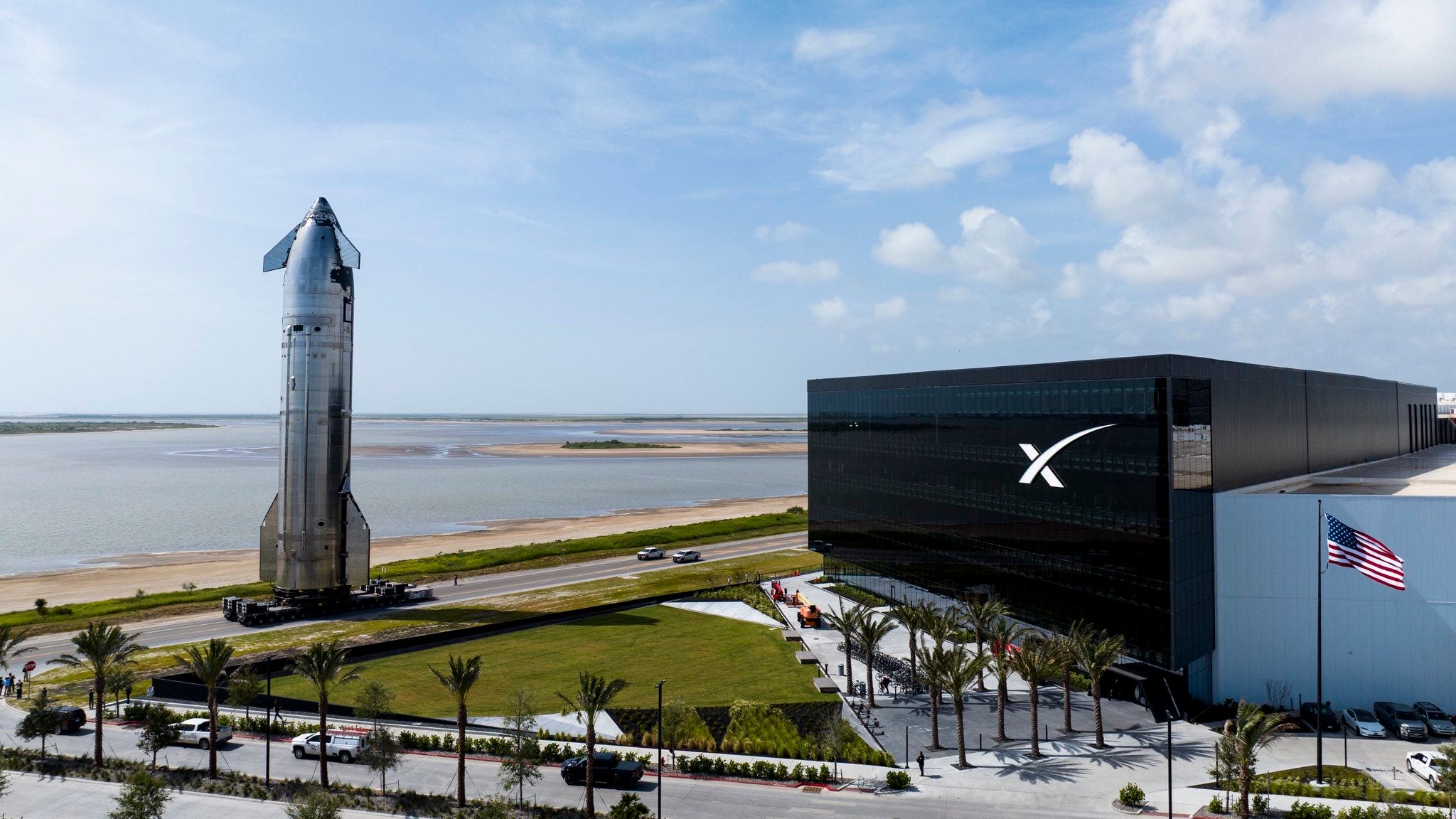
Innovation in bits can happen anywhere, a great engineer with a laptop and internet connection can build something world-changing from Tulsa or Taipei. But innovation in atoms: rockets, chips, biotech, etc, still requires physical co-location. The same way the industrial clusters of 19th-century Britain weren’t accidents, neither is what’s happening right now in South Texas.
Starbase, Texas is real. In May 2025, local voters (nearly all SpaceX employees and their families) ratified their new municipality by a 97% margin, 212 to 6. When’s the last time you saw that level of civic consensus on anything?
Boca Chica was a sleepy coastal hamlet with no particular destiny before SpaceX arrived. What happened next echoes the great company towns of the past except with one crucial difference: nobody had to be there. These are engineers who chose to work, live, and now govern a place built entirely around a technical mission. Post-IPO many are now millionaires, and even on IPO day were still hard at work. You love to see people this focused on the mission (and rewarded for it).
But this is also what Balaji has been pointing at for years: ambitious people will eventually stop trying to fix captured institutions and simply route around them. Move to the place that wants you and isn’t yelling that you’re somehow “the problem” or whatnot because you have ambition to build things and advance industry.
California used to be that place, but it’s trending in a direction that isn’t anymore. The Google founders just left, quietly shifting dozens of personal and business entities out of state ahead of a proposed billionaire’s tax, as California perfects its art of making life difficult for precisely the people who generate the most value. High taxes, regulatory paralysis, a political culture that thinks punishing productive citizens is virtuous. The talent has noticed, the capital has noticed and even many of the companies have moved their headquarters.
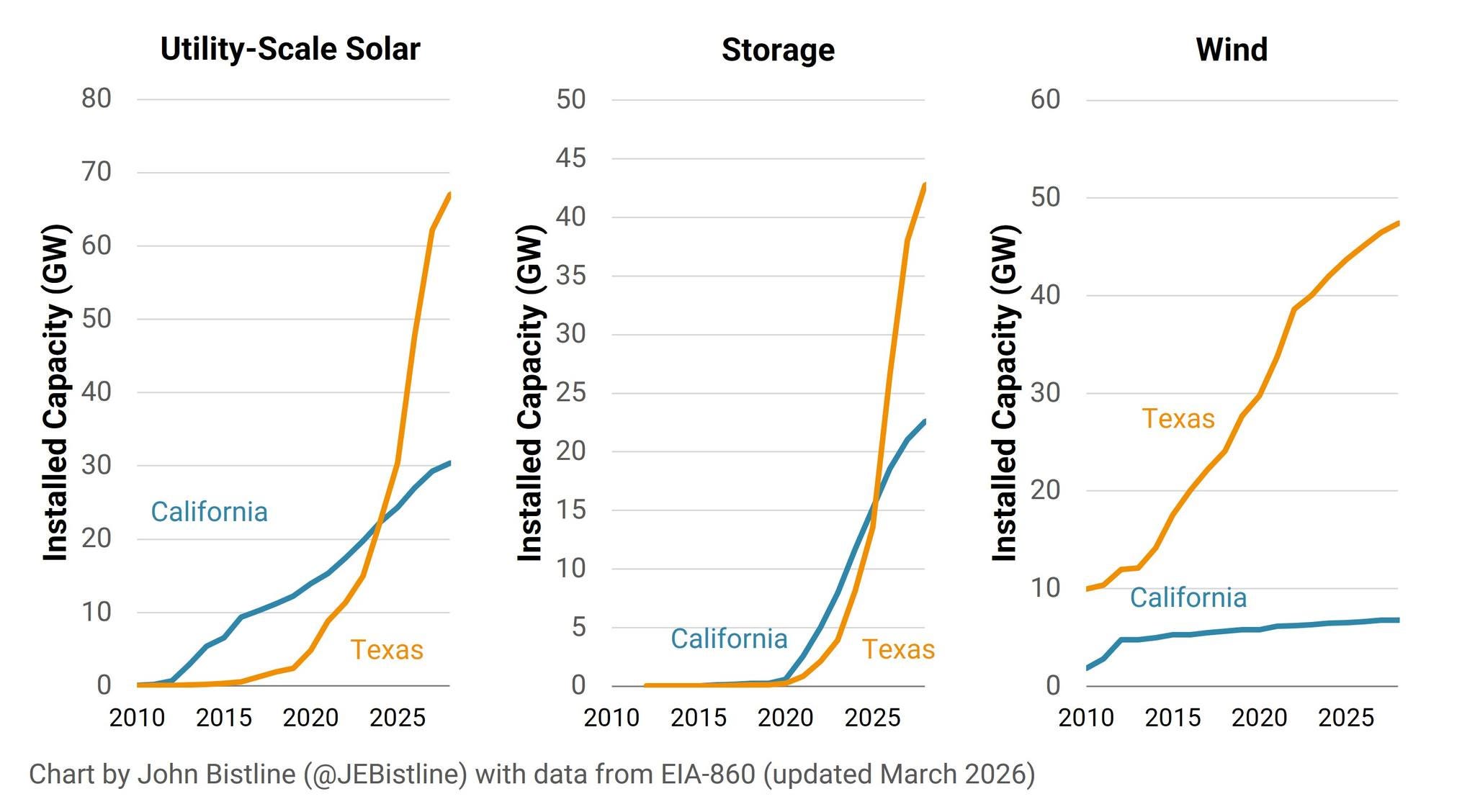
Green energy capacity tells the Texas growth story nicely. Without even having a formal climate mandate, Texas overtook California in utility-scale solar generation in 2025 for the first time, and it's not close on wind, where Texas generates nearly 3 times more than the next closest state. The state is also set to account for roughly 40% of all new utility-scale solar capacity coming online nationwide in 2026.
It’s sadly not just California, there are other places that seem to be promoting an odd strain of what I feel is fairly anti-American. Seattle elected Katie Wilson, a self-described democratic socialist, on a platform of new payroll taxes and capital-gains-style levies, layered on top of Washington’s new 9.9% “millionaire tax.” Business leaders noticed: a large share say they’re considering leaving, and some major employers are already shifting jobs to Bellevue or out of state. I even got my liberal friend Ken to agree it’s very bad. Meanwhile Delaware, the state that wrote the rulebook for American corporate law, watched one Chancery Court ruling against Musk’s pay package set off a “Dexit” wave to Texas, Nevada, and Florida who are all consistently pro-business.
Capital and talent don’t leave overnight. They leave after years of accumulated signals. A regulation here, a tax increase there, ongoing unhinged anti-capitalist speeches and quotes, and a culture that increasingly views builders as something to be controlled by the state rather than partners in creating prosperity. Eventually, entrepreneurs stop trying to convince institutions to change and simply move to places where the incentives are aligned with what they’re trying to build.
Texas is a shining example of such a place, and has no income tax, functional governance, and, crucially, a willingness to get out of the way. The formula isn’t complicated: freedom of movement + economic opportunity + civic participation = the conditions where innovation actually compounds. Silicon Valley was built on exactly this. Permissive regulation, abundant capital, a culture that treated risk as respectable. That environment has since been regulated and taxed into something that’s quite the opposite of what created its abundance, but its venture community clearly enjoys living there so it will continue, I just always wonder how much pain they’re willing to take. NorCal for certain has nicer weather during the summer, but weather doesn’t build anything, functional institutions do.
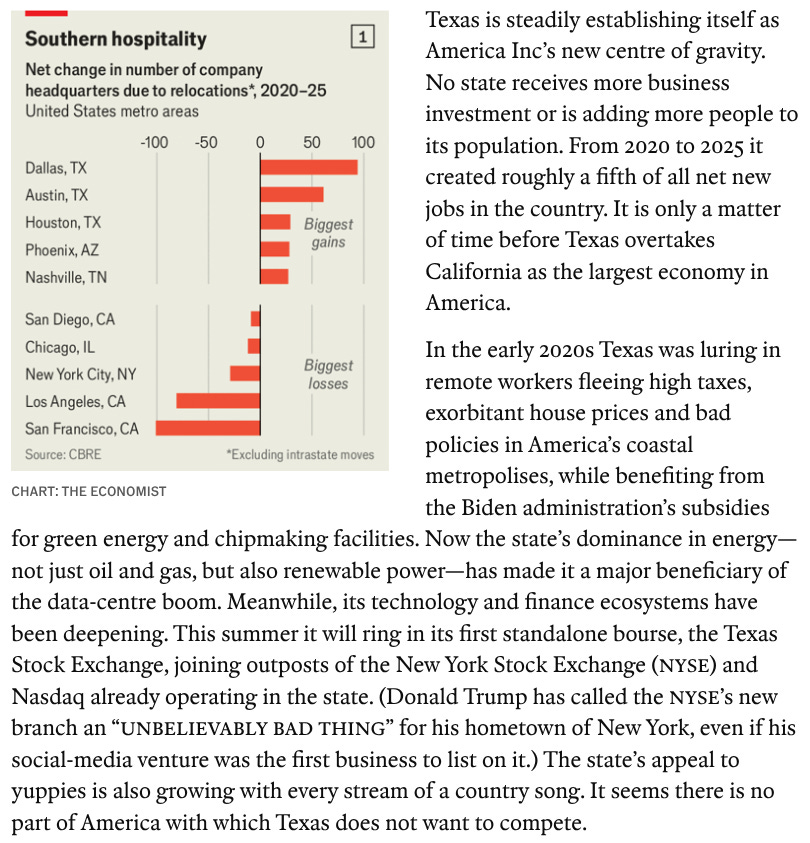
As The Economist recently noted in a story (I’ll paste the important part here since it’s paywalled):
Technology professionals have to stop accepting the premise that they’re obligated to fight for cities that have decided to fight them. Tech firms and entrepreneurs should vote with their feet. If you can, move to a place where the culture reflects and encourages what you’re trying to build. It’s way more fun than fighting Marxists.
Starbase is that place in its purest form, while the entire Texas triangle is pro-technology, growth and innovation (and a big reason I moved here to the Austin area).
Innovation in atoms needs a home. Increasingly, that home is Texas.
Fun bonus for today’s story: check out this video from Core Memory on how an entrepreneur in the middle of nowhere, Texas has become a telescope rancher, it’s pretty neat (and profitable). What if you used your imagination and built something similar?
This is where California along with a handful of other Blue states in Congress need to push back, Balance of Payments.
California gets back 90 cents on the dollar in federal expenditures from what it sends to the Federal Government. New Jersey gets 82 cents. CA works out to about $60B that flow primarily towards Red states that hate California. I would imagine a big part of the tax problem would be solved in CA if they received back their fair share. As far as over-regulation and NIMBY, GFL! Texas gets a surplus, $1.17 + an anything goes regulatory system.
Green energy is an estate/wealth management strategy. Republicans say that they hate it and are first in line to invest to get the tax mitigation. Dems do the same thing with oil/gas drilling investments. Everyone is a hypocrite, especially when it comes to money/taxes.
Cape Canaveral's latitude is higher. Earth's slightly larger centrifugal force at a lower latitude makes Boca Chica TX a modestly better launch site. Best yet, until Space-X Boca Chica had little, so acquiring R&D, manufacturing, and launch sites there was a lot cheaper.
I lived in Houston 21 years. Its weather was like Calcutta's; its unfettered development of discordant uses left most of Houston looking like Hell. A ride down I-45, I-59, along I-10, or Westheimer does serious emotional damage. A visual assault to anyone coming in thru Bush International. What kind of city-planning is that?
Greater Houston Partnership, a creature of the oil companies, still runs everything. Houston's ugliness could not attract the Summer Olympics. Nor could the Partnership turn down the heat from Houston's massive, paved-in-all-directions heat-island. The Partnership tried initiatives in import-export and in hi-tech [Silicon Bayou anyone?!!!], but nothing new took root at scale in one-trick-pony Houston. Dallas is not Eden, but it has zoning. Texas will remain a growth state until leftists from outside tip the balance.
My deep family roots were just north of Houston, TX, tho' my upbringing was in far Northeast Enemy Territory, Yankeeland.
I wish Texas, even one-trick pony, Houston all the best. But seeing the Lone Star trying to turn blue, especially under weak-kneed Pastor Lite, has to turn Texans blue as well. But look on the bright side. Just figure, if Texas doesn't get Pastor Lite, it gets a crook who never misses a personal opportunity.