


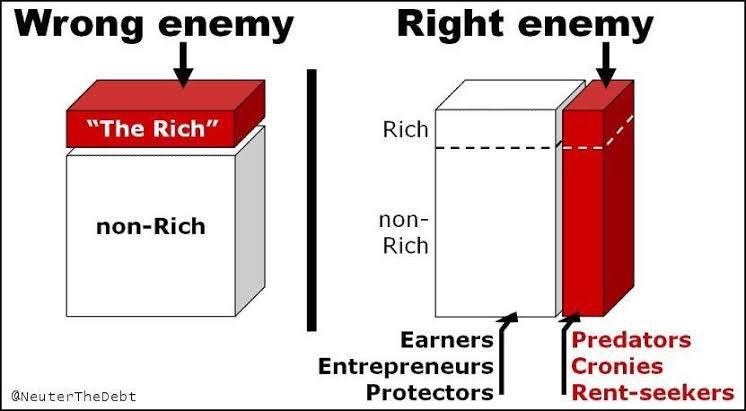
A few weeks ago I wrote about how we’ve stopped teaching the story of prosperity, on how capitalism’s extraordinary track record has frequently been edited out of the curriculum/conversation, replaced with a vague hostility toward success that believes it’s morally superior. Normal liberal friends I speak to are also concerned here, as they love builders and economic growth. This was recently an entire thesis by Ezra Klein and Derek Thompson. But we constantly see examples of so-called liberal politicians going the other way. We should wholly reject this. I want to talk more about this topic today and some of what I’ve noticed lately, particularly among leadership in America.
I recently saw an (economically illiterate) argument from AOC (which the internet resounded rejected) that billionaires are by definition thieves, that you cannot “earn” that kind of wealth, that every large fortune is by definition evidence of exploitation (what about Beyoncé or Taylor Swift - they never mention those names, of course, it’s just big bad business people). Leaving aside they get the definition of billionaire wrong from the opening sentence (net worth in assets is not cash in an account), the deeper problem is the zero-sum framing underneath it all. The implicit assumption is that value is a fixed pie and that for Elon Musk to have more, someone else must have less. This is simply not how economies work. SpaceX didn’t redistribute the cost of launching a kilogram into orbit, it collapsed it, from roughly $54,000 to under $3,000. The real question critics never want to engage is: who should be deciding where capital goes? The historical options are the state, committees, or people who’ve proven they can allocate resources effectively. The 20th century ran the state experiment at enormous scale. The results were famines, shortages, and mass death. The market, for all its imperfections, at least has a feedback mechanism where eventually bad allocators go broke.
AOC is hardly alone. Seattle Mayor Katie Wilson, a self-described democratic socialist, was asked at a public forum whether she was worried millionaires might leave Washington over the state’s aggressive new tax climate. Her answer, delivered with a laugh: “Bye!” The audience cheered. Washington had just passed a 9.9% income tax on income above $1 million, which the Tax Foundation warned would create the highest top rate on wage income in the entire country. The results are already arriving: Starbucks is expanding in Nashville, committing 2,000 jobs and $100 million to Tennessee, and Seattle could lose up to $750 million in tax revenue as the company grows elsewhere. Fisher Investments left for Texas. Jeff Bezos left for Florida. Wilson, meanwhile, joined a Starbucks picket line after winning her election. That’s the governing strategy: antagonize your city’s largest employers and celebrate when capital exits.
In New York, Mayor Zohran Mamdani filmed a video on Tax Day outside Ken Griffin’s $238 million Manhattan penthouse, staging it as a campaign-style announcement for a new pied-à-terre tax on luxury properties. Griffin’s response was immediate: Citadel filed new building permits in Miami and began shifting investment there, with Griffin saying Mamdani had made it clear that New York “doesn’t welcome success.” Apollo Global Management is now planning a second headquarters in Florida or Texas. Every time one of these politicians waves goodbye to a producer, they act as though the tax base is permanent and the people funding it are optional. They aren’t.
But California may be the most instructive case of all. A coalition of labor groups and activists are currently pushing a ballot initiative that would impose a one-time 5% tax on billionaire net worth including unrealized gains, meaning assets that haven’t been sold and may not even be liquid. Think about what that actually means in practice. A founder with wealth tied up in a private company or early-stage equity would potentially have to sell assets, possibly losing ownership stakes or voting control, just to pay a tax bill on paper wealth that may never materialize. The state doesn’t hand you money when the stock drops, it just locks in your liability based on a snapshot valuation and wishes you luck. Before the initiative even made the ballot, California’s three wealthiest taxpayers publicly announced their departures, representing, by one analysis, 38% of the state’s entire billionaire wealth walking out the door. As if this all wasn’t bad enough, we even just discovered there was a CCP spy who was mayor of a California city, there’s so much evidence we are (intentionally and otherwise) undermining our own country from the inside.
Let’s zoom in on one specific person in California, Sergey Brin, because it’s just too good of an example to ignore. Brin, who fled the Soviet Union with his family in 1979 as a child, relocated out of California ahead of the wealth tax deadline and issued a rare public statement: “I fled socialism with my family in 1979 and know the devastating, oppressive society it created in the Soviet Union. I don’t want California to end up in the same place.” Think about the arc of that story for a moment. A man escapes one of history’s most brutal experiments in state control, builds one of the most valuable companies in human history in the freest economy on earth, mints untold millionaire employees and enriches countless public market shareholders and then watches that same state inch toward the ideological conditions he once fled. He’s now poured $57 million into campaigns to stop the tax and has shifted his political support significantly rightward. When someone with lived experience of actual socialism looks at what California is doing and says it reminds him of home, that’s a warning from someone who knows what the destination looks like.
The irony runs even deeper when you look at housing, because the same political movement that celebrates chasing away employers and investors also blames actual builders for the housing crisis their own policies created. Rep. Pramila Jayapal, who represents Seattle, recently posted: "Seattle has one of the worst housing crises in the country... Teachers, nurses, and transit workers who can't live in the city they serve... We built this crisis by choosing developers over people." Leaving aside that Democrats have governed Seattle continuously since the late 1960s, the diagnosis is precisely backwards. Seattle doesn't have a housing shortage because it chose developers, it has one because it consistently chose not to. Zoning restrictions, permitting delays, and decades of neighborhood opposition to density are what built this crisis. California tells the same story, where environmental review law was routinely weaponized to block new development, making it one of the most expensive places in the country to live. Meanwhile Austin, also a liberal city, tried something different: they cut parking minimums, reduced lot sizes, and let builders build. Median rent fell more than 16% and the city added 120,000 units in under a decade. In 2024 it led the entire country in affordable housing construction. The difference is whether you treat builders as partners or enemies.
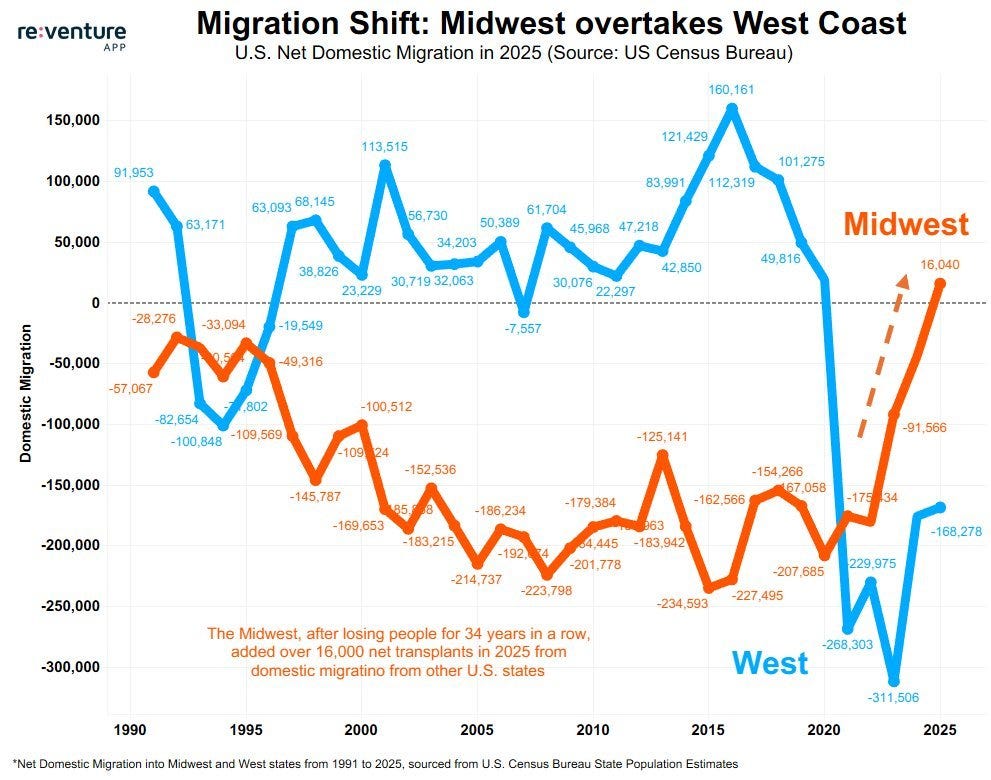
What connects all of these stories of tax flight, the wealth tax, the housing crisis that blames builders while blocking building, is a single recurring error: the belief that prosperity is something to redistribute rather than produce, and that the people doing the producing are the problem. The productive class, given sufficient provocation, will simply go somewhere else, and they are. The politicians left behind will have the satisfaction of their misguided ideals and a shrinking tax base to fund them. That's not a trade any serious person should be proud of.
We have the 6th worst income inequality, as measured by GINI Index, among OECD countries. Among the entire world, our income inequality is similar to countries like Haiti, Papua New Guinea, and Bolivia. This was not always the case. Going back, we were similar to Canada. a little higher, but not much. In 1979, we were at 34.8 and they were at 33.5. Now, we are at 41.8 and Canada is 31.5.
So, yes, I agree that "the pie" is always expanding as you say. It's not a finite amount, but even as that pie grows, more and more of this ever expanding pie is going to the largest asset holders. People are mad. The California plan (which I think I will vote against) is a ballot initiative, not sponsored by any government agency. I am a homeowner in California and I benefit from very generous tax laws for property owners. The system is so rigged towards owners that we have to raise taxes in every other way imaginable to make up for it and It's a driver of our housing crisis. The way our property tax system is set up, if I sell my house to downsize when I retire and stay in California, I will pay significantly higher taxes on the new home, so why leave?
The New York tax is on second homes owned by non-residents of the city. These are homes that largely sit empty, yet still drive up prices, in a city desperate for housing. Also, look into the property tax rules for these apartments. They are taxed based on what the owners say they can get in rent, not what it's actually worth on the market.
Trying to punish billionaires for being billionaires feels good but does nothing. They are beyond consequences, financially or otherwise (another reason not to concentrate wealth). Read Noah Hawley's essay in The Atlantic about his encounter with the billionaire class for more about this. I don't agree with wealth taxes and the like, but something significant has to be done. We are not heading to a good place. We are heading towards income inequality experienced by some of the poorest nations in the world.
California isn't pushing the billionaire tax initiative, it's a Proposition that has been brought forward by specific union and interest groups. The state is largely against it. It's not indicative of CA as a state, but more that there is a segment of the population frustrated that they are being left behind and lashing out in more and more aggressive ways.
Until we have solutions for the rising costs across fuel, housing, education, etc. these groups will grow in size and power. The system is not working for them, and they aren't going to just calm down and accept it.