


“Socialism is a philosophy of failure, the creed of ignorance, and the gospel of envy, its inherent virtue is the equal sharing of misery.”
—Winston Churchill
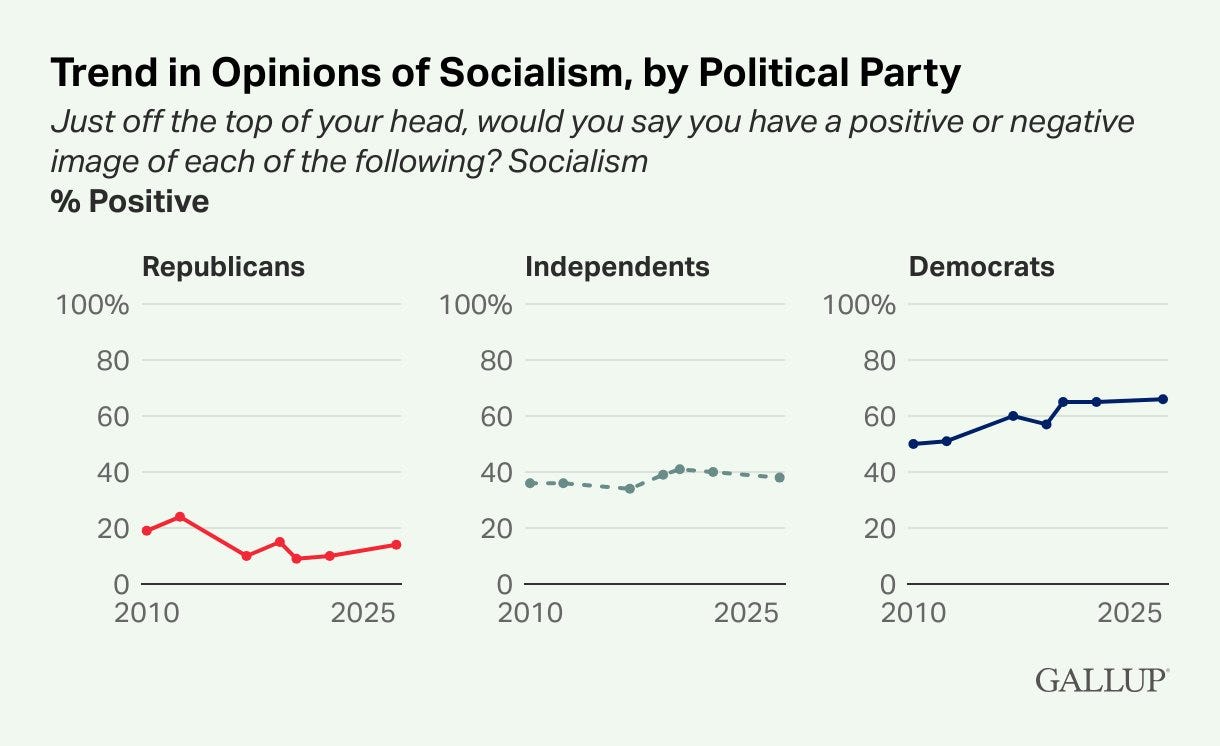
I saw a fairly alarming stat the other day: 62% of Americans under 30 now express a favorable view of socialism, according to a Cato/YouGov survey. This is not just one survey, the results are similarly mirrored by data from GALLUP, and if you’re observing what’s happening around us (some American politicians explicitly promoting socialist ideas tried and failed in the Soviet Union) it could actually be around this high. Two-thirds of young Americans warming to an economic system with a body count that dwarfs history’s worst catastrophes is …concerning to say the least. Some of you might be sitting here wondering why, although I don’t think it’s particularly mysterious.
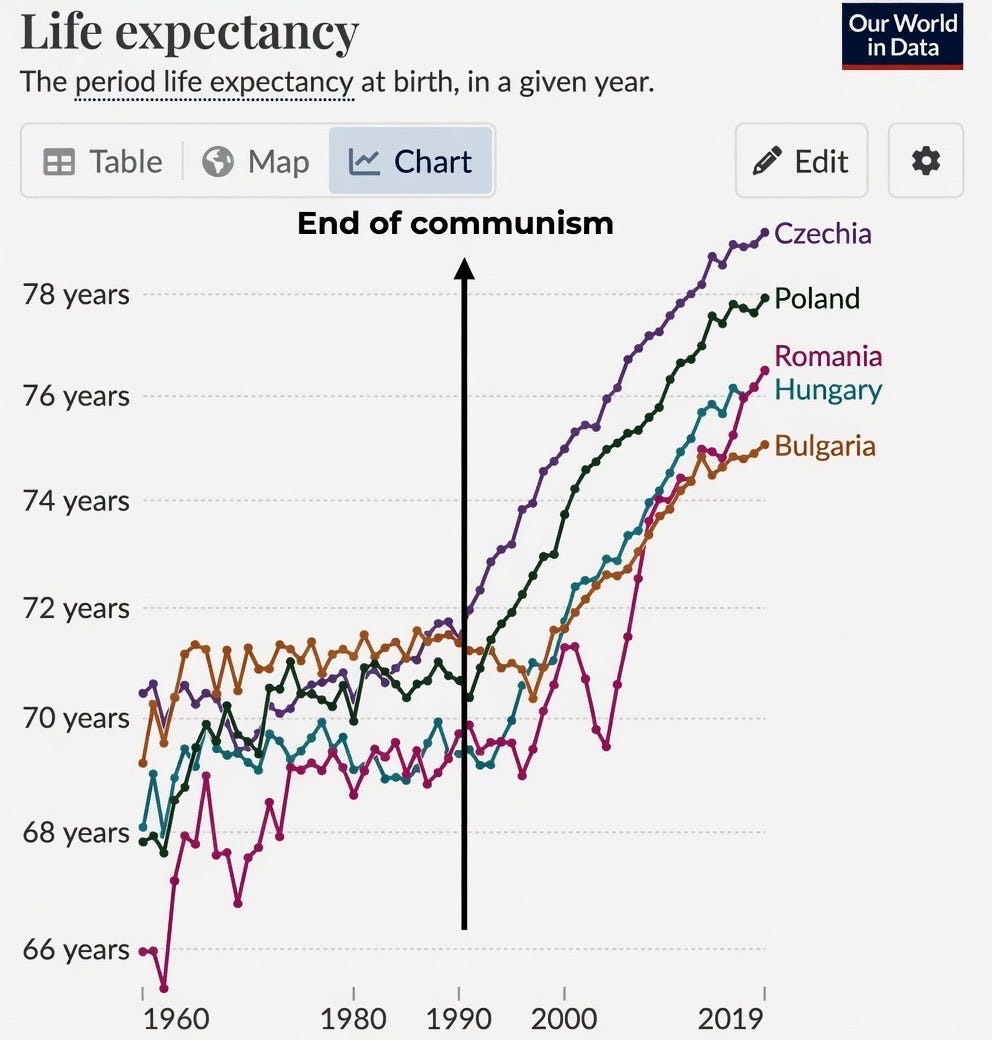
At least one main answer is obvious: we’re failing to educate young people about the global successes of capitalism, both in school and in the culture. As a story in the Wall Street Journal by Samuel J. Abrams, a professor at Sarah Lawrence College and senior fellow at the American Enterprise Institute recently noted, students are, and I’m quoting from the article: “arriving to campus not only skeptical of free markets, but openly embracing socialist ideas. The problem isn’t that students have rejected capitalism. It’s that many have never been taught how it works or why it matters.” This is a generation that was handed one (continually failed) side of a debate and had it branded education, never having the full story. In just 2 centuries, capitalism has driven extreme poverty down from over 80% of the world to under 10%, doubled global life expectancy and lifted billions out of subsistence, arguably the greatest improvement in human living standards in history. And people think this is evil!
Sober professors across the country are starting to admit the problem. Jonathan Zimmerman, a 30-year Penn faculty veteran, recently wrote in The Chronicle of Higher Education that despite universities' stated commitment to "critical thinking," they "typically present one side of an issue — the left-wing side, almost always — and call it a day." He calls it not just political bias, but "a mark of bad teaching." Predictably (and depressingly) his colleagues responded to his call for self-examination at a conference with silence, followed by a language policing session. An institution that can't handle one dissenting professor in a conference room has no business claiming it's training students to think freely. Just read this passage from the story and see if you can honestly say these people haven’t lost the plot (it’s almost like they’re cult members). It’s perfectly emblematic of the problem, and it’s widespread across our universities and in the broader culture. Yuri Bezmenov tried to warn us.
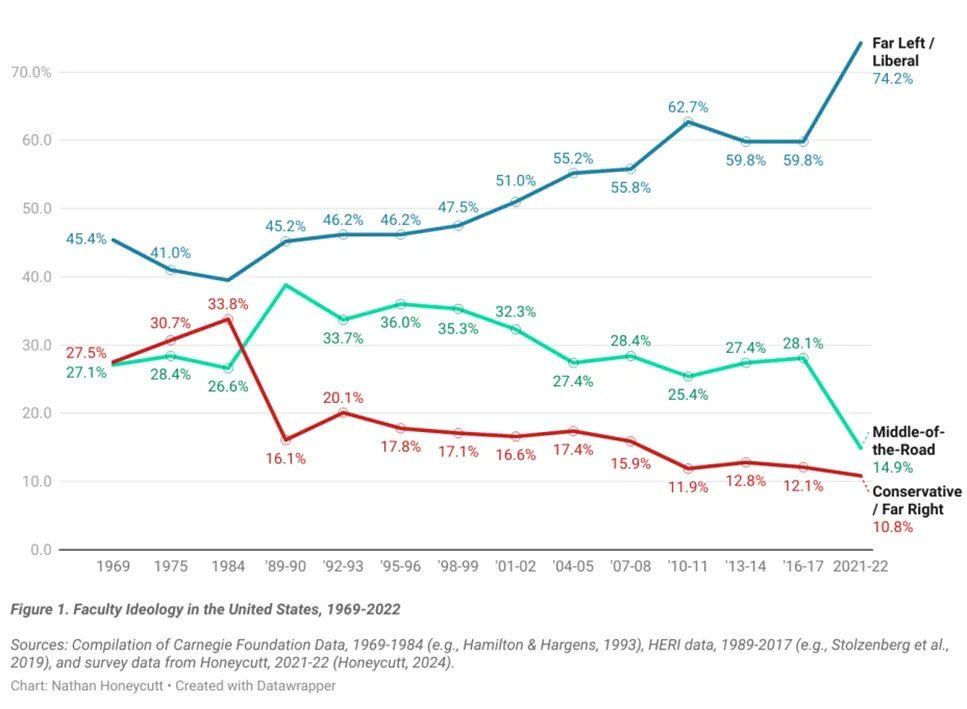
We’ve talked about the academic bias data before, where a peer-reviewed Oxford study of roughly 600,000 social science abstracts found that approximately 90% of politically relevant research leaned left, in every discipline, every year studied. And we shared analysis of Buckley Institute’s undergraduate survey, where 46% of students think nations like Cuba and the Soviet Union offer a better economic model than the United States. Cuba, where the average monthly salary is around $20. Venezuela, which sat on the world’s largest proven oil reserves and still managed to produce mass starvation, empty supermarket shelves, and a refugee crisis of millions. The Soviet Union, which killed tens of millions of its own people through engineered famine, gulags, and political terror before collapsing under the weight of its own inefficiencies. These are the destinations that central planning reliably reaches. This is real socialism, and it’s been tried.
What's particularly striking is that the socialist sympathies don't exist in isolation, they're part of a broader ideological package students absorb on campus (and online, before they graduate high school). As we've covered in the DEI era's postmortem, the dominant campus framework in many universities for the past decade has been fundamentally Marxist in structure: society divided into oppressors and oppressed, America cast as a colonial villain, and Western institutions treated as the root of all suffering rather than the source of most of the world's hard-won freedoms. When that's the water you swim in, rooting for authoritarian socialists is where you can easily end up. A generation trained to see their own civilization as uniquely guilty is naturally more sympathetic to regimes that oppose it, even when those regimes would jail or kill the very students championing them. It’s how you get kids openly rooting for terrorists and sympathetic to regimes that are openly hostile to liberal democratic values.
As commenters here have pointed out before, and I agree with them on, most students thankfully don’t grow up to become political zealots (note how it’s mostly senior citizens who even go to protests, as one example). But it’s naïve to ignore they are at the very least being nudged one particular direction, the data from pretty much every source reads this cleanly. Anyway here’s what normal students actually want, and we should work to deliver on: they want affordability, fairness, and economic security. About three-quarters of Millennials and Gen Z see the costs of healthcare, college, and housing as a serious problem for a stable society, and all of those costs have risen considerably in real terms. The frustration is real and it deserves serious engagement.
But the answer to expensive housing isn’t a system that produces no housing. The answer to unaffordable healthcare isn’t a system that produces no medicine worth having or starts promoting a system like Canada’s MAID program (so incredibly dystopian). The answer to inequality isn’t a model whose primary historical output has been equally distributed misery. Ironically, it’s forms of government intervention of free markets, poor policy decisions and artificial restriction of supply that cause most of our problems. Capitalism is great and what actually works, when our leaders and institutions don’t get in their own way.
The students aren’t the problem. The gap in their education is, as are institutions which continually spread anti-capitalist messaging and mistakenly believe their own country is evil and oppressive. A generation that genuinely understands what markets do (how they allocate resources, generate innovation, lift living standards) and what happens when governments replace them, would not be this confused. The data is in, and it’s been in for decades. Cuba, Venezuela, the Soviet Union ran the experiment at enormous human cost so we wouldn’t have to. The least we can do is teach it, so we are not doomed to suffer through this historic mistake.
Call me cloistered in my NYC bubble but I don't ever hear anyone say "look at Cuba! What a great system they have there!" Or, "wow, Venezuela was really doing something right." Or "Marx really knew what was up!" What I do hear a lot of is people frustrated and angry that .01% of the population control 90% of the economy (or whatever the number is).
As you stated, I think if there were more of an effort on the part of those controlling so much (whether politicians or billionaires) to address the very real issues of affordable healthcare, housing, education etc. there wouldn't be such a backlash toward the idea of "capitalism." But what we see mostly are very bad actors who have taken advantage of a system built by them for them — stretching and breaking the rules with very little pushback or consequences while demanding everyone else play strictly by the rules and quit complaining so much. Trust in the powers that be has eroded so far there may be no coming back.
I think people are searching for a more equitable system — one that allows for innovation, individuality, freedom (of speech, movement, etc) — all the things you hold up as byproducts of "capitalism" — but at the same time recognizes that our country and the "civilized" world has come as far as it has because of strong community — communities that believe that you are "only as strong as your weakest link."
What is sadly on full display is a system governed and run by people who simply don't like people. The resistance you are seeing to "capitalism" is more a resistance to the selfish people in power that are (or at least seem to be) only out to "get theirs." If we had more charitable, honest leaders across the board (government, business, entertainment, etc) we could expect to see not as much resistance to our economic system.
Also, yes, I went to college 20 odd years ago and don't have a great idea of what is happening on campuses now (my son is 10 but my nieces and nephews seem to be enjoying their experiences) but I certainly don't remember my professors demanding I think any one way. There was a ton of open debate amongst students and professors. The goal, it seemed to me, was to get students to break out of their belief systems and to experience and experiment with different ways of thinking — neither right or left or center or whatever. There was no pressure to think one way or another.
Anyhow, as always, thanks for getting the discussions going!
People don't even get the fundamental principle of capitalism: That every economic transaction is a win-win that creates value for both parties.