


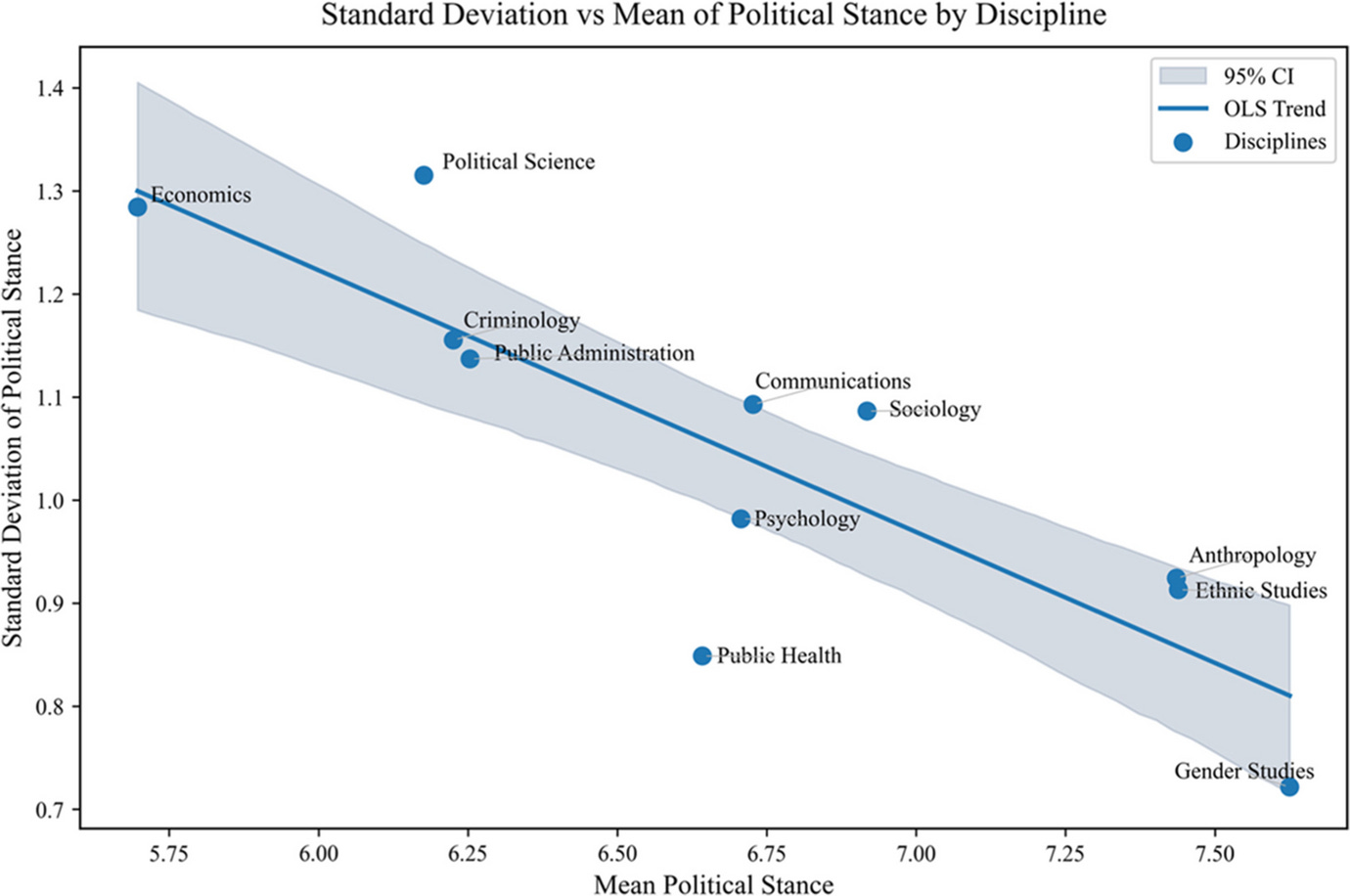
A new peer-reviewed study published in Theory and Society analyzed roughly 600,000 social science abstracts published between 1960 and 2024 across 11 disciplines, 6 decades, and hundreds of journals. The findings are something many have pointed out over the years, because it’s plain to see. Approximately 90% of all politically relevant social science research leaned left, and the mean political stance of every single discipline was left-of-center every single year of the study period. Economics was the least skewed, with a mean score of 5.7 out of 10 on the left-right scale. Gender studies clocked in at 7.6. The ideological dial only turns one direction here.
And it’s getting worse. All 11 disciplines showed further leftward movement between 1990 and 2024, with an acceleration point identifiable around 2010, incidentally right around when your social media feed started feeling like a reeducation camp. This is a documented, measurable trend that will hopefully help the few holdouts understand most of our education system that affects culture, particularly social sciences, skews heavily left-biased. Some might be fine, but this is so extreme it’s clear many of us who went through the education system have been steadily fed a specific information diet.
What makes this study harder to dismiss than the usual rebuttals is the methodology. The researcher, a doctoral student at Oxford, used large language models to score each abstract against a fixed 2025 ideological reference scale, with anchor points running from Far Right to Far Left, with Joe Biden rating as a 6 out of 10 center-left. The LLM reliability metrics were strong and the findings held across multiple alternative datasets and a battery of robustness checks. People like to continually say educational bias is “a FOX News” or “right wing” talking point but this is a very robust dataset published in a sociology journal with peer review. Not everything is propaganda, and just because someone you might not like or agree with says something doesn’t necessarily invalidate it (this is really how children or cult members process the world).
There’s another detail buried in the findings that deserves more attention than it will get: the disciplines that lean furthest left are also the most ideologically homogenous. The more extreme the orientation, the less internal dissent. So that means things like gender and ethnic studies don’t just skew a bit left, they’re essentially a monoculture. And the mechanism driving this isn’t professors changing their minds over time. It’s self-selection: new, more ideologically uniform academics entering the field, generation after generation, gradually flushing out heterodox thought. As always, the people who preach diversity are the least diverse intellectually.
This also connects directly to what I wrote about the state of college students, that the ones leaving these campuses with alarming views on free speech and soft spots for economic systems that don’t work at best and cause mass starvation at worst. When the research outputs of your professors are 90% ideologically aligned in many fields and that alignment is hardened over decades, you don’t need to formally indoctrinate anyone. The air itself becomes indoctrination. A student swimming in this water for 4 years doesn’t know they’re wet, as the famous graduation speech from David Foster Wallace goes.
The study’s author is careful to note this doesn’t prove bias corrupts research conclusions. Maybe, he allows, sustained inquiry into social phenomena just happens to produce left-coded results. That’s a generous interpretation at best and feels like something you have to say when you publish this type of research. But actual findings in the paper are less charitable: separate controlled experiments cited in the literature showed that, as brief examples, pro-immigration research teams estimated more positive effects of immigration on public programs, and historians rated abstracts higher when they aligned with the reviewer’s own ideology. So bias can bleed into answers, and into who gets published (this also explains why some pranksters were easily able to get multiple fake papers published, merely because they were ideologically aligned).
One other thing I want to point out is there’s a massive replication crisis in the social sciences, and while that itself might not always be due to one political ideology or another, the vast majority of the people responsible are in fact left-leaning. Many findings don’t replicate (often fewer than half) and effects frequently shrink or disappear. Add incentives like p-hacking and a bias toward positive results, plus ideological homogeneity, and you get a literature that looks settled but isn’t. This would not occur as often if there were more people to provide an adversarial perspective, something good science requires. And if you can’t be in the room with people who disagree with you, I’m not sure if you’re really cut out for this type of work.
Someone asked me the other day why I care about what’s going on in universities and about them remaining neutral. It’s kind of a nihilistic question because we all should care. But I’ll answer here again: it’s important academia gets things right, because the implications extend far beyond campus walls. Research informs public policy, shapes medical guidelines, and drives decisions in business and economics. When the underlying findings are fragile or skewed, the downstream effects show up in real lives, real costs, and real tradeoffs. Our institutions should strive to be politically neutral arenas for inquiry, where conclusions are earned through evidence and not aligned in advance with ideology. Scientific results should be durable, replicable, and open to challenge, not purely persuasive in the moment or convenient to prevailing views. If we lose that standard we undermine the quality of the decisions built on top of it.
What we have now is an academic ecosystem that mostly produces politically uniform research, trains students who emerge afraid to challenge professors and peers, and presents its outputs to the public as neutral expertise. It isn’t, the research says so, and the data is coming from inside the house. In a way it feels like the church has clawed back educational control, just a different kind. And if any of today’s post bothers you, I want to reiterate that both liberalism and education thrive from critique, not shying away from it. I still remain optimistic we can do better.
My experience with STEM and Business professors is that they are fairly neutral, which is what we would expect from an evidence based logic driven perspective.
You really need to stop misinterpreting studies. This study was on SOCIAL SCIENCES which is not, as you claim, "academia". Many college students go their entire college career not taking classes in social sciences.
And it is an open question about whether studying these topics makes someone more progressive, or if more progressive people choose to study these topics. You dismiss that part entirely, but it really is an open question of causality. You can't just *hand wave* details that are inconvenient for your narrative.