


“He who knows only his own side of the case knows little of that.”
—John Stuart Mill
Occasionally, a friend will tell me something along the lines of I “don’t talk about or promote liberals enough.” The subtext here is I never criticize conservatives. Don’t worry if you think this is you, I am not singling you out — more than one friend has said this to me before which makes it all the more interesting. The implication however is obvious: if you’re not evenly distributing critique, you must be biased, have some kind of agenda, etc (my only agenda is towards all of us having a better time here, to truth and reality, and achieving excellence).
Regardless, I find the framing odd and misunderstands both what I actually do and also what liberalism is supposed to be.
First, the technical claim isn’t true. I promote liberal voices all the time. I share links to and promote liberal ideas, podcasts and videos every day both in public and dark social directly to friends. Recently I even wrote an entire story recommending one of Ezra Klein’s podcast episodes as its sole content to my 15,000 subscribers. Klein’s arguably the most influential liberal thinker in America right now, shaping how educated liberals talk about politics, institutions, and tradeoffs. I vehemently disagree with him on certain things, as I do most people, because I have my own unique set of beliefs. This doesn’t stop me from sharing his ideas, or sharing ideas from conservatives who I also agree with and disagree with on certain issues. Everyone can do this, it’s not hard, and this would be legitimately liberal.
But this last paragraph is the boring part of this topic anyway, because it shouldn’t matter if I fulfill some imaginary quota of promotion (or critique). An actually liberal society revels in critique, it encourages it even.
Because liberalism — real liberalism — is supposed to be self-correcting. It’s built on doubt, pluralism, and revision. It’s never treated any sacred cow as beyond question. Mill, Berlin, Popper… the entire tradition comes from the idea that the truth survives pressure. Classical liberalism is a concept I’m pretty confident most of you subscribe to, whether you vote liberal or conservative in any election.
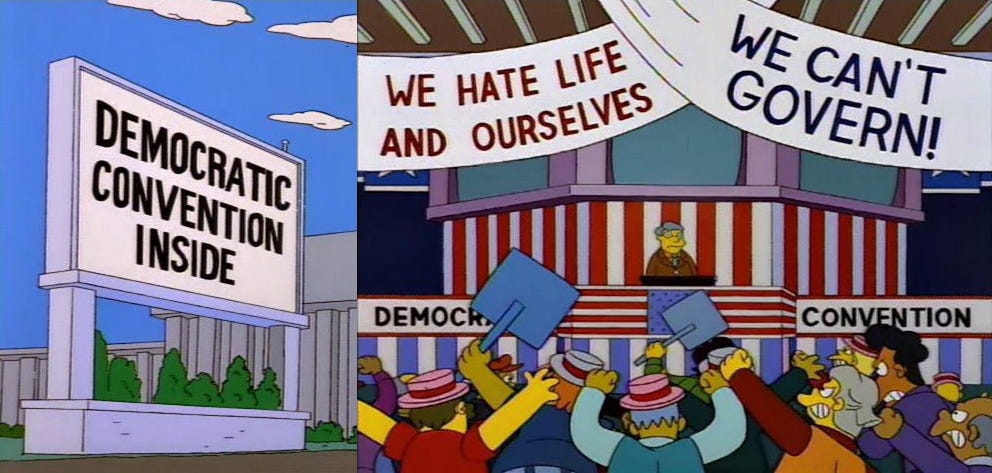
But what we have today increasingly looks a lot less like this sane variety of liberalism which very much embraces heterodox thinkers and ideas. You don’t get a new Hayek or Hume without people who are willing to dissent from orthodoxies of their time whether religious, political, or economic. Today’s leading liberals frequently feel more like managerial orthodoxy, that also constantly caves to extremist, unpopular ideas from activists who have infiltrated the party, some of whom even make it to senior governing positions. And that’s not a good sign.
If you look around, unflinchingly managerial state liberals run many of the institutions that shape elite opinion: media, universities, corporations, philanthropy, nonprofits, Reddit, even the top 50 Substack newsletters are pretty universally some strain of liberal/left. These aren’t some insurgent scrappy forces anymore. They’re the establishment. And when any worldview becomes institutional, stagnation follows unless it keeps its capacity for self-critique alive. When pushback is treated as some kind of betrayal, you simply get groupthink or worse. Honestly this is where it starts to feels more like a cult to me, or perhaps something like CCP light.
I am far from the only one to note all of this. That’s also why Tom Edsall’s recent New York Times column matters, which you should read if you haven’t. It isn’t some conservative polemic. It’s a sober analysis drawing on centrist and liberal thinkers — including Steven Pinker, Yascha Mounk, Matthew Yglesias, Noah Smith, and others — who argue that Democrats and liberal institutions have developed a serious credibility problem with the public. Poll after poll shows voters, including Democratic voters, describing the party as weak, out of touch, and obsessed with symbolic politics at the expense of material concerns. I looked around online and as usual, some people didn’t like these things were pointed out. More “don’t notice that” type commentary. But the reality is liberals cannot improve their popularity with normal people without first turning against the extremist, identitarian left who seem more psychotic than liberal. And given they are embedded within institutions, we can’t simply ignore them. Of note, I pointed a lot of this out after the 2024 election and find it interesting we’re still having this discussion.
Anyway, commenting here isn’t “attacking liberals.” It’s taking them seriously, because you understand how much they control what we see and hear in the creative marketplace, how our kids are educated, how the news is presented, etc. There’s a real case you could make that the party that actually listens to feedback from the public with an open mind deserves our trust, to drive culture, and win elections. And there’s also a case to be made the party which blocks out popular, moderate opinion and doubles down on crazy ideas deserves to lose all this. And yes, this part is very bipartisan. On so many topics open debate and discussion would have prevented us from getting to a point some kind of corrective action was taken that wasn’t fun for anyone. America wants to be sane and moderate.
What’s wild is how often even raising these ideas gets spun into a morality play about motives. Instead of debating what’s true, people want to psychoanalyze why you brought it up. The whole “why aren’t you harder on conservatives?” thing is a distraction, and a pretty revealing one. If your immune system attacks the critic instead of the claim, ask yourself why that is. Especially with people who don’t let the politics du jour control their moral compass.
My audience here for sure skews liberal. They don’t need another rundown of conservative critique, they’re swimming in that 24/7. What’s harder, and I think way more valuable, is asking whether liberal institutions are still behaving liberally. Do they still prize open inquiry over moral posturing? Do they still put individual rights before group identity? Do they still trust argument more than administrative enforcement? Do they believe biology and genetics are real? Are their personal relationships and family more important than their political tribe? Have their rank and file become openly antisemitic? Is there widespread fraud in their cities that goes ignored? Are they actively trying to censor online discussions? Do they still believe in boarders, or even countries as a concept? I could keep going, but it’s not great I even have to ask these questions in the first place.
I don’t think my politics are particularly controversial, they’re basically what any 1990s moderate liberal or conservative would’ve recognized. What’s shifted is the Overton window, not me. But somehow, that’s now read as heterodox, even risky. Which kind of proves the point.
Liberalism doesn’t die because someone from the right lands a punch. It dies when it forgets how to argue with itself. That’s what’s happening now, and that’s why people like me critique it. The political landscape isn’t that complicated by the way. If you want republicans to win, liberals should just keep being more extreme and pretend none of this is happening. If you want democrats to win, have them expel the extremists who promote anti-American ideals and act sane again like they did before the great awokening, when everyone mostly got along and the country was united. It’s not exactly brain surgery.
We classical liberals need to reclaim the term "liberalism" from the left. Twenty-first Century progressivism is increasingly illiberal, and that is now the orthodoxy of the left (and not even the most extreme faction of the left).
There are now three dominant factions in American politics: progressives, liberals, and populist nationalists. Of these, I worry that liberalism is on the defensive and fading fast in the face of authoritarian pressure from the left and right.
Another worrying factor: liberalism is primarily centered around ideas, while progressivism and populist nationalism are increasingly centered around constituencies. Ideas can be debated and exchanged. What does a free republic do with constituencies seeking power, patronage and extraction?
As someone who identifies as a classical liberal, I largely agree. Liberalism should be self correcting, and in several important areas it has not been for quite some time. It would benefit Democrats to be less ideologically rigid and more genuinely open to feedback (particularly on issues like immigration and certain aspects of trans policy), where inflexibility can alienate centrist voters and drift away from core liberal principles.
However, I think that a 1990s era neoliberal centrist you reference would be unlikely to support Trump or the modern Republican Party. MAGA politics and Trumpism do not align with classical liberalism and proudly reject it. From my perspective, pushing back against that corrosive movement is the most urgent priority right now.
Doing so absolutely requires introspection, listening to people like you, stronger candidates, and WAY BETTER messaging from Democrats (which is generally downright pathetic), but it also depends on reasonable people being willing to speak up and call out what is happening in with the Orange Elephant in the room with us.
Looking forward to next week. Cheers.