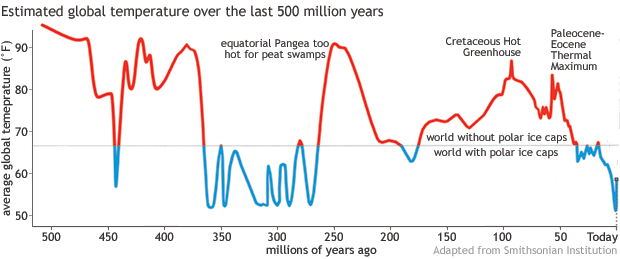
The climate is always changing, enjoy our Holocene period (everything amazing no one is happy)
A few weeks ago I wrote comparing AI existential risk to the climate hysteria we’ve all been subjugated to over the last few decades. I actually think it’s a perfect analogy, and by the way neither one of these groups will ever give an inch that things will be “okay” despite the world continuing just fine or whatever progress is made addressing either issue. The goalposts will simply move. There’s no incentive to ever say either problem is possible to “fix” when a priest class can continue to monetize this fear and use it to assert power over the rest of us. This also doesn’t mean we should do nothing about things like AI cybersecurity risk, or let big companies pollute infinite amounts haphazardly (of course they shouldn’t, don’t be daft). But the fears are all greatly exaggerated by neurotic people.
Anyway I already spoke on the AI part, let’s share some recent stories on climate change that should sober you up on this issue. I think it’s important you don’t live in fear, and I still think it’s extraordinarily reckless to promote doom in the population at the retail level for things we should solve at utility and commercial scale. Four recent pieces I read make a related case about climate change itself that you should read. Unfortunately, because it’s a religion some of you will refuse to read any of this and skip to the comments, but maybe you will consider another view? This is actually the mark of an intellectual by the way. Some would even go so far as to say it’s morally responsible to change your mind when presented with good arguments. As usual, I’m going to present you some.
The question to ask today isn’t whether ‘climate change is real’ (the Earth’s climate is always changing, and was long before us, there’s clear evidence of this) but whether we’ve been conditioned to vastly overstate its importance, and whether the policies pursued in its name are actually making the world better or worse. If you live in the EU or UK and spent the summer without HVAC because of some beaurocratic policy decision, we know how you feel already.
But just because something is happening and has some negative effects, it doesn’t mean that we should spend a lot of time and energy worrying about it. We need to ask how big of a problem climate change is in the grand scheme of things, and whether the solutions advocated for are worthwhile. This is especially true since we have entire nations adopting climate goals that slow economic growth, and serious people put forth proposals that would keep some of the poorest people in the world in crushing poverty for much longer.
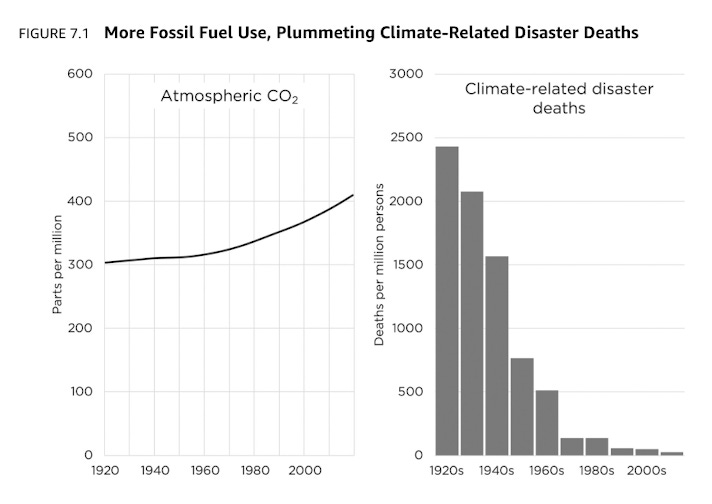
If you’re going to look at one chart to understand why we shouldn’t worry much about climate change, it is the one below, which comes from Alex Epstein’s book Fossil Future.
For decades, environmentalists have said that climate change endangers human well-being and warned of natural catastrophes. They were right that more carbon dioxide in the atmosphere would lead to higher temperatures. Yet they were completely wrong that it would directly hurt humans all that much.
Michael Doran on “China’s Net Zero Advantage”: As published in Tablet Mag, the emergency label is purely about politics and has nothing to do with the climate.
That label has political utility. It softens some of the opposition to a project for restructuring labor, housing, transportation, investment, race, consumption, and industrial policy. It also encourages the public to judge the project by the standards of an emergency rather than the standards of ordinary politics, where such a program would have to win an argument on its merits. Climate screams “fire” so that socialism can deliver the fireman.
If the fall of the Berlin Wall discredited state ownership as a comprehensive economic program, it did not inhibit the left’s belief in its historical rightness or its quest for centralized state control. In the post-Cold War era, climate politics supplied a new moral rationale and a new set of instruments for these aims.
Sir Richard Dearlove on “Energy Security: Blowing in the Wind”: As the former MI6 chief says in the GWPF’s 2026 annual lecture, Britain has been so fixated on climate that it missed the bigger threat.
As my title suggests, the UK’s climate stance/policy currently lacks security anchors; and the answer, my friends, is certainly not blowing in the wind. It has been more a finger in the wind. As a country we have been drifting and we are dangerously exposed. The most pressing threat to this country is not man-made climate change, as Ed Miliband and now Dr. Fahnbulleh, avidly supported by legions of so-called experts, would have us think. There is no simple link between cancelling Rosebank and stopping wildfires. To believe such a thing is the height of naivety, or ignorance of the science, or conviction akin to religious belief.
The country has lost the industrial capacity to reproduce its own energy system, so that uncertain access to equipment and spares (for example generators and transformers) is a graver and more chronic danger than a temporary shortage of gas.
We are not the victims of a conspiracy to make us vulnerable. We have quite casually done this to ourselves. We have as a nation negligently wandered close to a cliff edge and the adversaries I have described stand ready to help us over it; and the fragility of the present international order enhances the risk.
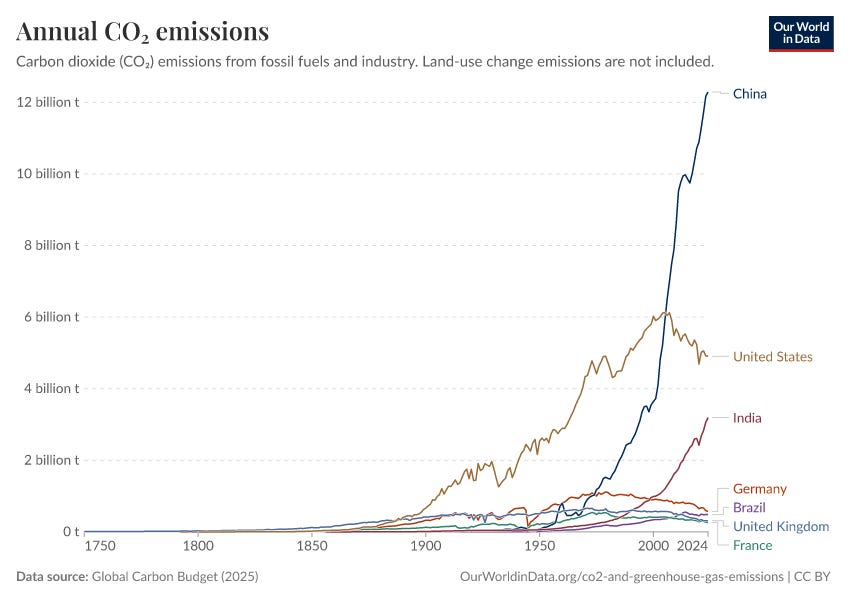
Imagine thinking anything the UK or Germany (talk about them in a bit) did would really matter here
Noah Kaufman in “The Climate Question That Economists Cannot Answer”: Kaufman examines how climate economics can lend a veneer of scientific certainty to policy decisions that depend heavily on assumptions and political preferences.
Despite this, the most visible use of climate-economics analysis today is to advance extreme arguments that most economists do not agree with. How did that happen? One important reason is that policy makers want these damage estimates. Elected officials want to show that the benefits of their preferred climate policies exceed the costs. [...] Small changes in assumptions [...] can yield results that appear to justify virtually any policy response.
People hate the idea of knowing they have been deceived or manipulated or perhaps the issue wasn’t exactly what they thought. The climate issue has religious-like beliefs from people who as you know are not very rational. Or activists like Greta who foam at the mouth about every “current thing” issue without actually understanding them.
But I think pretty much all of us have been made to think the climate issue is something absolutely dire in our current lifetimes. And that if we didn’t do small things in our personal lives like use paper straws (might actually be worse for the environment btw) or big things like have fewer children we were evil or complicit in some existential issue. But that’s just not the case, and we actually can solve it without living uncomfortably. We should acknowledge when issues of our time, however real, are also used to gain power over ourselves or our nations by those who do so in order to nudge our behavior in some way they see fit. It’s naïve to ignore the climate is one of those issues, and AI will be too.
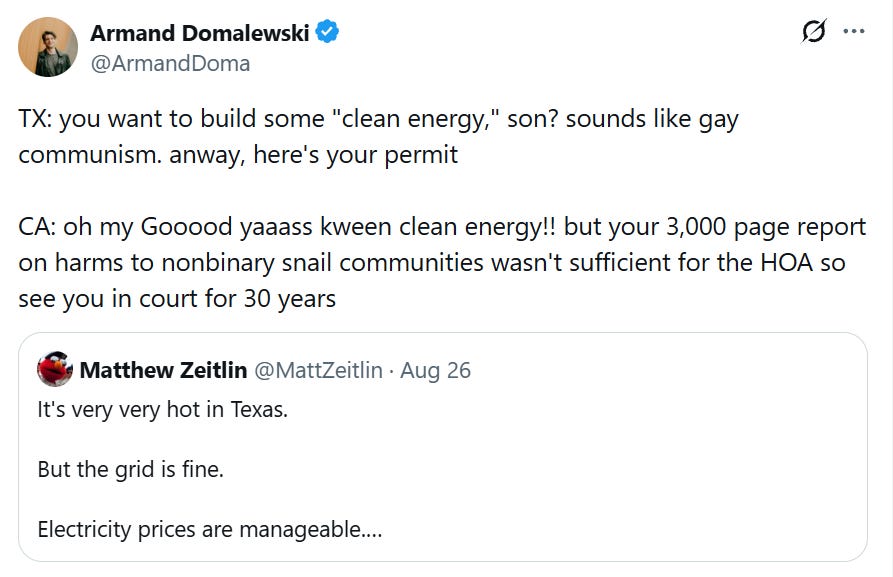
Post from Armand, a San Francisco liberal who doesn’t drink their kool aid
The ironic part of all this is where I live Texas, without even having a formal climate mandate, is building more green energy infrastructure than anywhere in America. And it’s at utility scale so everyone is being green without really trying. Meanwhile, the places most heavily regulated with the loudest “protect the Earth” views frequently have the least productive new carbon-free infrastructure buildouts.
For example, we see places like the UK and Germany commit economic Seppuku by bowing to the “green” climate zealots, while having to turn back on coal (high emission energy). None of it makes any sense, they’re actually increasing carbon in the name of the climate by shutting off nuclear (green, elemental energy). If we stop listening to these idiots we’re going to solve this stuff where the market is free to act, and anyway it ultimately makes the most sense for solar and nuclear to power most of the world.
It turns out, the so-called “environmentalists” are actually evil and the people focused on building and innovating carbon free energy are the good guys. This is why environmentalists make such great movie villains as others have noted (they legitimately want to make your life worse). Also, I really just don’t worry about the climate, again it’s simply not a thing that I care about at the retail level. What does bother me are things like PFAS chemicals, actual environmental pollutants that are honestly unnecessary and we have perfectly good substitutes for. Some carbon emissions are fine, the Earth will filter them. It’s not a problem, we do not need to have “zero” (this would mean no humans would exist).
Finally, and this is endlessly amusing, the same people constantly crying about the climate are currently fawning over a “we hate Elon” documentary that (I think unintentionally) showcases everything he’s accomplished in service of reducing carbon emissions. This is while these amoebas lecture everyone else professionally yet do nothing themselves other than saying “progress and technology bad.” We’ve talked about them before and pointed out the hypocrisy, you simply can’t take them seriously. As always, the Randian heroes were fake but the villains are absolutely real.
The world is going to be fine, the fewest people on record are dying due to climate-related deaths, first world countries have developed efficient technologies that could only be dreamed about 50 years ago, all while the media covers everything like it’s end times. Go live your life, buy an EV, have more kids, the real issue presented here is actually to people’s mental health by consuming too much doom porn (which never comes true) or letting meddling bureaucrats halt progress.
Texas and California are both funny in their own ways.
California spends years debating and fighting if they should do anything burning a huge cash pile brain damage along the way.
Texas says they hate green energy, but are first in line to take advantage of the sweet tax credit benefits, which has resulted in a booming green energy projects coming online taking major stress off the fossil fuel grid.
Everyone is a massive hypocrite when it comes to money and their old takes.


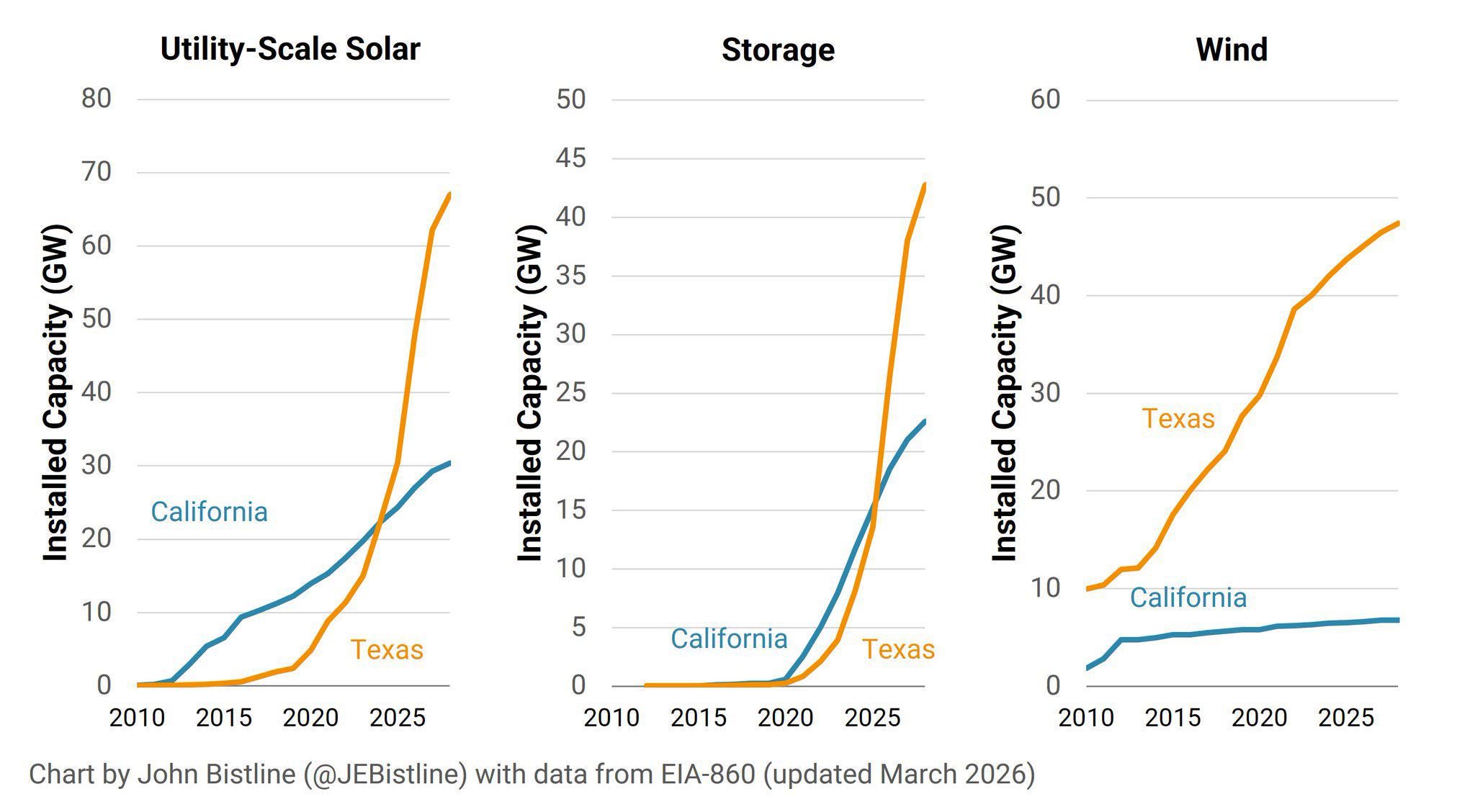

Texas and California are both funny in their own ways.
California spends years debating and fighting if they should do anything burning a huge cash pile brain damage along the way.
Texas says they hate green energy, but are first in line to take advantage of the sweet tax credit benefits, which has resulted in a booming green energy projects coming online taking major stress off the fossil fuel grid.
Everyone is a massive hypocrite when it comes to money and their old takes.
Beautiful Scotland is covered with bird killing spinning monstrosities