


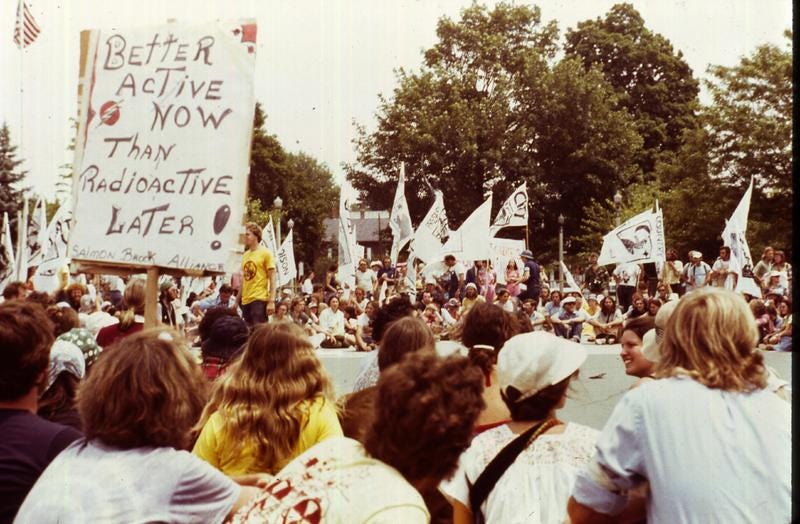
There’s a series of events that happens in America every time we want to do anything new. Someone proposes building something useful, and immediately a coalition of NIMBYs materialize, clutching save the whales posters, demanding “more studies,” and generally making the permitting process so miserable that whoever wanted to build the thing goes somewhere else or gives up. We’ve seen this movie with housing for decades, in fact I’ve even written on it before. The sequel is data centers, and the script is nearly identical. Several of you asked me to cover this topic, so let’s go into some more detail today, as the panic is clearly manufactured (and quite silly).
Opposition to data center developments across the U.S. has exploded over the past year. One tracking site shows that while only 8 different local and state government efforts to enact moratoriums or bans were active in May 2025, that number has swelled to 78 in just a year’s time. Clearly there’s coordination here. And like its housing NIMBY cousin, it wraps economic protectionism and reflexive anti-progress sentiment in the language of “environmentalism.”
The Utah situation is the clearest example of how unmoored from reality this has gotten. Online posts claimed a new AI data center in Utah would raise nighttime temperatures across the state by more than 20 degrees, with some versions citing 28-degree increases. This is pure fiction being shared online, with people simply lying to try to create fear of progress. For reference, wildfires burning thousands of acres of land reach temperatures near 2,200 degrees Fahrenheit and still don’t shift a state’s temperature by 28 degrees. The people sharing these insane stats are clearly not thinking critically, which is the defining condition of any modern online panic. I don’t know if they are even capable of independent thought, much of this happens on TikTok after all.
Who feeds this stuff? Two parties are clear: engagement farmers who figured out that “tech is poisoning your water and cooking your state” generates online engagement, and adversaries who have a direct strategic interest in Americans turning against the infrastructure of their own technological future. China is racing to build data centers and they’re not holding community forums about them. If you can convince a significant portion of the American public building compute infrastructure is an environmental crime, you don’t need to outcompete us. We’ll just do it to ourselves. In 2025, local opposition to AI data centers led to the delay or cancellation of projects totaling $156 billion. That is an extraordinary amount of infrastructure to forfeit to a manufactured panic.
On the water front, researcher Andy Masley did the actual math that nobody in the outrage ecosystem bothered to do. His conclusion, covered in Pirate Wires: data centers are not taking all the water, they’re not projected to, and sometimes they’re even improving water access. He went further and audited a popular book making the rounds that claimed a data center was using a catastrophic amount of municipal water he found the author was off by a factor of 4500, apparently confusing cubic meters for liters, making the city appear to use 1,000 times less water than it actually does. This is the research that gets turned into memes and Senate testimony. On the national, local, and personal level, AI is barely using any water, and unless it grows 50 times faster than forecasts predict, this won’t change.
As for electricity: yes, data centers use power. So does every factory, hospital, and car charger you’ve ever benefited from (and yes, you benefit from data centers too, the fact that you use the internet to read this already proves it). A University of Southern California professor recently presented research showing data centers are responsible for only a 0.007% to 0.08% increase in residential power bills. The hysteria isn’t remotely proportional to the impact. And in many cases, they are now bringing their own power supply and improving grid infrastructure.
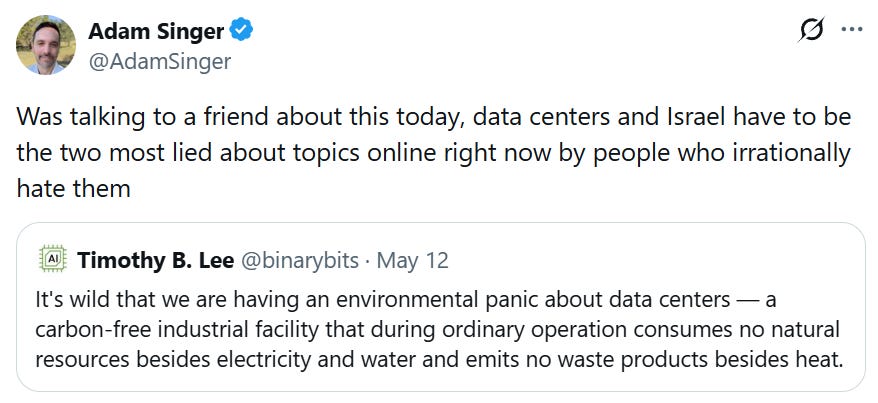
I can’t help but notice the resurgence of antisemitism we're seeing also follows the same playbook as the data center panic: enemies of progress, real or foreign, spread disinformation until an irrational mob forms around a fake threat. Throughout history, Jewish people (or now Israel “controlling our government”, it’s really the same thing) have been blamed for whatever people feared most: controlling finance, corrupting culture, running institutions. The specific accusation shifts but the template is constant. Data centers get the same treatment. Poisoning your water, raising your temperatures, stealing your land. The constant is a common so called “evil” enemy to rally the mob that is easily stirred to fear, even if that fear is not real.
What we’re actually building with this infrastructure is the equivalent of the electrical grid in the early 20th century. People opposed that too: the noise, the lines, the unfamiliar hum of something new and large. It seems almost comical now. The people fighting data centers today will look the same to anyone reviewing this period twenty years from now, when AI-assisted medicine is diagnosing diseases earlier and the compute that made it possible was built despite the protests, not because of them.
Communities already have zoning laws, they have noise ordinances, they have environmental review processes. The top complaints from communities near potential data center locations include noise and light impacts, land use, water use, infrastructure and traffic, energy and grid capacity, and environmental worries, all of which are addressable through the regulatory frameworks we already have. The answer to “do it right” is not “ban it everywhere”, which turns the process into a weapon (the exact NIMBY playbook).
The enemy here is a fake, manufactured villain assembled from bad statistics, engagement-optimized panic, and the same reflexive opposition to progress that’s made housing unaffordable and permitting a decade-long ordeal. Meanwhile, other countries are building. The question isn’t whether this infrastructure gets built, it’s whether it gets built here. If not, we could easily lose our status as a top competing economy, and that’s something you should actually be concerned about.
I feel like another part of the panic though, is people's fears about A.I. It has been stealing jobs and causing problems for artists. Maybe not on the scale that most people think, but it is happening. And its also causing problems with learning in schools (I am married to a teacher and good friends with another so I see this through their struggles with it). So part of the equation here is that real people ARE being affected in a negative way, and lots of people see data centers as expanding a thing that has taken something meaningful away from them or a loved one.
I think that your other points on the matter are most likely true (I intend to research this myself after commenting because I want to see for myself). But I do think you need to add the above to the mix. In all of this, emotions play a strong part, but not all of them are invalid.
The AI companies manufactured this outrage themselves by talking about taking everyone's jobs, massive unemployment, etc. They wanted to be see as changing the world and they are, but a lot of folks like the world the way it is right now.
We'll see if it's too late to turn around the marketing of AI and make it more acceptable. If not, it's the fault of OpenAI, Anthropic, et al for creating this mess.