


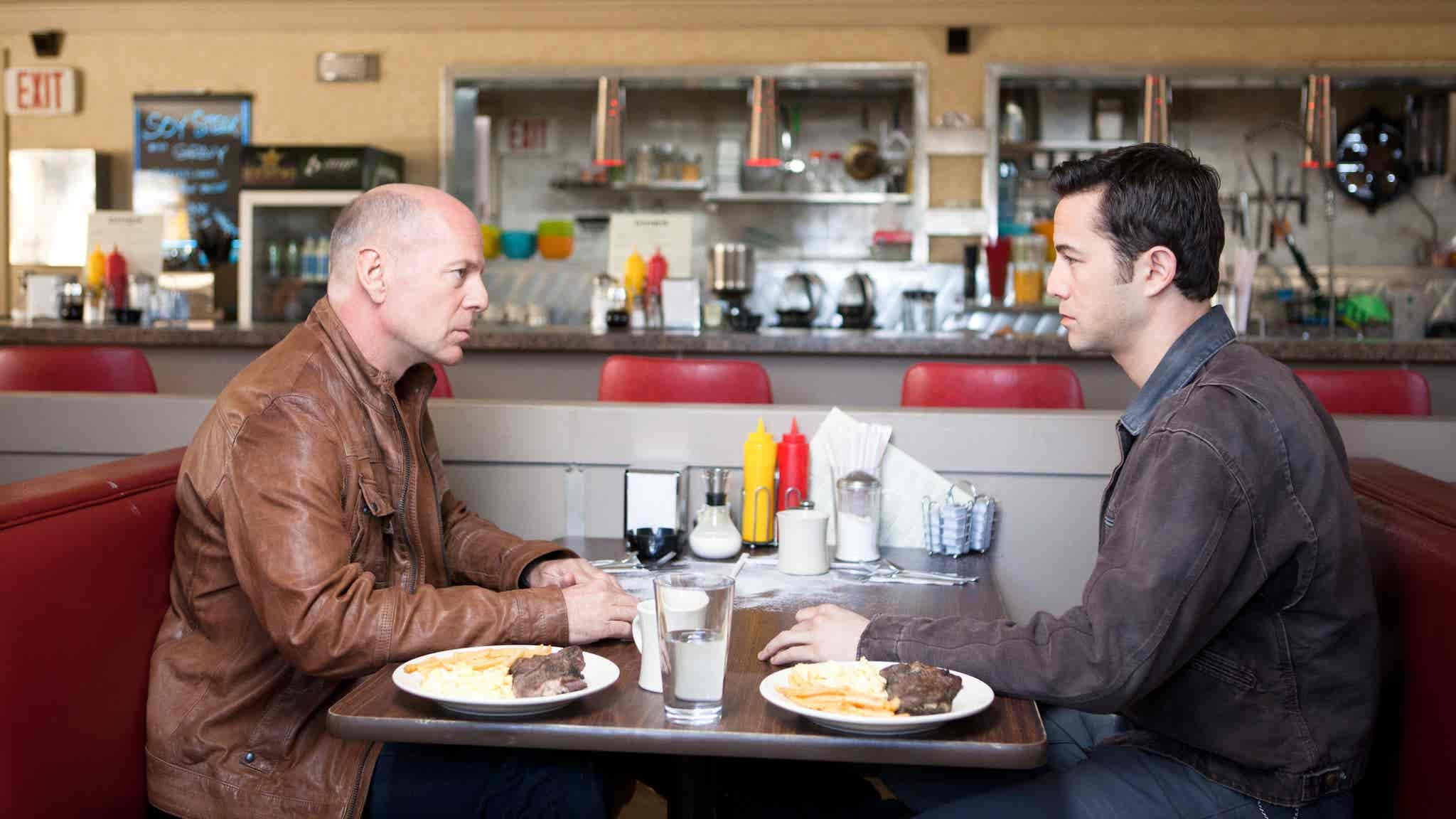
Light spoilers ahead for Looper, go watch it if you haven’t and read this one after.
I watched the movie Looper the other weekend at the suggestion of a friend, and immediately knew I had to write about it. The flick gets categorized as a time-travel thriller, which is technically correct but sells it very short. The protagonist, young Joe, works for a criminal syndicate but methodically stacks his pay and runs the job cleanly unlike his peers, deferring gratification toward a specific endpoint: the day he retires, cashes out, and disappears to Paris to “live well” (do drugs and party). He’s deliberate, works carefully, and has a plan. But the end goal is pure hedonism, the good life as a destination you reach once you’ve finally saved enough at something you don’t really want to do. This all sounds really familiar doesn’t it? A lot of people are running this exact playbook right now in our actual reality, trying to score a big payday to “exit.” You see people doing this via day-trading, crypto moonshots, publishing make money online content, working jobs they hate, all with the goal of stacking enough money to finally live. Young Joe would fit right in on fintwit.
Then old Joe shows up: broken, haunted, driven by a grief young Joe can’t yet imagine, and the plan reveals what it always was: optimizing for the wrong thing entirely. Because what actually changed young Joe wasn’t the money, the escape, or Paris. It was love. A real thing, built with another person, that gave the future self something worth protecting. And none of that was in the plan, because you can’t really put something like that in a plan. You can only become the kind of person it finds (in the case of the movie, it was just by chance).
The diner scene where both Joes sit across from each other is the movie in miniature. Two versions of the same person, barely recognizable to each other, shaped entirely by the intervening decades. Old Joe doesn’t hate young Joe even if he’s frustrated with him. He simply knows exactly how little young Joe understands about what’s coming, and how badly the math of a life built purely around high risk accumulation and exit eventually fails you.
Most people are young Joe, they treat their future self as an abstraction. A person who will eventually deal with things. Someone who will get fit, sort out the finances, build career capital, develop the relationships worth having and the skills they really want to have …later. The future self becomes a kind of debt repository, and most people think ‘well, he’ll deal with those problems.’ They dump the consequences of present decisions there and don’t think too hard about it, because their future self feels far away enough to be theoretical.
Except they’re not theoretical. You will be that person, and you will live inside the accumulated residue of every decision you’re making now. The body you’re in at 55 is being built today. The financial position you occupy at 60 is being constructed incrementally across decades of small choices that compound in one direction or the other. The professional reputation you carry is being written by how you show up now, when fewer people are watching and the stakes feel lower. The skills you want to have to write a screenplay or compose an album need to be nurtured today if you want to do something meaningful there tomorrow. There is no reset, there’s only the loop closing.
This is what makes compounding such a useful concept beyond finance, though it works there too, dramatically. Neglect compounds, debt compounds, poor health compounds. So does skill, reputation, fitness, and emotional resilience. Even the way you make your money matters, it tends to inform how you act in other areas. And the math doesn’t care whether the inputs are positive or negative, it just runs. The only variable you actually control is which direction you’re feeding it.
What’s most interesting about Looper philosophically is that young Joe’s problem isn’t recklessness, it’s that he’s built an airtight case for a shallow destination. The self-control crisis is largely this: the present self reliably overweighs immediate reward and underweights future cost, and modern life is engineered to exploit exactly that tendency at every turn. But young Joe isn’t even failing at self-control. He’s succeeding at it, just toward the wrong end (I wrote about a hauntingly perfect real-world example of this before, it’s emblematic of so much). This is a different and more interesting problem, the exact one we see people suffer from constantly.
The good news is the intervention isn’t complicated, it mostly requires asking one question with some regularity: is what I’m doing right now making things better or worse for the person I’m going to be? Don’t do this in an anxious or pretentious way, just as a genuinely orienting question. Am I building something or consuming it? Investing or extracting? And more importantly: what am I actually building toward, and is that thing worth the compounding? If you’re merely trying to enact the circumstances for a pleasurable, hedonistic life you don’t have to do anything in, you should definitely think through that more. The check always comes due, and the longer you wait the more pain you’ll suffer later. Arriving somewhere with enough money to pay bills but no friends, no creative skills, no interests, no spouse might not be fun. You’ll be behind just in different ways, and might find money alone isn’t even the most difficult thing to make up time for.
Most people know the answer when they ask it. They just don’t ask it very often, and they refuse to answer it honestly. Old Joe, by the time we meet him, is trying to fix his accumulated damage through sheer force of will across a time loop, the kind of solution available only in a science fiction flick. In real life there’s no closing the loop on a past version of yourself, you just carry forward whatever was built. The better intervention is the boring one: become the kind of person your future self would be grateful for, consistently, before it becomes urgent.
Young Joe eventually figures this out. It costs him everything. You don’t have to wait that long.
I only saw Looper once, but I still think about that movie. Such a great concept for a story.
Compounding is one of the most important concepts to grasp for a satisfying life.