


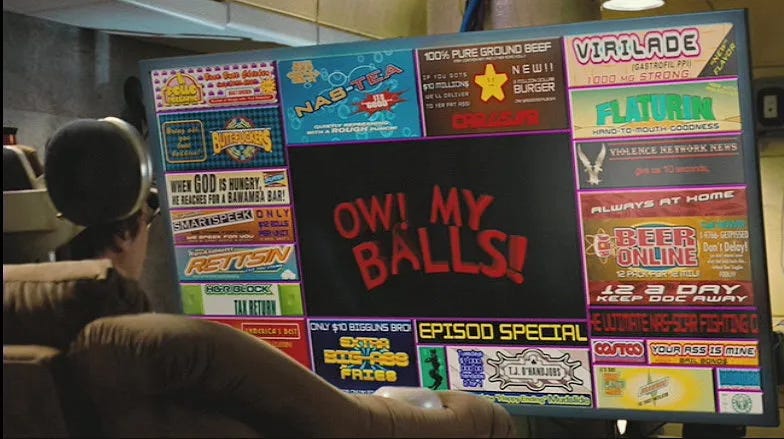
Rose Horowitch’s new Atlantic cover story is a fairly comprehensive read of something I’ve been writing about for a while in various ways: Americans on the whole are getting dumber as we in fact do get richer.
The numbers are fairly stark, we’ll go through some of it in case you can’t access the essay. The share of Americans reading for pleasure dropped 43% between 2004 and 2023. Less than half of us read books anymore, even as we’re drowning in text messages, captions, and posts. NYT bestseller sentences have shrunk by a third over the past century (a proxy of complexity people are able to process, even when they do read).
The comprehension data shared here is also wild, almost 30% of adults can’t paraphrase or draw an inference from a few pages of text, up from under 20% in 2017. That feels way worse than people reading less, as it’s actually people losing capability. And it’s compounding downward: 4th and 8th grade reading scores have slid for a decade, and the share of 13-year-olds who say they rarely read for fun jumped from 8 to 29 percent since 1984.
My favorite, most damning part is the Harvard anecdote: some students now genuinely believe professors are “being unfair” by making them get information from a book instead of a summary, as if reading itself were an arbitrary obstacle rather than the whole point.
I’ve made the underlying case before: some friction is good. Reading a book is friction by design, and that resistance is exactly what builds the capacity to hold a complex argument in your head. Skip the struggle and you might save time but you also skip the workout. This is the same instinct I described in resist slop world: the outsourcing of the human parts of thinking to whatever’s easiest, until the muscle that used to do the work atrophies from disuse.
The downstream effects of this have broader implications for all of us. I’ve written before about how little today’s undergraduates actually know about history, and how comfortable large numbers of them are with censorship and even political violence. It’s hard not to connect that directly to a generation that never built the stamina to sit with a difficult book, wrestle with a hard argument, or hold 2 competing ideas at once long enough to reason through them. You can’t Socratic-method your way through an issue if you’ve never trained the underlying muscle on anything longer than a meme or Instagram photo caption.
The concerning part I took away from all this isn’t purely that people are reading less. It’s that an entire generation is growing up incapable of the deep, linear thinking that reading trains, at the exact moment AI can hand them frictionless summaries instead. Convenience and comprehension are trading off in real time, and convenience is winning.
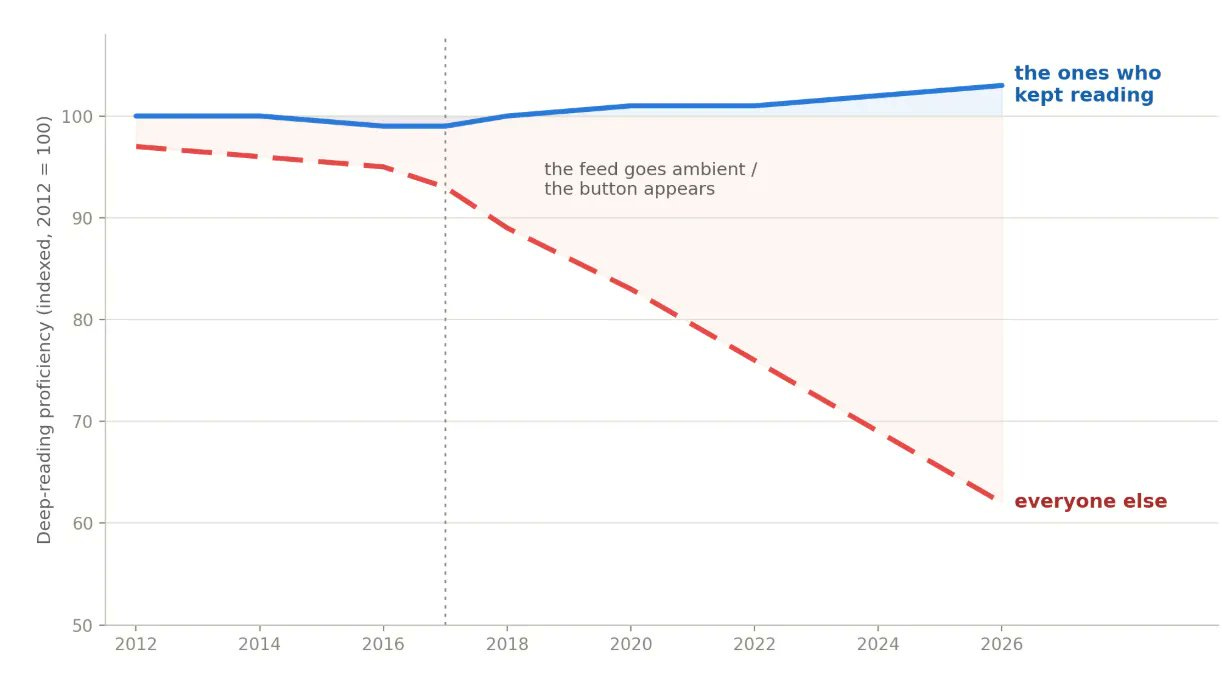
This all makes me think we’re witnessing the beginning of a massive gap between people who read deeply (and can think deeply) and people who don’t. A huge new IQ study I saw recently brings this together. People who were read to more as children score meaningfully higher on IQ tests as adults, and the effect holds even after stripping out wealth and class. Reading early builds intellect that compounds.
The same dataset shows what happens on the other side of the trade. Lower scorers report more TV watching, more celebrity gossip tracking, more lotto playing, and more trouble filling out a complicated form. Most tellingly, they find it more boring to just sit and think. This is really the entire regression in one finding. The capacity to sit still with your own mind, without a feed refreshing in front of you, is itself a marker of the thing we’re losing, and the thing short-form content trains people out of.
The study also found that people with higher measured intelligence score much higher on “actively open-minded thinking,” the willingness to sit with evidence that contradicts what you already believe instead of closing the loop early. This describes a trained skill, and it’s the exact skill a difficult book forces on you page by page.
Interestingly, the same study found people with higher IQs are better at spotting pseudo-profound nonsense, grammatically correct sentences that sound deep but mean nothing. This is precisely the skill you need to survive an internet full of AI-generated summaries and synthetic insight. The people who never built that detector are going to be the easiest marks for the next decade of slop merchants.
AI has, perhaps counterintuitively, made long form reading more valuable since it’s now more scarce. The people who can wrestle with long-form ideas, synthesize information, and think critically will use AI as a force multiplier (or know when to skip it entirely). Those who rely entirely on summaries, short-form content, or AI to do their thinking for them will find it increasingly difficult to separate signal from noise or really provide much value to the world at all (these are the people who AI genuinely can replace). The future will be divided between people who can evaluate, question, and build on what AI produces, and people who simply accept it uncritically. Those capable of deep reading will possess a truly unfair competitive advantage.
Will the economy reward the advantage?