



We’ve written before about how doomerism is a mental illness, a hardened state of despair no amount of good news can penetrate. We’ve also written about permabears, those constitutionally committed to the dark side of every ledger, for whom every green shoot is a trick and every recovery is a setup for the next disaster. Depression about life, economics, anything really is a choice. You alone are responsible for your own happiness or sadness. It’s called being an adult.
Annie Lowrey at The Atlantic has combined both pathologies into a single 3,000-word essay titled in a way that infers all is doomed, forever. She’s coined the term “permacession,” a permanent recession that, by her own extensive admission in the very same piece isn’t actually happening, in an economy she herself describes as “pretty darn great.” In America, the country that has lapped the entire developed world economically for two straight decades.
Let’s go through her story point by point, because when you see what’s really happening if you were actually upset about things you should be less so after.
Claim: Consumer sentiment is at its lowest since 1952. This is very alarming.
University of Michigan sentiment surveys measure feelings, not facts. Feelings are downstream of media consumption, tribal identity, and what your TikTok algorithm decided to show you this morning (still suggest deleting it). The author eventually cops to this herself, she just buries it in paragraph 15 after spending paragraphs 1-14 treating the sentiment data as gospel.
You cannot simultaneously argue sentiment surveys are capturing some profound economic truth AND that social media is poisoning people’s perception of economic reality. You have to pick one, and she picks both.
Claim: People feel worse now than during the Great Inflation, the Volcker shock, the 2008 financial crisis, and the early COVID months.
This is actually a more interesting data point in the piece, and the author basically shrugs and moves on after noting it undermines everything she thinks she understands. If people felt better when mortgages were at 18.6% and the unemployment rate was flirting with 15%, the obvious conclusion is that sentiment surveys are measuring something other than economic conditions. Political polarization and media negativity are the variables that changed. But these are hardly economic facts.
Claim: “I found that my usual explanations fell short.”
At least she admits it, credit where it's due. Unfortunately her response to this admission is to invent a new word ("permacession") instead of updating her priors. A scientist runs an experiment, the results contradict the hypothesis, and instead of revising the hypothesis she names the anomaly herself and brands it terminal. This is precisely the pattern we wrote about recently with biased academic research: the conclusion comes first, the framing follows.
Claim: The economy is delivering real improvements but people won’t admit it. This is a serious problem.
So she’s saying things are getting better? Yes. Inside her gloom piece is a genuinely brave acknowledgment that the American economy is working for most Americans. The Federal Reserve’s own data shows the net worth of the bottom 50% has risen dramatically in the 2020s, up from roughly $1.9 trillion pre-pandemic to over $4.2 trillion today, more than doubling. Near-full employment. Low-income wage growth outpacing high-income wage growth for an extended stretch. Americans spending more on restaurants, vacations, cars, and wellness. The median household net worth hit $193,000 in the most recent Federal Reserve survey, up 37% from 2019 in real terms, the biggest jump on record.
The author knows the economy is not in complete shambles. She just won’t let herself feel okay about knowing it. Physician, heal thyself.
Claim: Europe’s GDP per capita was 77% of the US in 2008. “Now, the continent is half as productive.”
This is one of the most staggering economic facts of the 21st century and it gets one sentence in a doom piece. As of 2024, the US GDP per capita sits around $86,000. France is at $39,000. The UK is at $48,000. Mississippi, America’s perennial last-place state by this measure, has a higher GDP per capita than France, the UK, Italy, and Spain. The American economic model: messy, unequal, chaotic, and constantly criticized by unemployed people in the EU, has so thoroughly outperformed every major allied competitor that France and Britain would be among America’s poorest states if you transplanted them here. Even after adjusting for purchasing power, the US runs about 38% higher than the EU average, and the gap is widening every year. This is the part where a normal person says “holy cow, we’re doing something right.”
Claim: Inequality is the fundamental problem. The top 10% make as much as the bottom 90%.
Inequality is a real issue worth discussing. But it’s also been a fixture of American life for decades, and the piece offers no real explanation for why it would suddenly be causing record-low sentiment specifically right now, when by the author’s own admission low-income wage growth has outpaced high-income wage growth in recent years. The inequality argument actually cuts against the permacession thesis if you follow it honestly.
And if you turn off social media, which has industrialized the constant comparison of your life to everyone else’s curated highlight reel, inequality stops dominating your daily emotional experience. Comparison is a thief of joy. We’ve written about this. The fix is really easy, deleting Instagram.
Claim: The cost of housing, child care, health care, higher education, elder care has crept up faster than inflation for two decades.
This is true, and worth being angry about. You know what caused most of that? Massive government intervention, regulatory capture, and the deliberate restriction of supply. This is a policy failure people mistakenly believe is a market or “capitalism” failure. The solution is to build more, regulate smarter, and get government out of the way of housing construction (NIMBYs are the actual villains, we’ve covered this).
Diagnosing the problem and then using it as fuel for generalized economic despair rather than specific policy reform is the Atlantic’s entire model.
Claim: Republican/Democrat economic sentiment gap has grown from 20 points to 50 points. This is distorting everything.
This is the most honest and important observation in the piece. Partisan identity is now so fused with economic perception that roughly half the country will describe the economy as bad regardless of the data, depending purely on which party holds the White House. If you don't believe me, note that Republican sentiment cratered the moment Biden was inaugurated and skyrocketed the moment Trump won, with zero underlying change in economic conditions at either specific point. This is a psychology and media phenomenon.
And if sentiment is 50% political theater, then sentiment surveys should be weighted accordingly when making policy, or writing 3,000-word Atlantic essays about economic despair.
Claim: Sam Peltzman at UChicago found a “happiness crash” — a historically unprecedented decline in self-reported happiness since 2020.
It is fascinating research, and here’s the variable that explains most of it and that the author dances around without landing on: smartphones + social media. The happiness crash begins exactly when algorithmic social media achieved mass adoption and started optimizing for outrage engagement. Jonathan Haidt has been screaming this from the rooftops for years with extensive data. The economy didn’t make people unhappy, too much screen time in the attention economy did. These are very different problems with very different solutions.
Claim: “We never got back to socializing in person after COVID.”
Actually, the more I think about it, this one is just wrong. No one is wearing masks anymore, airports are full, people are going to concerts and traveling. For the people who are still socially isolated, this is pretty sad. But again, not an economic problem. An atomization problem, a cultural problem and a device addiction problem. Will be solved in time.
Claim: TikTok and Instagram are giving people “money dysmorphia” and a distorted sense of economic doom.
She looked up “how jobs are doing” on TikTok and got fed crypto spam and AI apocalypse content and, I cannot stress this enough, she included this as evidence in her argument. TikTok’s algorithm is not economic data. Using your For You Page as a research tool for an Atlantic story is silly analysis which shows you what we’re dealing with. Ironically, this is exactly how these sites manipulate people, and probably why the author herself feels things are permanently hosed.
Claim: “In a roundabout way, the country’s affluence might be contributing to its pessimism.”
Now we’re getting somewhere. This is actually the thesis that explains everything and the author stumbles into it 2,800 words deep. Ronald Inglehart’s postmaterialism theory is real and well-documented: as societies get wealthier, they shift from survival concerns to identity and meaning concerns, and the goalposts for “good enough” move to places they can never realistically reach. Rich people in rich countries are not grateful for being rich people in rich countries. They are furious about the remaining problems in their rich countries (everything amazing, these people aren’t happy). This is a spiritual problem people need to solve for, it’s actually not that hard, and it’s amusing (and on brand) that an intellectual at The Atlantic can’t offer a good solution.
Claim: “I don’t see an easy salve for what’s ailing us.”
Here’s one: buy the S&P every month, and stop publishing 3,000-word essays in major national magazines telling people the economic vibes are permanently bad when you’ve spent the entire piece demonstrating that things are actually pretty good.
Media that profits from anxiety is part of the negative feedback loop Lowrey herself identifies. The Atlantic gets clicks when people are scared. TikTok gets engagement when people are outraged. Politicians raise money when the base is terrified. The permabear industrial complex has a business model, and understanding the op is step one. The call is coming from inside the house.
On the title itself: “Permacession”
Nothing in a dynamic market economy is permanent. That’s definitionally true, it’s what makes it a market economy rather than a planned one (which is what these people actually want, what better way to get there than constantly preach doom about what we’re doing?). The word “permacession” is doing the same thing “vibecession” did: giving an emotional state an economics-y name. Except vibecession made sense (I’m a big fan of Kyla who coined it), and permacession doesn’t.
The Great Depression ended. The Volcker recession ended. The dot-com crash ended. 2008 ended. COVID ended. Every single one of them ended because that is what economies do. They adapt, they grow, and ultimately confound the people who named the bad thing themselves. Eventually, even in a raging bear market (which we don’t even have) the short sellers who aren’t complete morons flip long.
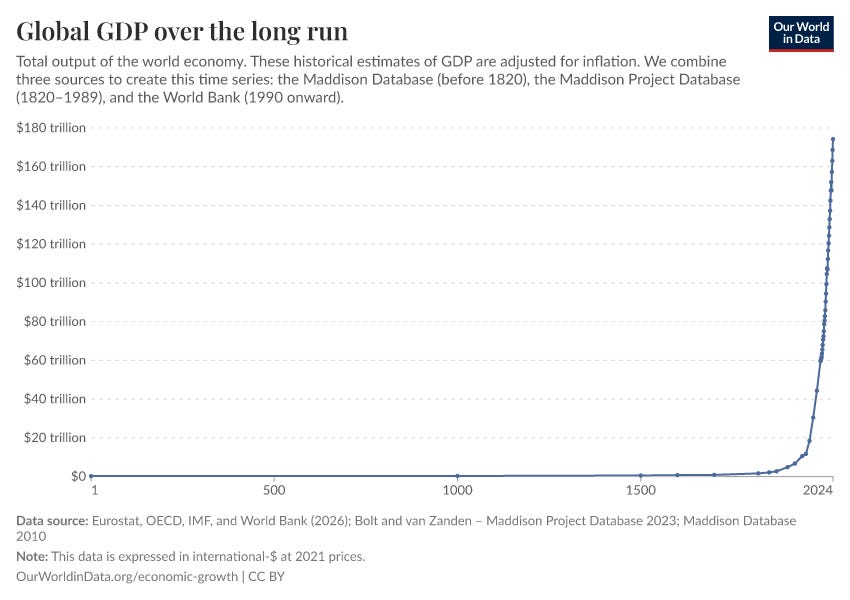
America has the most dynamic, innovative, and resilient economy in human history. It has outgrown all the haters. It keeps doing it. The people who have been betting against it in markets, in policy, in prestige magazine essays have been wrong consistently for 250 years. Permabears recognize no such track record. They just invent new words for the same bet.
As always: stay curious, ignore the doom merchants who profit from your misery, and remember that things can be imperfect and still be extraordinary.
You seem to have missed the entire point of the Atlantic piece. It agrees with your assessment that the low levels of consumer confidence are irrational and not tied to reality. The fact that you think this is a "left" issue is, frankly, pulled out of thin air.
In fact, your biggest criticism seems to be of consumer confidence surveys in general which have been a leading indicator of consumer spending for many decades.
I realize you have a pet theory here, but reading an article like this through the lens of your pre-existing argument isn't helpful.
"Annie Lowrey at The Atlantic has combined both pathologies into a single 3,000-word essay titled in a way that infers all is doomed, forever."
Except that's not at all what she's doing. She's describing the current state of the American psyche vis-a-vis the economy. That she's articulating what people are feeling is not an endorsement of what they're feeling — it's just reporting.
I get that you're trying to dress her up as some sort of villain, but the actual villain isn't Annie: it's the people.
"You cannot simultaneously argue sentiment surveys are capturing some profound economic truth AND that social media is poisoning people's perception of economic reality."
Why not?