


There’s a lot of talk about socialism these days, despite it’s inherently flawed premise and repeated failures, resulting in millions dying, mass starvation, widespread human suffering, readers here already know the history. Unfortunately, it’s rising again due to new promotion from people who hate America, combined to create the perfect storm since we also recently stopped promoting the story of prosperity and our information ecosystems are deeply propagandized. Also, our biased education system simply ignores past examples that might challenge some of the ideals they’re so keen to promote, which I find both annoying and civilizationally suicidal. Perhaps this is cyclical, and every civilization has to re-learn forgotten mistakes (even though we have parables that try to help, but ofc they’re unhelpful if no one reads them). So all we can do is share stories which are more instructive than dry statistics.
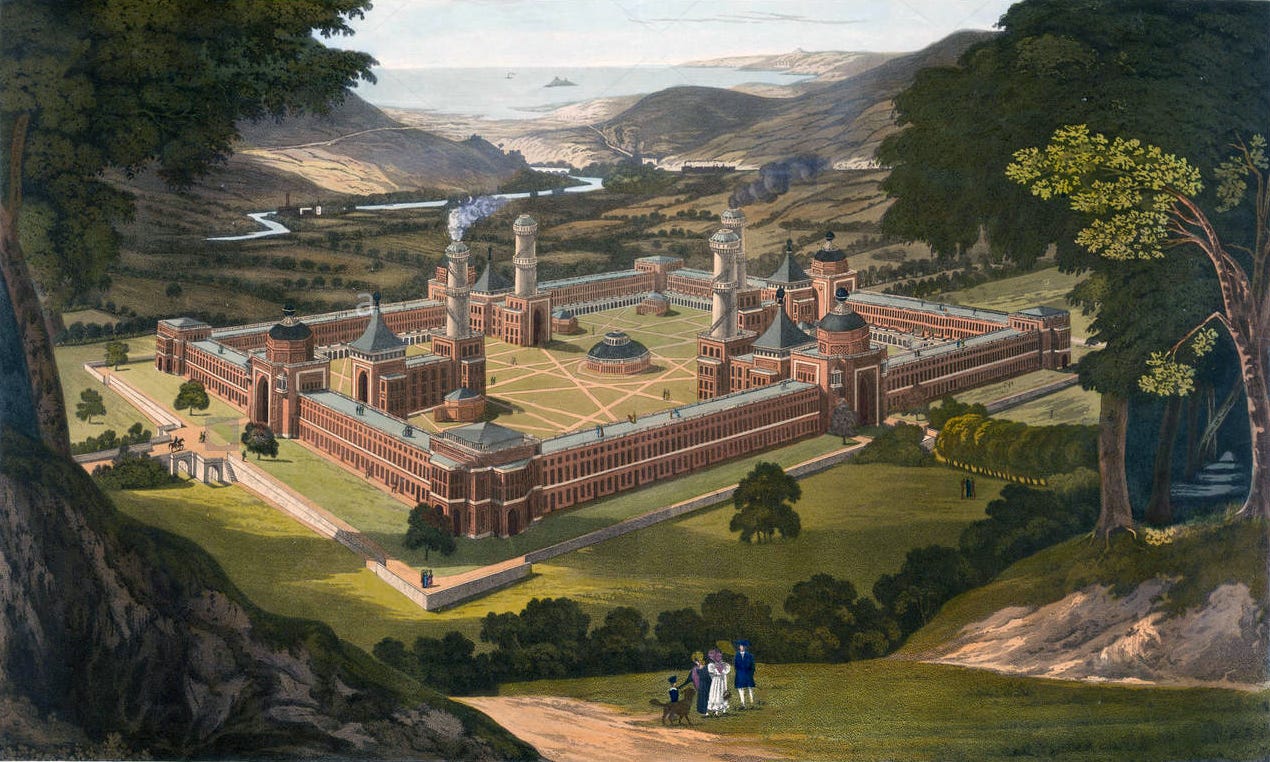
Today we have a fun one which takes us back to the year 1825. Here, a wealthy Welsh industrialist named Robert Owen acquired a complete American town, a plot with 20,000 acres, 160-plus buildings, working mills, workshops, barns, farmland already producing food. He renamed it New Harmony, and 1,000 people showed up in year 1, most convinced they were present at the birth of a new way of running civilization. It’s also notable that Owen wasn’t some kind of crank, before ever setting foot in Indiana he’d already made his name running textile mills in New Lanark, Scotland with shorter hours, real schools, better housing, and the mills still turned a profit. For the early 1800s that’s really impressive and illustrative of his operator skills.
Although, his prior success is exactly what made him dangerous. Owen had convinced himself that people are basically a product of their environment, where you could rearrange the environment and you rearrange the person. Kill private property, kill competition, split the rewards evenly, and cooperation just... happens, naturally, without anyone having to be talked into it, which is of course idealist and ignorant of human nature. As is always the case, a very intelligent person is unable to model the behavior of others, many of whom simply operate differently.
The experiment pulled in serious people. Real optimism, real brainpower, real $ behind it. In January 1826 William Maclure floated an entire boat of scientists and educators down the Ohio River, historians still call it the “Boatload of Knowledge.” Thomas Say, the father of American entomology, was on it, so was naturalist Charles-Alexandre Lesueur along with Geologists, artists, educators, people like this. So this wasn’t some kind of backwoods commune of true believers with no credentials interested in getting high. It was, arguably, one of the highest concentrations of talent in America at that moment. If intelligence and good intentions were sufficient conditions for a new economic system to work, New Harmony had every box checked.
Unfortunately, it fell apart almost immediately. The hardest workers began to realize they were feeding, housing, and clothing neighbors who contributed much less while receiving the same rewards. Over time, those workers had less reason to continue putting in extra effort. The incentives that existed in a normal market system had been removed, and the results were predictable, and disastrous. Production declined, food became scarce, disagreements grew, and the community became increasingly divided over who was contributing what.
By 1827, residents were leaving in droves, with roughly 80 people departing in a single day at one point. Owen eventually found himself arrested in a financial dispute with his own partner, then spent another $200,000 of his own money paying off the community’s debts before finally abandoning the experiment.
Josiah Warren, one of America’s earliest libertarian thinkers, watched the whole thing from inside and later wrote that “the difference of opinion, tastes and purposes increased just in proportion to the demand for conformity.” He identified the incentive problem decades before Mises and Hayek would make it central to economic theory: when people are separated from the rewards of their own effort, incentives change. If additional work produces no additional benefit, fewer people will choose to do additional work. Human nature is undefeated, and most modern economists and behavioral scientists would have spotted the problem before the project began (that is, if they hadn’t been brainwashed by Marxist hogwash).
Owen’s own farewell address really shows a refusal to learn from failure, and I find it hubristic. Rather than conclude that the system itself had flaws, he blamed the settlers, describing them as “unprepared to be members of the community of common property and equality.” The implication was clear: the system would have worked if only the people participating in it had been better suited for it. Oh, how naïve. As has been said before:
If your solution to some problem relies on “If everyone would just…” then you do not have a solution. Everyone is not going to just. At no time in the history of the universe has everyone just, and they’re not going to start now.
This has been the recurring defense of socialist experiments throughout history. The theory remains sound: the problem was always the circumstances, the leadership, the timing, or the people involved. It’s basically the Tobias theory of life (from the show Arrested Development).
The irony is that Owen had already discovered what actually worked and I guess simply didn’t like the implications. New Lanark, his profitable mill town, proved decent wages, humane conditions, education, and improved quality of life could exist within a market system and everything worked well. Workers could be treated better while businesses remained profitable, he had built a model that successfully improved people’s lives, but he couldn’t accept his existing answer was the best one.
New Harmony had elite talent, abundant capital, a functioning town, and genuine goodwill, it wasn’t lacking intelligence or idealism. It was one of the most carefully constructed attempts to build a cooperative society in American history and it still failed within 2 years.
Every generation since has found a reason to believe the incentives can be solved this time, but the experiment itself has remained remarkably consistent: good intentions are valuable, but they are not a substitute for understanding how human incentives actually work and how humans behave in real world conditions. As we continually see, what works in the minds of academics and really smart people doesn’t work out so well in reality.
Socialism is evil and civilizationally suicidal, and we should stop pretending the same failed experiment will magically work this time.
When I was a child, I visited a commune in Marin County where my father was living. The few children were left unsupervised, unfed, ignored by adults busy getting high. Two children drowned in a fetid swimming pool while the adults slept off their partying. The hippies complained when the health department came and fenced in the unmaintained pool.
Of course there are people trying to glorify the disaster by making a documentary about the wonderful commune. It’s amazing how people refuse to see what is in front of them.
Fascinating story. First time hearing it. Thank you for sharing.
One of the interesting 2nd order effects of the Biden open border policy is a lot of these asylum seekers were running from communism.
I wonder how successful this message will grow once it spreads beyond the “Marxist Masters Degree” archetype.